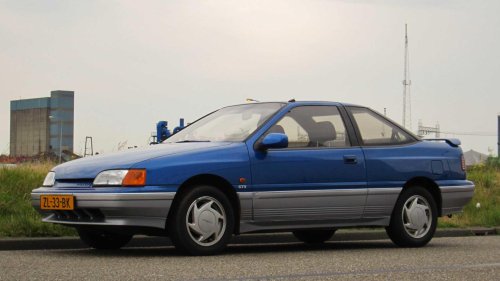
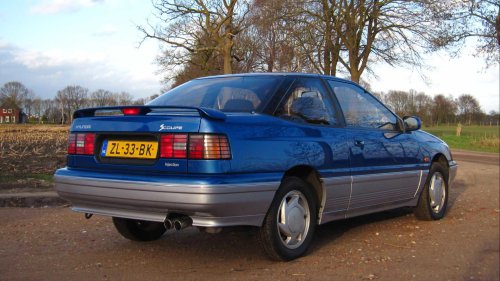
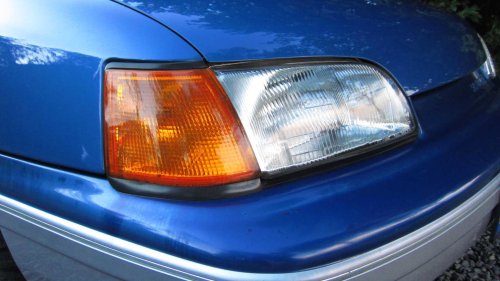
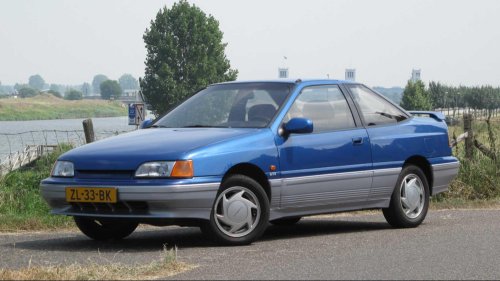
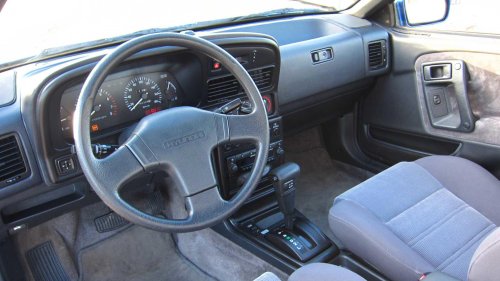
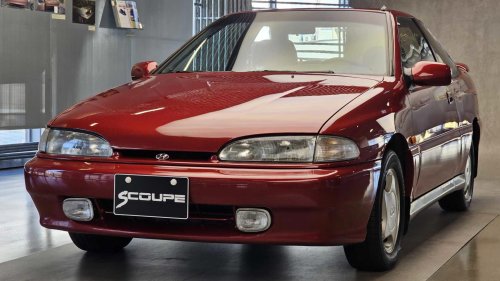
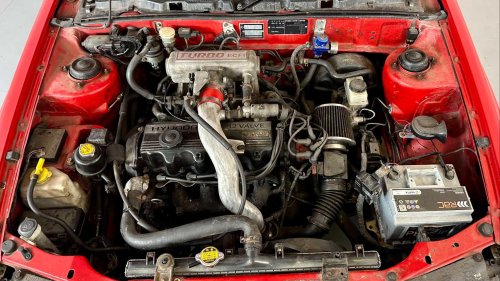
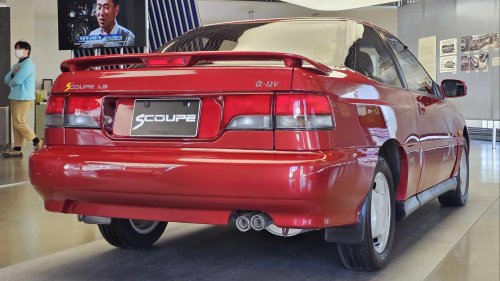
In the early 1990s, the sports coupe craze was heating up fast. It can be argued that Japanese brands rejuvenated the segmentwith models such as the Toyota Supra, Nissan Z, andHonda Prelude. To keep up, American marques began producing models in response to the Japanese competitors, such as the Ford Probe and the Dodge Daytona. Even Hyundai entered the fray.At the time, Hyundai was one of the freshest additions to the American market. The marque had only entered the market a few years prior in 1986, and the company was looking for a way to make enough waves for folks to notice. Its first model, the Excel, was a small, cheap subcompact without a single sporty bone in its body. However, Hyundai's breakthrough sports coupe, called the Scoupe, was supposed to help the Korean automaker make a name for itself in the United States. A Bigger Picture Wikimedia Commons: Rutger van der Maar Quick Facts About The Hyundai Scoupe Introduced to the US market in 1991 Pronounced "S-Coupe" Used a Mitsubishi engine Based on the Hyundai Excel Axed following the 1995 model year The Scoupe arrived in the US in 1991, but the model's development began in 1985. Back then, Hyundai was struggling with image issues. The Korean automaker had, so far, produced a handful of models such as the Stellar and Excel. While the Stellar never made it to US shores, the Excel did better in the country, mainly thanks to its incredibly cheap base price.Hyundai was keen to fix its perception issues. In the US, people saw the company as a budget automaker. The brand was like the generic cereal brand in a bag on the bottom shelf at the grocery store. Other, more established marques like Ford and Toyota could be compared to the name brands, like Cap'n Crunch and Cheerios. Hyundai didn't want to be known as the budget, generic carmaker. It figured producing a sporty model would be a good way to help break the mold.Wikimedia Commons: Rutger van der Maar Once work on the as-yet-unnamed Scoupe began, a problem quickly arose. Hyundai didn't want to invest in building a new sports coupe from the ground up. Instead, the company decided to adapt the Excel's underpinnings for the model. However, the product still needed an engine because Hyundai wanted something more potent than the mill in the Excel. The business turned to Mitsubishi for assistance because the two automakers had worked together on a few projects since the early 1970s.Wikimedia Commons: Rutger Van Der Maar They reached a deal, and the incoming Scoupe was able to use the Mitsubishi 4G15 inline-four engine, which Hyundai referred to as the Sirius powerplant. With propulsion sourced and its Excel-based underpinnings sorted, all that was left was to style the car. The job fell to Park Jong-seo, head of Hyundai design at the time. His small team penned the Scoupe's decidedly early-1990s boxy look. The model's public unveiling was at the 1989 Tokyo Motor Show. A year later, the Scoupe entered mass production. A Hopeful American Excursion Wikimedia Commons: Rutger van der MaarIn the showroom, the Scoupe sported a base price of about $8,495, or roughly $20,216 in today's money. This low price put it well below most competitors, such as the Honda Prelude, which started at $15,025 in 1991, nearly double the amount for a Scoupe. Three grades were available, including the base model, the mid-range SE, and the range-topping LS, or "Luxury Sport."Sales started strong, with Hyundai shifting roughly 26,421 units in the first full model year. However, the volume steadily declined over the model's short life. According to anecdotal evidence, the Scoupe was both liked and disliked, often at the same time. Some folks loved the model for its extremely low price, making it a great option for those who wanted a sports coupe but didn't want to spend as much as models like the Honda Prelude. The car also offered tremendous fuel economy, courtesy of the Mitsubishi-derived engine.Wikimedia Commons: Rutger van der Maar However, there were also a few glaring downsides to the Scoupe. For starters, there were numerous complaints about the build quality, which was, reportedly, shoddy at best. The fit and finish were disappointing, and several interior panels rattled under normal driving conditions. The Scoupe also didn't handle well, and its Sirius powerplant was woefully underpowered, producing just 81 horsepower. For comparison, the Toyota Celica's base engine for the 1991 model year, a 2.0-liter four-cylinder, produced 135 hp. The Scoupe Gets A Facelift Wikimedia Commons: Damian B OhIn 1993, Hyundai launched a radically facelifted version of the Scoupe. Gone was the 1980s-esque styling, replaced by a much rounder look that fit the times better than the previous appearance. While the styling changed, virtually all the negative aspects mentioned previously remained.The interior was slightly updated and made slightly more luxurious, but the cabin was still bare-bones at best. The Scoupe's fit-and-finish was reportedly just as poor as the pre-facelift iteration. To make matters worse, the vehicle was still significantly underpowered, a major blow to the offering's sporting prowess. Under The Hood Wikimedia Commons: Damian B OhWhile the Scoupe's base engine was underpowered for a sports coupe, Hyundai also offered a slightly more potent version. Its 1.5-liter four-cylinder pumped out 96 hp and replaced the wheezy Sirius powerplant. It was called the Alpha engine and belonged to the engine family bearing the same name.While the power output increased slightly, it was still nowhere near what most of its competitors were churning out. In 1993, a turbocharged version of the Alpha engine producing 116 hp was added to the Scoupe's lineup.Wikimedia Commons: Damian B Oh Buyers had a choice between two transmissions throughout the Scoupe's lifespan. At the base level, there was a five-speed manual, with a four-speed automatic as an optional upgrade. Front-wheel drive was the sole drivetrain.As for suspension, it was a simple setup with MacPherson struts up front and a torsion-beam live axleat the rear. While this was a simple, easy-to-maintain suspension system, it did not lend itself to sharp handling, which was a major downside for a self-proclaimed "sporty" model. Stopping was taken care of by a pair of disc brakes up front and a pair of drums around the back. The End Of Hyundai's First Sporty Model Wikimedia Commons: Damian B OhDespite a strong start, the Hyundai Scoupe never recaptured its first-year popularity. Sales fell to just about 15,126 in 1994, and by 1995, that number had shrunk to just 4,780 units. Following this news, Hyundai decided to discontinue the model entirely and developed an all-new sports model. This fresh offering was called the Tiburon and debuted in 1997. Learning from the Scoupe's mistakes, the Tiburon fared a bit better in the market and even managed to stick around until 2008.However, had it not been for the Scoupe, Hyundai may never have produced the Tiburon and, in turn, never broken free from its "budget car" reputation.






















![Hyundai is testing a smaller EV — could it be the IONIQ 4? [Video]](https://cdn.topcarnews.net/thumb/id/aHR0cHM6Ly9pMC53cC5jb20vZWxlY3Ry-ZWsuY28vd3AtY29udGVudC91cGxvYWRz-L3NpdGVzLzMvMjAyNi8wMi9IeXVuZGFp-LUlPTklRLTEtRVYtZnJvbnQuanBlZz93-PTE1MDAmYW1wO3F1YWxpdHk9ODImYW1w-O3N0cmlwPWFsbCZhbXA7c3NsPTE/62d7459438201b3f1399106554e467d7.jpeg?t=20261006&post_id=68203)