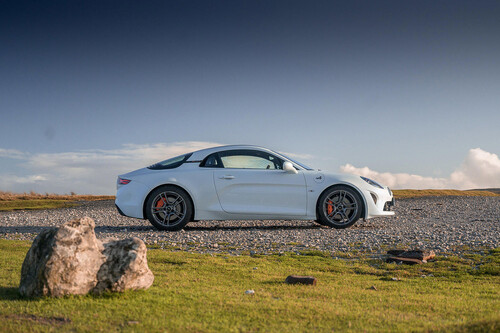
A 3.0-liter twin-turbo V6. Racing heritage. A sub-five-second 0–62 mph. Devastatingly good looks. This sounds like the recipe for a supercar that should be on posters on bedroom walls the world round, especially in the mid-1990s. But while this car had all of them, it never made it as far as it should have. And it’s far from the only one. A Rich History Of Almost Supercars via Bring A Trailer It’s a harsh reality that not everything can be a success. Not every car can be a winner and, in the incredibly expensive world of supercars, not all of them are commercial successes that put their manufacturers on the map. Sometimes it’s because the manufacturers themselves don’t have the cachet needed for people to justify supercar money. One car that comes to mind is the Vector W8 — an American supercar made between 1989 and 1993. It had a 6.0-liter twin-turbocharged V8 capable of 218 mph, a carbon fiber and Kevlar body, an aerodynamic wedge design, and a $450,000 price tag. That made it more expensive than a Ferrari F40. It didn’t stand a chance, and only 22 were made. Money is a consistent sticking point, and the Jaguar XJ220 is another such victim. A supercar capable of over 217 mph, the car was seen as somewhat of a failure on launch due to some promises that weren’t kept, as a planned V12 was reduced to a twin-turbo V6.Other times it can be a technical limitation. The Lotus Esprit V8 had the makings of a supercar with its mid-engine layout, approximately 4.3-second 0-62 mph time, and 175 mph top speed, but reliability issues, a weak gearbox, and an aging platform held it back from its true potential. Truth is, there are any number of cars and countries you can pick from, and you’d be forgiven for thinking that France in particular has one automaker worth talking about. You’d also be wrong. French Supercars Don’t Start And End With Bugatti Via: Motor1When you think of French supercars, you immediately think of Bugatti. It’s hard not to, as the brand is synonymous with style, luxury, and sports cars. They’re also probably the only sporty French car brand you can think of, as the country doesn’t exactly have a reputation for speed. Citroën, Peugeot, Renault. Not who you go to when you want a supercar. That said, the land of baguettes and wine has tried its hand at sports cars that don’t have a Bugatti badge.The Renault R.S. 01, for example, was a track machine with 500 hp in GT3 spec. Released in 2015, it received rave reviews and attempted a single-make series, but unfortunately costs prevented it from going much further. There’s also Alpine, who brought back their A110 to great applause in 2017. The car won the inaugural World Rally Championship in 1973 and was revived for the modern market after 40 years.Even Peugeot, known to some as a durable rally car producer and to others as the car that sits in the outside lane doing 10 miles an hour under the limit, had a go. Its Oxia car had 670 bhp and a top speed of 217 mph, or it would have done if it was ever produced, being that it was unfortunately a concept that never made it to production. France’s sports cars fall into the more avant-garde category. Things which, like their normal road cars, go their own way and eschew tradition in favor of innovation. And there’s one supercar that, while forgotten today, deserves to be known. The Venturi 400 GT Is A Baby F40 Bring a TrailerWhat you see isn’t a Ferrari F40, nor is it one of those amazing replicas you see on Facebook Reels at 2am. It's a Venturi 400 GT — a French sports car with aristocratic ties, a twin-turbocharged V6, and its own racing series.It was created by Venturi, a Monaco-based French automotive manufacturer that was founded in 1984. The idea behind the company was essentially to create a French Grand Tourer capable of competing with marques like Aston Martin, Porsche, and Ferrari. After making an initial flurry of coupes, they released the 400 GT in 1994.The car was derived from the 400 Trophy that the company had created two years earlier — the Trophy being made for a single-make series called the Gentlemen Drivers Trophy which ran for four seasons. The GT, staying true to the company's desire to create French Grand Tourers, was a homologation special for the Trophy to allow it to compete in the 24 Hours of Le Mans. It competed in 1994 and was seventh in class.Supercars.netThe 400 Trophy had received backing from the Italian aristocrat and heir to the Agusta and MV Agusta firm, Ricciardo “Rocky” Agusta. It had a 3.0-liter PRV V6 engine making 408 hp and 383 lb-ft, a mid-engine, rear-wheel-drive layout, a five-speed manual, a race-developed chassis, carbon-ceramic brakes, and that very familiar design. The GT had all of this too, as it kept the same engine, same backbone, same aesthetic, but was adjusted to be road legal.The adjustments weren’t many; mainly a catalytic converter, lighting, and a nicer interior more befitting of a car that looked as sporty as it did. It created a visceral drive, helped by the fact that it was essentially a race car with a license plate. And while a car with this DNA could have succeeded, it barely got out of the factory. The Venturi Barely Makes It To The Road Bringatrailer.comBeing that the 400 GT was a homologation special, and somewhat of an afterthought of one at that, it wasn’t made in great numbers. Fewer than 100 cars were made in total, with about 70 of those being Trophy cars for racing and 15 the GT version for the street. The car was deeply impressive but unfathomably niche, leading to Venturi ceasing its production after just three years. Trophy cars have been converted to be road-legal since, muddying the water, but it’s still an incredibly rare sight today. Venturi Has A Fetish For The Unconventional VenturiYou might have heard of Venturi before reading this article. The company has had their fingers in many pies, covering everything from electric cars to world speed records to Antarctic expeditions and both Formula 1 and Formula E. The Venturi website even has a section for its space-based exploits. And while their tenure is as wild and as varied as you’d expect from a boutique French automaker, it’s actually got some pedigree.The Venturi Fétish, released in 2004, was the first electric sportscar and predated the Tesla Roadster by four years. The 25 units they produced made 241 hp and could hit 62 mph in four seconds. The company’s Formula E team had eight race wins across their eight seasons, finishing second overall in the 2021-22 season. They hold multiple world speed records, setting 21 world speed records in six days in 2021. The 400 GT is far from their only claim to fame.It’s a shame, then, that the legacy of the 400 GT is that it looks like a French F40. While that is absolutely true, it’s not entirely fair. One of the very few road-legal cars sold for $150,000 in 2019, which can’t be said of those Facebook models. The car could have been the French supercar, but for its owners’ financial limitations and lack of brand recognition. And while Venturi has seemingly found its niche now, the 400 GT will forever be one of history’s greatest what ifs. C’est la vie.