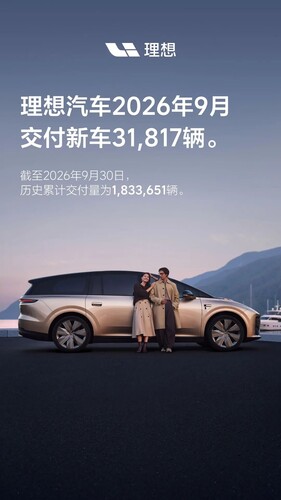
Chloé Morgan · 6 months ago@chloemorgan234Li Auto Joins China Chamber of Commerce to EU Ahead of Market Expansion to Europe Liked by+18 othersPost commentRelated PostsHas NIO Really Found Its Footing? 12 · Olivia Lee · 22 days agoLi Auto i9 Home orders to open immediately after launch tomorrow night, self-developed battery version deliveries to start in late October 92 · Jenna Pelletier · 23 days agoLi Auto launches i9 EV in China: world’s most aerodynamic mass-production SUV at 0.215 Cd 89 · Madeleine Green · 24 days agoTaiyi Shanglian Plans to Take Control of Neta Auto; MIIT to Tackle Online Misconduc 66 · Claire Fortin · 24 days agoSeeds | Former Li Auto AI Executive Launches Embodied AI Startup, Raises RMB Hundreds of Millions 83 · Liam Girard · 25 days agoNEV sales share reached 60.6% in August; Nvidia reportedly under investigation by US Department of Justice 29 · Amelia Martin · 26 days agoThis Chinese Luxury Brand Wants To Take Europe By The End Of The Year 66 · Camille King · 28 days agoLi Auto i9 large electric SUV breaks Huawei's drag coefficient record ahead of debut 20 · Morgan Moreau · 29 days agoXiaomi tops 800,000 deliveries as SkyNomad N70, N90 EREV SUVs launch 49 · Morgan Labelle · 29 days agoLi Auto i9 breaks Luxeed R7's drag coefficient record ahead of debut 83 · Zoë Girard · 29 days agoLi Auto's refreshed i6 filing confirms in-house battery and Mach chip 38 · Oliver Mitchell · 29 days agoLi Xiang: Li Auto i9 Marks Breakthrough Across Three Key Challenges 36 · Mason Wilson · 29 days agoAnother major Chinese automaker heads to Europe: debut in October, sales later this year 41 · Owen Hall · 1 months agoMIIT’s 411th New Vehicle Filing: Key Models at a Glance 42 · Camille Brown · 1 months agoLi Xinyang Post: i6 Equipped with Self-Developed 5C Battery and Mach Chip 79 · Ryan Anderson · 1 months agoSupreme People's Court releases first rules for AI dispute adjudication; JLR China responds to global layoff rumors 10 · Lauren Rogers · 1 months agoLi Auto Responds to Questions Regarding Self-Developed Batteries 17 · Olivia Leblanc · 1 months agoTop 10 best-selling cars in China in August: BEV takes nine and half spots, gas cars disappear 67 · Annabelle Scott · 1 months agoWM Motor Inventory Cars Auctioned, Average Unit Price Only 25,000 Yuan 50 · Charlotte White · 1 months agoE Weekly Highlights | Li Auto Plans to Invest in SEVB; Xiaomi Auto to Enter Europe in 2027 60 · Emily Brown · 1 months ago




 +18 others