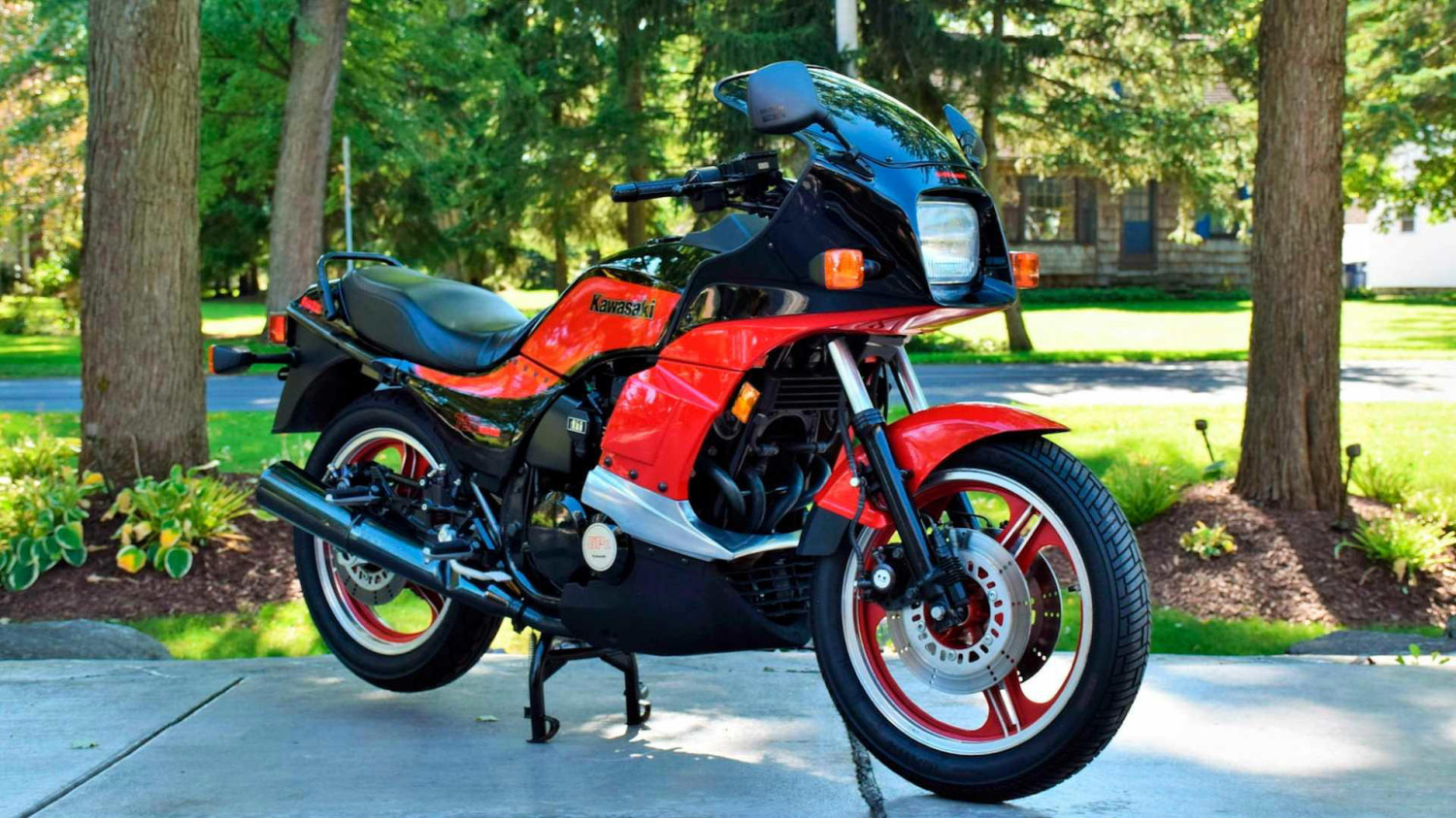
Forced induction is fairly commonplace in the automotive industry, but it has yet to see widespread application among motorcycles — at least from the factory. After all, given that there are a number of bikes that can easily produce 200 ponies or more — while adhering to emissions regulations — adding a turbocharger or a supercharger only serves to complicate the package and incur extra weight. For all but the most power-hungry of riders, forced induction isn't really worth the compromises, so there have only been a few motorcycles to have offered the feature from the factory.Of course, over the years, several manufacturers have tried their hand at turbocharging bikes, and some have even incorporated superchargers in their quest to find more power. However, there's one brand in particular that has proven itself to be a pioneer of two-wheeled forced induction: Kawasaki. From initial attempts at turbo bikes in the 1970s to the release of the first-ever factory supercharged production motorcycle, Team Green isn't afraid to push the limits of performance. The following bikes are just some of Kawasaki's many groundbreaking releases, and they all have one thing in common: forced induction. The Z1R-TC Offered Early Turbo Power 1978 Kawasaki Z1R-TC - 4The two-wheeled world got its first taste of factory turbocharging in 1978 when Kawasaki USA dreamed up the Z1R-TC. As the bike was a dealer special (meaning that kits weren't installed at Kawasaki HQ), it's technically only semi-production in nature. However, it arrived years before the likes of Honda and Yamaha dipped their toes into turbocharging motorcycles, so it serves as a fitting starting point. California's emission regulations killed the Z1R-TC after just two years, but it burned bright for its brief lifespan. Slapping A Snail On Kawasaki's Z1R Liter Bike A former Kawasaki USA exec named Alan Masek approached the brand with a plan to drum up sales for its faltering Z1R flagship. At the time, the 1970s competition from Honda and Suzuki was proving to be superior on the street and the strip, and Team Green needed something that would get riders excited.As the founder of the Turbo Cycle Corporation and a purveyor of American Turbo-Pak kits for bikes like the Honda CB and Kawasaki Z1, Masek had an eye for what riders wanted — power. He struck a deal with Kawasaki to take stock Z1Rs, install turbocharger kits at his shop, and subsequently sell the converted bikes — dubbed the Z1R-TC — through official dealers. But here's the thing: though the model could be found in Kawasaki showrooms, it was offered without a warranty. Being a TCC-modified creation, the Z1R-TC was an aftermarket special, and buyers were offered no recourse should they crank up the boost and blow their engine. 10 Pounds Of Boost For Unhinged Performance When a Z1R arrived at Turbo Cycle Corporation, the bike received a Rajay turbocharger, an adjustable wastegate, as well as a high-flow fuel pump, and a boost gauge. A 38m Bendix carburetor handled fueling instead of the factory Kawasaki four-carb setup, while a cylindrical header exhaust replaced the stock pipe. Otherwise, the chassis and engine were left alone, still running an 8:1 compression ratio, a flex-prone steel frame, and some inadequate Kayaba suspension. Nevertheless, it made for a spendy purchase — MSRP came to about $5,000 when a standard Z1-R would set you back $3,695.The setup proved to be extremely effective from a performance standpoint, even if it was plagued by turbo lag and unpredictable acceleration. When running 10 lbs of boost, the Z1R-TC was rated for as much as 130 horsepower — a nearly 40-pony increase over a run-of-the-mill Z1-R. On the road, this was enough for drag racer Jay Gleason to run a 10.05-second quarter-mile. Remember, with the onset of the malaise era, muscle car output decreased dramatically, and some trims of the Ford Mustang and Chevrolet Camaro were making around 150 horses — or fewer. Kawaski’s GPz750 Turbo Was An Encore Mecum Auctions Honda, Yamaha, and Suzuki marched lockstep into the 1980s with their turbocharged bikes, introducing the CX500 Turbo in 1981 (and the later CX650 Turbo), the XJ650 Turbo in 1982, and the XN85 Turbo in 1983, respectively. Though Kawasaki's GPz750 Turbo arrived later in 1984, the wait was well worth it. By all accounts, Team Green's turbocharged two-wheeler proved superior to the lot, producing 112 horsepower and 73 lb-ft of torque such that it could lay down 10.7-second quarter-miles with ease. 1980s Turbocharged Motorcycle Specs Comparison Honda, Yamaha, Suzuki, KawasakiThe modifications required to turn a standard 750 into a GPz Turbo were sparing but effective. Kawaski incorporated the KZ650's milder cylinder head along with flat pistons, thinner-walled frame tubing, revised ignition timing, a beefier primary chain, and a thicker swingarm. Moreover, the Turbo featured fuel injection rather than carburetors, reyling on a Digital Fuel Injection microprocessor to monitor throttle position and altitude. All-in, the changes accounted for a 30-lb weight difference and an additional 35 horsepower. The GPz750 Turbo was one of the fastest bikes on the road at the time, and Kawasaki itself eventually one-upped the model with its GPz900R made famous by Top Gun. The Ninja H2R Introduced Factory Supercharging The H2 nameplate originally appeared on Kawasaki's 750cc two-stroke triple back in the 1970s. Though the bike's specs were relatively modest by today's standards, the short wheelbase, flexible frame, and sudden power delivery earned it the infamous moniker of "The Widowmaker." It was a truly iconic motorcycle, and Kawasaki fittingly revived the badge for the release of the industry's first-ever supercharged production bikes: the Ninja H2R and Ninja H2. 2025 Kawasaki H2 Specs Comparison KawasakiBeing a track-only bike, the Ninja H2R was intended to push the limits of motorcycle performance, while the subsequent Ninja H2 translated those capabilities to the street. At the time of its debut in 2015, reviewers found that even the road-going Ninja H2 was capable of mid-9-second quarter-mile performances, with 0-60 mph coming in just 2.6 seconds. Both bikes were monumental efforts — in their development, Kawasaki's motorcycle division tapped several outfits from the Kawasaki Heavy Industries umbrella.The centrifugal supercharger unit was engineered completely in-house with assistance from the Gas Turbine & Machinery Company as well as the Corporate Technology Division, while the angular bodywork was sculpted under the expertise of the Aerospace Company. Truly collective efforts, the Ninja H2R and Ninja H2 were each bestowed with Kawasaki's River Mark emblem. The stylized kanji design dates back to the 1870s, and the KHI reserves the insignia for innovations of significant historical importance. Kawasaki Expands The H2 Range Kawasaki's SX line sees the Ninja H2 as a supercharged sports tourer With the SX SE, Kawasaki added radar to the Ninja H2 The Kawasaki Z H2 brings the supercharged inline-four to a naked configuration Since the debut of the original H2R and H2 in 2014, Kawasaki has expanded on the line through a number of off-shoots. The Ninja H2 SX first appeared in 2018, bringing with it a slightly milder engine tune, a more relaxed riding position, a set of side bags, a longer wheelbase, some heated grips, and cruise control. The SX SE model doubled down on the initiative, equipping the model with radar-enabled advanced motorcycle tech like adaptive cruise control, forward collision warning, and blindspot detection.In 2020, Kawasaki added a naked version to its supercharged H2 lineup in the form of the Z H2. Apart from the obvious differences in handlebars, riding posture, and lack of fairing, the bike featured an engine re-tuned for more mid-range torque, and a double-sided swingarm. Though the base bike hit the market with lower-spec Brembo brakes and hand-adjustable suspension, its SE replacement has since added Electronic Control Suspension (KECS) with Showa's Skyhook EERA technology, which can adjust dampening on a per-millisecond basis. Kawasaki's H2 Featured Self-Healing Paint Kawasaki USAIn 2019, Kawasaki started giving the Ninja H2 its "Highly Durable Paint," a special type of top coat in which light scratches can repair themselves. Per the Kawasaki website, "the soft and hard segments in the coat work together like a chemical spring, creating a trampoline effect that absorbs impacts."It's worth mentioning, of course, that Kawaski is careful to note that paint recovery is "not immediate" and that the paint will not recover from scratches "caused by a coin, key, or zip-fastener." Still, the brand was one of the first to do it in the motorcycle space, and it's since expanded the treatment to other bikes like the Ninja 1000 SX and Versys 1000. Of course, the technology itself is far from novel, as several luxury Japanese cars have incorporated self-healing paint from the factory — the fourth-generation Lexus LS offered the feature as early as 2007, and Infiniti had followed suit by 2009.