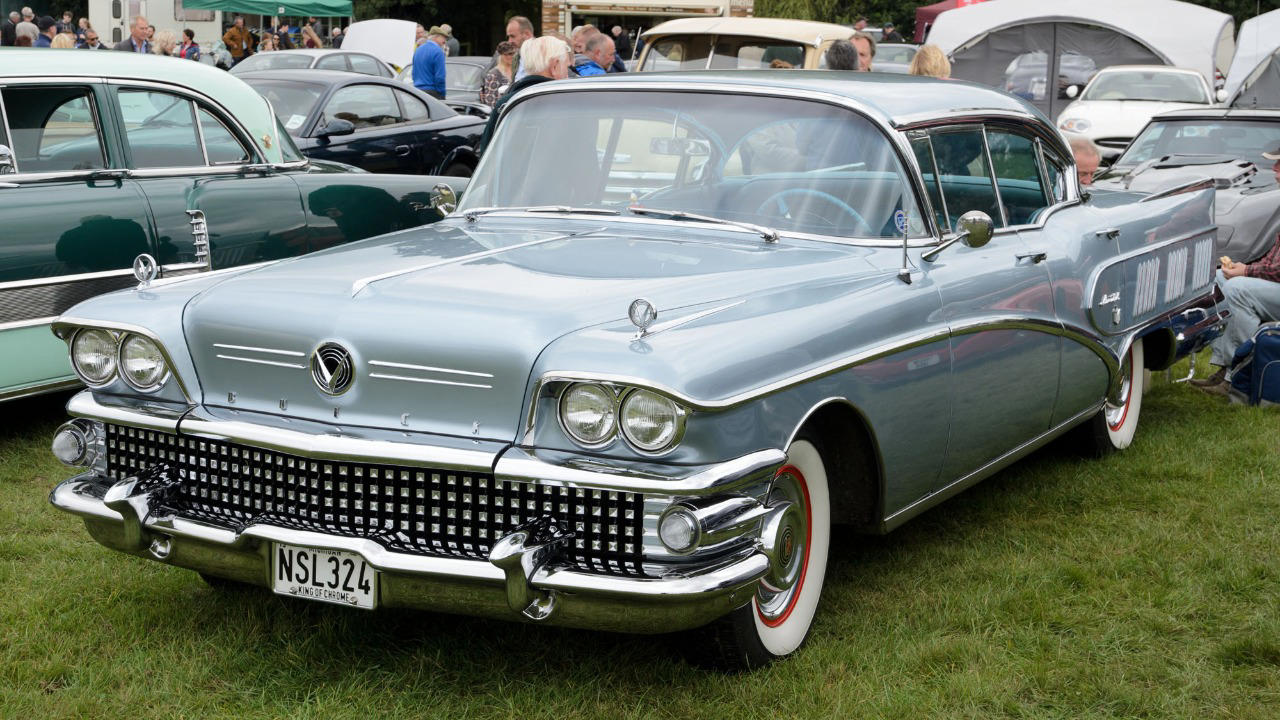
Why the 1958 Buick Limited embraced bigger-is-better thinkingThe 1958 Buick Limited was no cautious product of committee thinking. It was a statement car, launched in a year when American automakers still believed that size, chrome, and spectacle could buy prestige in a softening market. That faith in excess shaped everything about the Limited, from its immense footprint to its shimmering trim, and it explains both its fascination for collectors and its commercial failure at the time. Buick’s high-stakes answer to Cadillac By the late 1950s, Buick faced a difficult competitive map. Cadillac dominated the luxury segment, while other General Motors divisions, along with rivals such as Ford and Lincoln, were crowding the upper-middle market. In response, Buick revived the Limited name as a direct challenge to that hierarchy, positioning it as a halo car meant to pull the brand closer to the top of the prestige ladder. Contemporary commentary describes how Buick’s response to these pressures was to reenter the rarefied circle of high-end American luxury with an all-out flagship. The Limited did not simply slot above the Roadmaster. It was conceived as a near-Cadillac in price, presence, and equipment, yet still carried Buick’s identity. That decision created a delicate balancing act. The car had to be more opulent than other Buicks to justify its status, but it also had to avoid treading too directly on Cadillac territory inside General Motors. Buick’s solution was to lean into visual drama and sheer scale rather than subtle refinement. Dimensions that advertised status The Limited rode on Buick’s longest wheelbase, which already signaled its ambition. Period descriptions emphasize how riding in a Buick gave the Limited an unmistakably grand stance on the road. The body stretched out in long, horizontal lines, with a low roof that accentuated the car’s width and length. It was not merely a large sedan or convertible; it was a rolling piece of theater that made ordinary traffic look undersized. That emphasis on scale reflected wider industry thinking. At the same time, Ford was trying to eclipse Cadillac with the Continental Mark III, and contemporary analysis notes that Ford was trying with size and presence, even as a recession undercut demand for such extravagance. Buick’s Limited fits that same mentality. Length, width, and wheelbase became shorthand for success. The car’s vast overhangs and expansive hood were less about packaging and more about signaling that the owner had arrived. Chrome, ornament, and the 160-bar grille If the Limited’s size suggested wealth, its ornamentation shouted it. The front fascia carried a distinctive grille composed of 160 individual squares, a detail highlighted in accounts that describe how 160 individual elements created a jeweled effect. The bumper was wrapped in heavy chrome, while additional brightwork traced the fenders and doors. Side trim formed sweeping patterns that visually lengthened the car even further. Observers today often see the Limited as the high-water mark of late-fifties ornament. Enthusiast commentary describes the 1958 Limited as long, wide, and drenched in chrome from front to rear, a characterization echoed in video features that present detailed walkarounds of surviving cars. The effect was intentionally theatrical. Where earlier Buicks had blended chrome with flowing fender lines, the Limited treated brightwork almost as jewelry, layered on top of an already imposing body. Luxury priced above many Cadillacs Buick did not intend the Limited to be a bargain alternative. Surviving sales material and collector research show that Limited convertibles were priced over $5,000, and one specialist description notes that with prices over $5,000, they were more expensive than most Cadillac models. That figure pushed the Limited into a narrow band of buyers who might previously have gone straight to Cadillac showrooms. The equipment list matched the price. Power steering, power brakes, and power windows were expected in this class, and the Limited added lavish upholstery and advanced accessories. Contemporary comparisons with the Cadillac Series 62 highlight how closely the Buick tracked Cadillac’s luxury formula, right down to power accessories and plush interiors. Buick’s strategy was clear: if buyers wanted Cadillac comfort and size, the Limited would provide it with a distinct Buick identity, at a price that signaled exclusivity rather than thrift. Sales shock: when excess met recession The market did not respond as Buick hoped. Total Buick production for 1958 reached only 240,659 units across the Special, Century, Roadmaster, and Limited lines, a figure cited in retrospective analysis that describes how Buick’s history in that year was marred by low demand. One detailed video account notes that 240,659 units represented a sharp drop from prior years and framed the Limited as part of a broader slump. Within that total, the Limited itself sold in very small numbers. A comparison with Cadillac’s volume reports that only 7,436 Limiteds were sold against 60,848 Cadillac Series 62 cars, a stark illustration of how hard it was for Buick to pull buyers away from the established luxury leader. The phrasing in that analysis, which emphasizes that only 7,436 Limiteds found buyers compared with 60,848 Cadillac Series 62 models, underlines the mismatch between Buick’s ambition and the market’s loyalties. Economic conditions compounded the problem. Collectors of other 1958 luxury cars have pointed out that the bigger-is-better balloon burst when a recession hit the United States, punishing brands that had invested heavily in large, expensive models. Buick’s Limited arrived at precisely the wrong moment for such a statement car, and its lavish chrome and bulk suddenly looked out of step with a more cautious consumer mood. Design controversy and the “mistake” label Even without the recession, the Limited’s styling might have been a hard sell. Later commentators have described the 1958 Buick line as overly busy, and one widely viewed retrospective explicitly characterizes Buick’s 1958 flagship as a Buick’s “Mistake”, arguing that an overly gaudy design led to dismal sales. That critique focuses on the heavy-handed chrome, the intricate grille, and the abundance of trim that competed for attention rather than working as a unified composition. Another analysis of the same theme, which refers to the car as Buick’s Mistake and ties the look to An Overly Gaudy and Garish Design Leads to Dismal Sales, reinforces the idea that the Limited pushed visual excess too far. The live discussion that frames this as Overly Gaudy and to Dismal Sales places the Limited within a broader critique of Buick’s 1958 range, including the Century and Roadmaster. In that view, the brand misread the public’s appetite for ornament just as tastes were beginning to shift toward cleaner, more restrained lines that would define the early 1960s. Inside the cabin: comfort as spectacle The interior of the Limited continued the exterior’s theme of abundance. Contemporary and modern descriptions emphasize a spacious, upscale cabin with power accessories and plush upholstery, similar in spirit to the features highlighted in discussions of late-fifties Buicks that mention chrome accents, wraparound windshields, and generous seating. In the Limited, that approach translated into deep cushions, broad door panels, and extensive use of bright trim and patterned fabrics. Collectors who have restored surviving cars, including the convertible examples documented by specialist dealers, describe interiors that feel more like lounges than ordinary passenger compartments. A detailed sale listing for a restored Limited convertible, for instance, highlights how the model combined its high price with a richly finished cabin, a point reinforced by the general description of the 1958 Buick Limited as a top-tier collectible. The cabin was intended to cocoon occupants in comfort while reminding them at every turn that they occupied Buick’s most exclusive space. From showroom misfit to collector favorite Although the Limited’s production run was short and its sales modest, its very excess has helped it gain stature among enthusiasts. Modern video essays often refer to the 1958 Limited as a shocking or unique machine within Buick history, and one such feature explains that in 1958 Buick unveiled a car unlike anything it had built before, long, wide, and saturated with chrome. That singularity makes the Limited a snapshot of a specific moment when American automakers believed more of everything still equaled progress. More from Fast Lane Only Unboxing the WWII Jeep in a Crate 15 rare Chevys collectors are quietly buying 10 underrated V8s still worth hunting down Police notice this before you even roll window down

















 +30 others