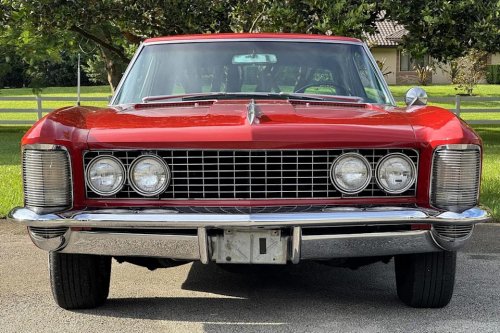
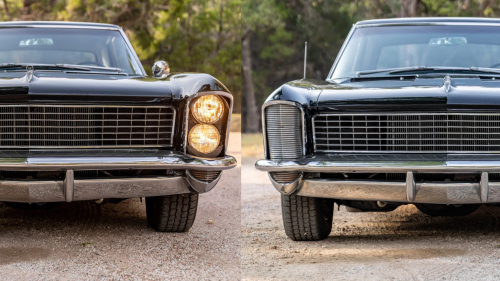
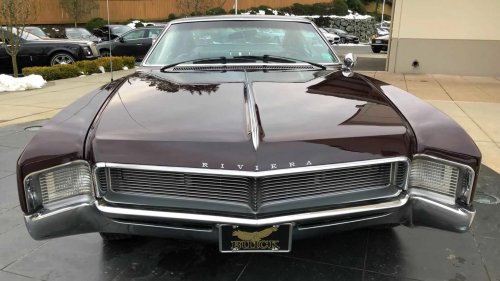
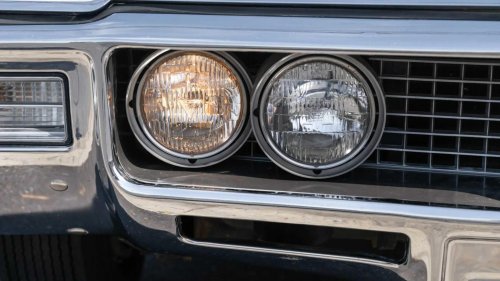
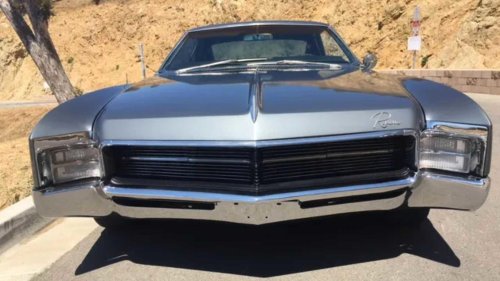
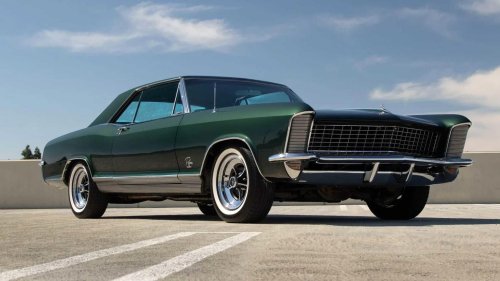
Numerous car manufacturers have tinkered with hidden headlights over the years, and from a design aesthetic, some have been more successful than others. Buick was certainly not the only American company to discover these headlights in the 1960s, but in its case, it did more than simply make the lamps disappear.Some of Buick’s efforts were quite novel and made the lights on its Riviera feel as if they were part of the car's sophisticated design logic. And although Buick's Riviera experimentation only lasted a few years – from 1965 to 1969 – it used several distinct hidden headlight arrangements in the interim.Each attempt was intriguing in its own right, and it's cool to look back at Buick's multiple efforts to perfect the art of hiding a lamp. The 1965 Clamshell System Is Where The Riviera Became Unforgettable Bring a TrailerBuick's coolest hidden headlights surely adorned the 1965 Riviera. They were hidden in the fenders beneath motor-operated clamshell covers that swiveled into place to hide or reveal a pair of vertically stacked lamps. When closed, these covers sat at the outer edges of the nose and made the front end of the car look very clean. But what made this system especially intriguing was not how it actually moved but how Buick set everything up.Many hidden headlight systems rely on placing the lamps behind a panel or grille door in an obvious way. With the Riviera, the clamshell doors were part of the leading edge of the front fender, and when they moved into their concealed location, they actually improved the proportions of the car. If you shut down the lamps, the nose looked slimmer, longer, and more refined. And this clamshell method fully contributed to the design aesthetic, rather than many hidden headlamp attempts, which can sometimes look clownish.Apart from the headlights, the 1965 Riviera was an impressive car. It had a 401 cubic-inch (6.6-liter) V8 producing 325 hp, or a Gran Sport package with a 425 cu in (7.0-liter) Super Wildcat V8 and 360 hp. The Gran Sport could go from 0 to 60 mph in 7.7 seconds and reach a top speed of 125 mph, presenting the car as a very serious American GT, with the clamshell light arrangement adding a little icing on top. Buick Turned The Idea Into A Moving Target Bring a Trailer In 1966, Buick treated its clamshell arrangement as a signature part of the Riviera's design. The headlamps hid behind the radiator grille, and when you turned them on, the lamps swung into position in front of the grille. When you turned the lights off, they folded back up under the hood, so the focus of attention was now toward the center of the car. The disappearing-lamp effect moved away from the corners of the nose to give this second generation an entirely different kind of elegance.The 1966 Riviera also looked very different from its predecessor, with a new front-end composition altogether. It was longer and built on a new frame, with a more sweeping fastback profile, and with this new vehicle, Buick had the opportunity to experiment even more with its hidden-headlamp project. The 1966 Riviera came with a 425 cu in V8 rated at 340 hp, and in the GS package you'd get a single four-barrel arrangement initially, before the dual-quad setup became available later.In 1967, Buick continued with its concealed headlamp concept. The lamps appeared and disappeared in roughly the same location, but the underlying car was different again. It now had a 430 cu in V8 pushing 360 hp, giving the car additional authority to match its refined style. By 1968 And 1969, The Mechanism Changed Again Bring a Trailer In 1968, Buick significantly revised the front of the Riviera. The car now had a large one-piece bumper with hidden headlights and square parking lamps. The lights would still flip up as they did in 1966 and 1967, but the underlying mechanism changed, as Buick used a vacuum-operated approach rather than an electric one. You'd still get that clean, concealed-lamp front-end appearance, but Buick was taking a different engineering approach to achieve its goal. Consequently, the 1968 car looked heavier and broader at the nose but, with those hidden headlights tucked away, still looked clean.Records show that the 1968 car was very popular with consumers, selling 49,284 units at a cost of around $4,600. Today you may have to pay $18,700, on average, for the 1968 Riviera in great condition. And this suggests that Buick's evolving Riviera formula worked back then and surely continues to work now.In 1969, Buick left the hidden headlamp hardware as it was. It carried over the design of the bumper’s concealed headlights and parking lights, although it did change the style of the front grille. The Riviera was still popular, with sales climbing to 52,872 units, including 5,272 Grand Sports, and today you may have to fork out more than $17,000 for one of these cars. However, this was to prove the end of the hidden headlight experiment and while each approach was successful, many think that the 1965 original was the cleanest and most singular expression of the theme. The Best Riviera Hidden Headlights Were Also The Most Complete Idea Bring a Trailer In 1970, Buick turned to exposed headlights which sat at the outer edges of the front fenders. In abandoning the hidden units, it may have been signaling that it was fed up with them and finally realized that they were more trouble than they were worth. Certainly, those hidden units were interesting design gestures, but their systems involved motors, doors, vacuum lines, and linkages, which were all vulnerable to wear and tear. And a sudden failure here could have been particularly problematic, to sideline the vehicle itself if the driver needed to go out at night.But turning away from that complexity, there's no doubt that Buick created a really satisfying design in its approach to the 1965 Riviera in particular. This hidden headlight approach wasn't just distinctive but was somehow complete. Those clamshell doors matched the stance, shape, and purpose of the car in a way that the later systems perhaps did not.And the market today tends to agree about that with prices for well-kept 1965 Rivieras the highest of all. You may have to pay around $28,600 for one of these versus less than $20k for other cars from the hidden headlight era. Some rare examples have been even more spectacular, with a first-generation 1965 Riviera Gran Sport setting a benchmark of $98,604 and a true outlier bridging $275,000.Of course, not every 1965 Riviera is an excellent buy, and some examples may be more trouble than they're worth. But the hidden headlight story may do much to reinforce the Riviera’s design appeal through the company's elegant attempts. The latest solutions were attractive and clever, with more mechanical involvement, but the 1965 clamshell system seems to be the most memorable. Hidden Headlights Were About More Than Novelty Bring a Trailer With its hidden headlamp vibe, Buick was clearly doing its best to create vehicles that were as aesthetically pleasing as possible and to care enough to keep necessary hardware from interrupting the shape of the car itself. After all, it was selling its Riviera as a personal luxury coupe with real design ambition, and it was, in many respects, cleaner, lower, and more European than many of its competitors.But still, you can't really look past Buick's 1965 attempt if you want to see one of the coolest hidden headlight designs of all time. Other cars may have made louder, wilder, or more flamboyant attempts to deal with this feature, but Buick came up with an elegant, more integrated, and more faithful idea. The company did try to refine its hidden headlamp approach across multiple generations, including electric clamshells, swing-down units, and vacuum-operated doors. But the first fully realized solution was probably the best, where a very clever idea made the rest of the vehicle's design pop.

















 +72 others