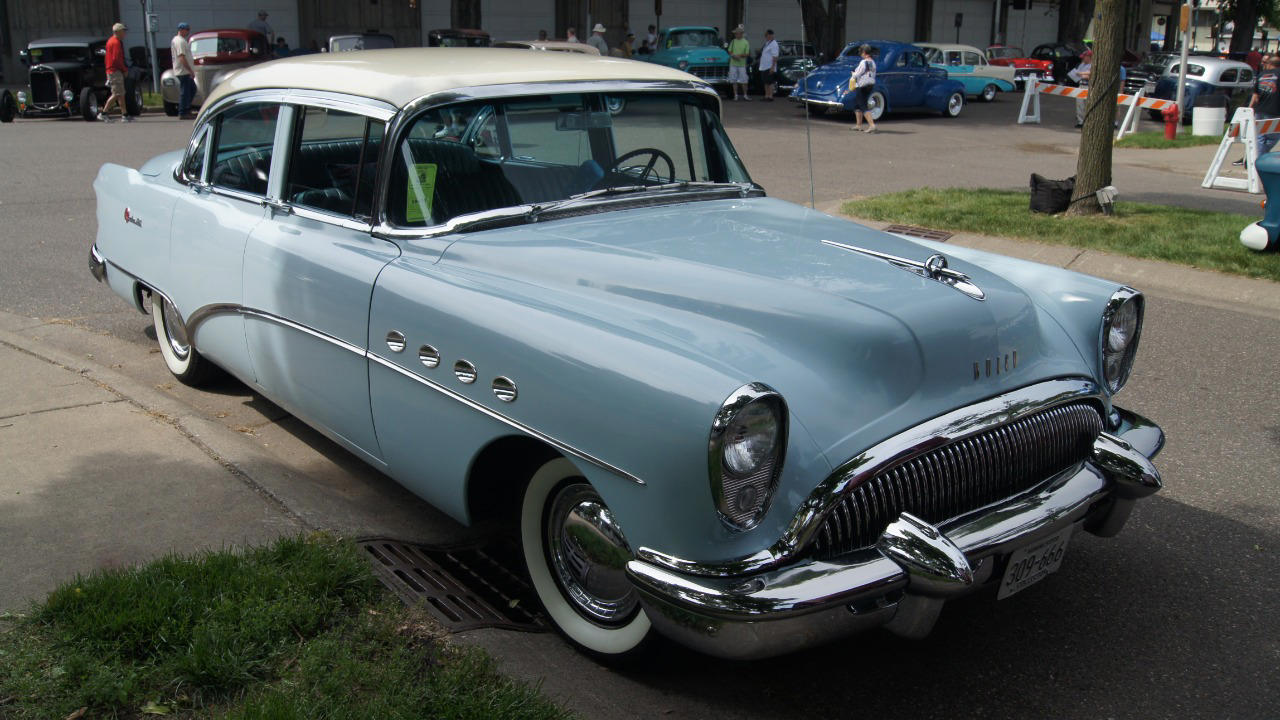
Why the 1954 Buick Roadmaster still feels commanding todayThe 1954 Buick Roadmaster arrived as a new flagship for a confident postwar America, and it still projects that confidence every time it rumbles onto a street or auction block. Its size, styling, and mechanical poise combine into a presence that modern traffic rarely matches, which is why this mid‑century giant continues to feel authoritative rather than merely nostalgic. A new platform with old‑school authority When Buick introduced the 1954 Roadmaster, it sat on an all‑new platform that lowered and widened the body while keeping the car unmistakably Buick. Contemporary observers described the styling as modern and contemporary yet still conservative in a Buick way, a balance that helped the car look serious rather than flashy. The long hood, substantial deck, and formal roofline give the Roadmaster proportions that still read as an “important car” at a glance. Underneath, the Roadmaster used the GM C‑body, a larger structure that it shared with Cadillacs, Buick Super, Roadmaster, and the Olds 98. That big‑car architecture gave it real physical presence, not just decorative bulk. The car grew in both width and overall length compared with earlier Buicks, so it occupies the road in a way that compact crossovers simply cannot duplicate. Even parked, the 1954 Roadmaster seems to command space. The combination of a low roof and broad shoulders makes it appear to crouch over the pavement, more like a luxury liner than a family sedan. That stance, rooted in the new platform, remains a key reason the car still feels imposing today. Styling that signals power, not whimsy The Roadmaster’s design was characterized by sweeping lines, bold chrome accents, and the iconic VentiPorts on the front fenders. Those elements were not subtle, yet they were arranged with enough restraint that the car avoids cartoonish excess. The long, flowing side sculpting leads the eye from the massive grille to the rear quarters, creating a sense of motion even at rest. At the front, a bold grille and heavy chrome bumper project a kind of rolling architecture. The grille’s width and the way it integrates with the hood and fenders make the car look wide and planted. Chrome spears and side trim emphasize length rather than surface clutter, so the ornamentation reinforces the impression of a serious, expensive machine. Collectors often point to the 1954 wraparound windshield, shared with Olds and Cadillac, as a stroke of design genius. It visually pushes the cabin forward and outward, extending the driver’s view and giving the car a panoramic, command‑bridge feel. That glass treatment, combined with the low beltline, makes the driver appear to sit in a place of authority, not buried behind thick pillars and high sills as in many modern vehicles. Mechanical muscle that still feels substantial Power for the 1954 Roadmaster came from Buick’s Fireball V‑8, a 322 cubic inch engine rated at 200 horsepower in period descriptions of a 322 and 200 horsepower package. For mid‑century buyers, those figures put the Roadmaster firmly in the upper tier of performance, especially when paired with Buick’s automatic transmission that aimed to deliver an effortless driving experience. Modern performance cars easily eclipse 200 horsepower, but the way the Roadmaster delivers its power remains compelling. The long‑stroke V‑8 produces abundant low‑end torque, which suits the car’s size and character. Drivers do not need to chase high revs; instead, the car moves off with a smooth, confident surge that matches its visual gravitas. The C‑body chassis, shared with Cadillac and Oldsmobile, contributes to that feeling. The long wheelbase and substantial weight smooth out rough pavement and give the Roadmaster a deliberate, unhurried gait. Rather than feeling sluggish, the car feels composed, as if it has reserves of strength in hand. That sense of mechanical surplus is a major part of why the Roadmaster still feels commanding rather than dated. Cabin luxury as a stage for the driver Inside, the Roadmaster treated occupants to a plush interior with generous use of brightwork and rich materials. Period descriptions of Buick Roadmaster Convertible cabins emphasize soft seating and carefully finished dashboards that wrapped around the driver. The result is less like a basic transportation pod and more like a mid‑century lounge that happens to move. The dashboard layout reinforces the driver’s status. Large, clearly marked gauges sit directly in front of the steering wheel, while secondary controls are grouped within easy reach. The wraparound windshield and relatively thin pillars flood the cabin with light, which enhances the sense of space and gives the driver a commanding outward view. Compared with modern cars that rely on high beltlines and thick roof structures, the Roadmaster feels almost airy, yet still solid. In two‑door hardtop form, described as a quintessential example of post‑war American luxury and style, the Roadmaster’s long doors and pillarless side glass turn the cabin into a kind of rolling veranda. When the windows are down, there is an uninterrupted opening from A‑pillar to C‑pillar, which amplifies the drama of entering and exiting the car and reminds onlookers that this is no ordinary coupe. Symbol of 1950s optimism that still resonates Commentary on the 1954 Roadmaster often notes that it embodied the optimism of the 1950s, with bold aesthetics and innovative features. One of the recurring themes in these accounts is how the car’s size and style reflected a nation that believed in progress and was willing to express that belief in metal and chrome. The Roadmaster did not try to hide its ambitions; it wore them on its flanks. That cultural context still clings to the car. When a 1954 Roadmaster Convertible appears at a show or auction, it carries with it images of open highways, expanding suburbs, and a growing middle class. The car’s presence is not just physical; it is symbolic. It represents a period when American manufacturers aimed for the top four spots in the domestic market and used cars like the Roadmaster to signal that ambition. Modern observers may view such exuberance with mixed feelings, but the emotional charge remains. The Roadmaster’s commanding feel is tied to that historical moment, and enthusiasts respond to it even if they did not live through the era themselves. Design shift that still looks contemporary The 1954 model year marked a significant shift in design from the prewar era. Earlier Buicks had higher roofs and more upright bodies, while the 1954 Roadmaster adopted a lower, wider profile with more dramatic lines. That change aligned Buick with contemporary trends and helped the car look forward rather than backward. Seen today, the 1954 Roadmaster does not read as a quaint antique so much as an early expression of modern automotive design. The integrated fenders, smooth roofline, and absence of separate running boards give it a surprisingly clean look. Enthusiasts who compare period photos of earlier Buicks with images of the 1954 car, such as those in collections related to The Distinguished Rocket Ship, often remark on how fresh the later design still appears. That visual longevity contributes to the car’s ongoing authority. A design that has aged gracefully commands more respect than one that feels locked in its own time. The Roadmaster’s ability to bridge eras helps it hold attention in a way that many contemporaries no longer can. Why it still dominates streets and shows On modern roads filled with crossovers and compact sedans, a 1954 Buick Roadmaster immediately becomes the focal point. Its length, width, and low stance create a moving horizon line that smaller vehicles orbit around. Even in static settings such as concours lawns or local cruise nights, spectators tend to orient themselves around the Roadmaster as a reference point for scale and style. Part of that effect comes from rarity, but rarity alone does not guarantee presence. The Roadmaster combines its scarcity with a coherent design, substantial mechanicals, and a cabin that frames the driver as a central figure. The car looks as if it expects to lead a procession, not blend into traffic. More from Fast Lane Only Unboxing the WWII Jeep in a Crate 15 rare Chevys collectors are quietly buying 10 underrated V8s still worth hunting down Police notice this before you even roll window down



















 +63 others