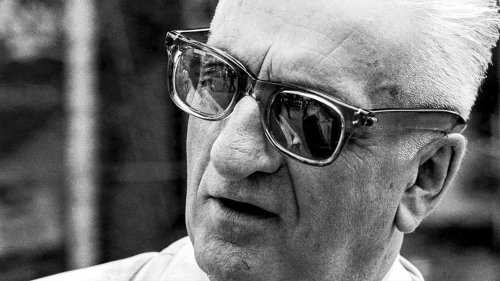
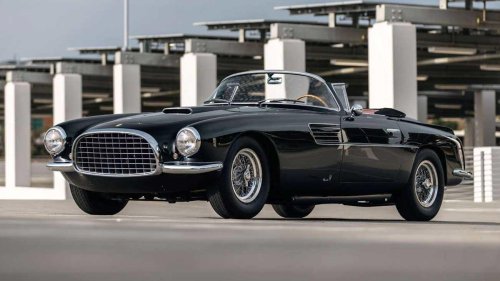
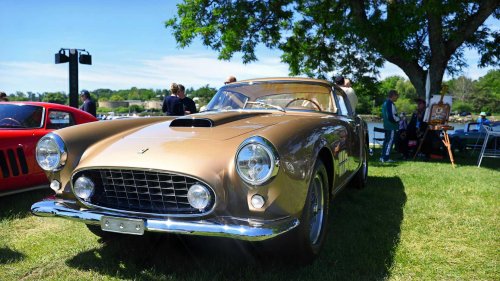
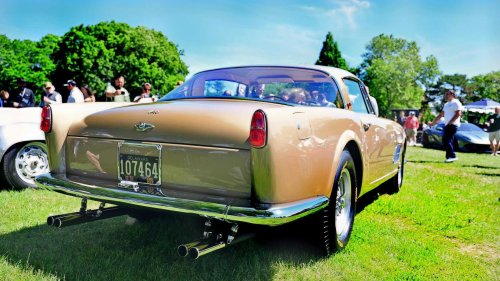
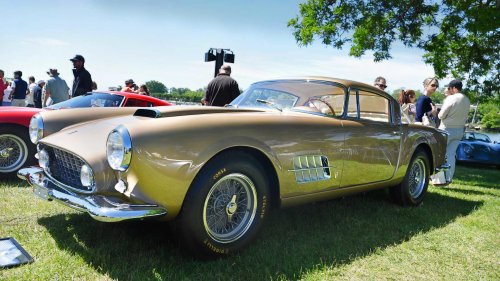







Let us paint the scene for you. The year is 1956; you’re in Belgium, attending that year’s Brussels Motor Show. You’re probably a low-level American auto-journo there to report on whatever Mercedes, Peugeot, or MG-something-or-other advertised ahead of the show. Suddenly, you see every photographer and journalist in the joint shut their mouth in unison. It’s like the air in the joint has suddenly left the building. Why? Because the biggest name in Italian sports cars just revealed his most exclusive magnum opus. Enzo Ferrari In The '50s: A One-Track Mind, Emphasis On Track FerrariLet’s get something straight about the kind of man Enzo Ferrari was in the immediate years after World War II. Old Man Ferrari converted his then brand-new race car factory into an aviation component outlet during the war. Just prior to the war, Ferrari had built his very first bespoke race car, after racing with cars built by Alfa Romeo since the beginning of his career in the late 1920s. After 1945, with every awful thing beforehand taken into account, the only thing Ferrari wanted to do in peacetime was race, and race often. Ferrari built his first self-titled race car, the 1947 125 S,in 1947.Had FIA-sanctioned races been cheap to operate, that would have been history made right then and there. Enzo Ferrari famously had no desire to build road cars, he only caved because paying racing drivers, their crew, and for all the equipment would bankrupt him if he didn’t. Even if Ferrari groaned at the thought, there was no shortage of wealthy clientele ready and willing to shell out big to buy a road car from a racing guru.Effectively, there were two approaches Ferrari could take to field a viable road car operation. One was low-slung two-seater sports cars, and was exemplified by early icons like the 166 Inter and 212 Export. Effectively, they were the quintessentially “Enzo-coded” method of fielding a road car. Of course, that meant taking a race car and bolting a new body, plus two leather seats to it. A New Breed Of Flagship GT Car FerrariThese little compact Ferraris might have been true to Enzo Ferrari's vision, but they alone could not move enough metal to keep his racing operation financially solvent. What Ferrari needed was twofold. Firstly, it needed to have larger profit margins than his smaller road cars. It also needed to serve as an ambassador for the brand that spread the word by sheer word of mouth. In short, Ferrari was gunning for what we in 2026 would identify as the period's influencer crowd.European Royalty, American celebrities, Middle Eastern heads of state, the kind of people who advertise a brand just by being near it, could theoretically set both sides of Ferrari’s operation up quite nicely. Even then, Ferrari’s first true halo GT cars would use the same underpinnings as one of its racing cars. And so, the Ferrari America series was launched in 1950. While clearly still sports cars, these North America-optimized Ferraris had several more layers of refinement than their established standard fare.At the heart of these Ferrari Americas was something different than the Colombo V12 synonymous with the brand’s smaller sports cars.Where the Colombo was small, peppy, and widely adaptable, the counterpart Lampredi 12-pot nearly resembled an American engine by comparison. It was larger, capable of far more low-end torque, and happy to cruise any American interstate with a gracefulness only a few others could match. America-flavored Ferraris like the 340, 342, and 375, used these engines to great effect. But if you want a shining beacon on a hill, the best display of what Ferrari can do when they embrace the US market, you get something like this. 1956 Ferrari 410 Superamerica: A Racing Purist’s Take On Luxury Benny Kirk/Hot Cars1956 was a pivotal year for Ferrari; the year where success on the race track, forged by drivers like Alberto Ascari, and cemented by the Argentinian icon Juan Manuel Fangio,permanently intersected with the jet set and high society. Fangio won Ferrari’s third Formula One driver’s championship in 1956, and their most ambitious foray into the high-end American market ran on a bespoke World Sportscar Championship chassis called the 410 S. Powered by a special dual-overhead cam variant of the five-liter Lampredi V12, the 410 S’s debut at the 1956 1000km of Buenos Aires came with none other than Fangio behind the wheel, on home soil no less.The two cars entered set a new lap record and nearly touched 190 mph on long straightaways. Later, two further cars were built and sent to America. There, icons like Phil Hill, Richie Ginther, and none other than Carroll Shelby himself spent time behind the wheel of one. Clearly, the foundations for a flagship GT were all there. But the 410 Superamerica was the car that merged the two paradigms together. The 410 S chassis was there, but elongated for more cabin space. The Lampredi motor was there as well, just without the DOHC setup. But everything on top of it was fit for royalty, or whoever could pay enough to buy one.Where there was once a basic bucket seat, a race harness, and only essential gauges and dials, there was now varnished wood, polished metal, and only the most plush Italian leather. The car was a siren call for the well-to-do of mid-1950s society. Suffice it to say, the 410 Superamerica had more presence than the Uruses and G-Wagens modern ballers drive. A Flagship Ferrari For Movers And Shakers Benny Kirk/Hot CarsWant proof the Superamerica sold itself on prestige alone? Well, take a look at just a sample of people who owned one. On the Hollywood elites side of things, the iconic director and actor Jackie Cooper purchased one from an LA-based oil tycoon. This example is famous for its unique coach-built bodywork with more elaborate aeronautical motifs. In hindsight, many point out that it almost looks like the Corvette of the same era. Meanwhile, Greg Garrison, the multimillionaire show-runner for The Dean Martin Show, owned chassis number 0671SA, with a unique Scaglietti body style.So the story goes, the car was stolen, stripped for parts, and sold to an Oregon farmer who wanted to, get this, turn it into a tractor! Garrison ultimately purchased the remains and took them back to Italy, and when Ferrari's higher-ups looked at the VIN, legend says they collectively removed their sunglasses in pure shock. Outside of celebrities, heads of state like Vietnam's last emperor, Bao Dai, Prince Bernhard of the Netherlands, and none other than the final Shah of Iran himself were owners of a 410 Superamerica by the end of 1956. On the business side of things, DuPont Chemical Company heir William Kemble Carpenter was a proud Superamerica Series I owner.Carpenter fell in love with the car after seeing it make its rounds on the global auto show circuit in New York City. With a base price of $16,800, Carpenter would have paid the equivalent of over $200,000 in modern money for his new Ferrari. In truth, you cannot even buy the cheapest Roma or Portofino for that kind of money anymore. For the caliber of car you got for the money, that was an absolute steal. But it was profitable enough to keep Ferrari’s racing ambitions alive, and that’s all Enzo Ferrari ever wanted out of the affair. A Nearly Priceless Piece Of Italian History Benny Kirk/Hot CarsIn the same way most great ultra-luxury cars of the period were, each Ferrari 410 Superamerica is a little bit special. One was even withheld by Ferrari, had its exterior further modified, and was unveiled in 1957, dubbed the 4.9 Superfast. As far as cars, so rare and so sought after that appraising it needs an army of experts, that’s among one of the best out there. It is a special occasion whenever one of the 410 Superamerica's three generations rolls across the auction block.Only 35 or so were ever built, so even conservative estimates peg their value as having a bottom end of roughly $5 million. At the ceiling, that figure could easily exceed $10 million or even $20 million. Suddenly, a modern 12Cilindri or F80 does not seem so special.Source: Classics.com, Hagerty