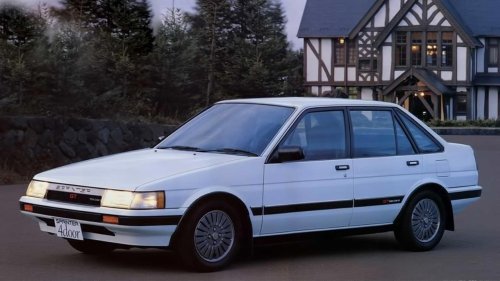
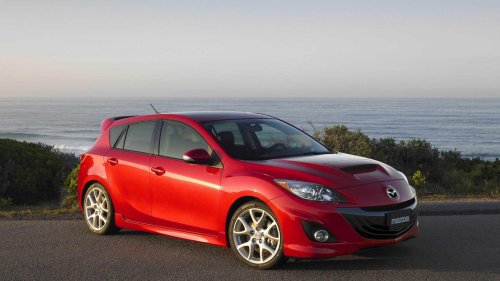
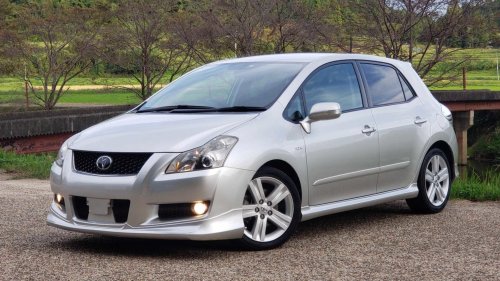
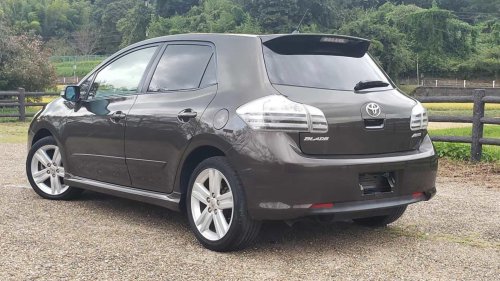
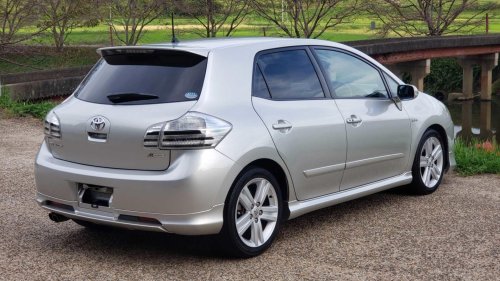



















Before the age of turbocharging came with its high-output downsized engines, stuffing big engines into small cars was all the rage. After all, back in the day, there was no replacement for displacement. Automakers and tuners alike used the opportunity to create all kinds of interesting cars, like the 1978 5.0L V8 AMC Pacer. In Germany, the 1993 2.8L Volkswagen Golf 3 VR6 slotted a six-pot transversely under the hood only because of its narrow 15-degree angle, an engine that would later be paired with a Haldex-based AWD system.But besides all the VW Group cars with the VR6 engine, transversely mounted FWD V6 hatchbacks remained vanishingly rare in history, with most hot hatches sticking to turbocharged four-cylinder engines, discounting rare cars like the mid-engined, RWD Renault Clio V6. But there is an exception - a Japanese family hatchback with a regular 60-degree V6 of no less than 3.5 liters capacity somehow shoehorned under the hood. It was only available in Japan and remains one of the most intriguing luxury hot hatches ever made. Enter The Blade Master: A Toyota Hot Hatch With A Lexus V6 If that description sounds enticing, it was. And it had a badass name to boot. But to understand what the Blade Master was, you have to understand the history leading up to its creation. The Backstory: Sprinter, Allex, Blade ToyotaFor years, Toyota built more upmarket and sportier Corollas for the Japanese Domestic Market (JDM) - typically sold through the Toyota Auto Store, Toyota Vista Store, and the Netz Store - starting with the 1968 Toyota Sprinter. These models often looked different from the regular Toyota Corolla, and usually came with more power and sportier handling. Some Sprinter derivatives were available internationally as sportier regular Corollas, but often just as a trim name with a sports appearance package. Some Sprinters made their way to the US, mostly remembered as the base of some GM/Toyota joint-venture NUMMI cars, such as the Chevrolet Nova.The Sprinter sedan was replaced by the Toyota Allex hatchback in 2001 - a badge-engineered version of the E120 (9th-gen) Corolla Hatchback, called the RunX in many markets. The E120 was sold only as a sedan in the US. The Allex was still a Corolla underneath, and the top performers came with the high-revving 1.8L Toyota ZZ four-cylinder engine. They were differentiated by exterior and interior styling tweaks. The hatchback of the E140 Corolla (that arrived in the US as a sedan only for MY2009) was the E150, called the Auris, and debuted in 2006. This car would introduce the Blade nameplate, to succeed the Allex. It came with a Camry-sourced 2.4L 2AZ-FE I4 engine and was sold through the Toyota Store and Toyopet Store in Japan. Then The V6 Transplant Arrived Wanting to create a truly high-performance luxo-hatch, the Toyota engineers discovered that the 60-degree 2GR V6 engine would fit transversely under the hood of the Blade. It was a tight fit, but they shoehorned it in and created the first high-performance E150: the Blade Master. Lifting the hood and seeing that big V6 filling up the entire engine compartment from corner to corner never fails to elicit surprised gasps from bystanders.Its claimed output was 276 hp - in accordance with the Japanese automakers’ gentlemen’s agreement to limit the maximum power of JDM models - but various sources seem to agree that it was, in fact, closer to 300 hp. That made it difficult to launch, as the power overwhelmed the front tires, but sub-six-second 0-60 times were easily achievable on street tires, with even quicker times possible on prepared surfaces with semi-slick tires. More Power And Luxury Than Any Rival Could Muster While the recipe seemed remarkably simple, the Blade Master was an unprecedented combination of ingredients and one that left all competitors reeling in some way or another. Only One Rival Came Close On Power MazdaAlthough 276 hp doesn’t sound like all that much today, remember that this was 2007, so it was enough to upstage basically all the hot hatches that you’d care to compare it to:Toyota Blade Master - 276 hp Volkswagen Golf 5 GTI - 197 hp Volkswagen Golf 5 R32 - 247 hp Honda Civic Type R (EP3) - 197-212 hp Mazdaspeed 3 - 263 hp Luxurious Features Dialed Up To 11Three trim levels were offered: Blade Master, Blade Master G, and Blade Master G Version L. Toyota turned up the luxury to 11 in the G trims, fitting everything as standard. These might be fairly commonplace on luxury cars today, but these features were very impressive for a hot hatchback in 2007: Leather/Alcantara upholstery Power front seats An 11-speaker audio system with a CD changer Satellite navigation Internet connectivity Keyless entry and start Automatic climate control Adaptive cruise control Automatic HID headlights LED taillights Seven airbags, including a driver’s knee airbag On the outside, the Blade Master could easily be confused with a regular Blade; the script beneath the left rear taillight still read “Blade” and you had to peer over the right of the liftgate to see the small “Master” script. The smart five-spoke alloy wheels were an inch bigger than those of the regular Blade, but 17 inches aren’t all that big either - probably to preserve the ride quality. The lower body skirts all around did provide the Blade Master with a more aggressive, hunkered-down look though. A Driving Experience That Failed To Meet Expectations Melting Rubber, And Not As Buttoned Down As You’d Expect j-spec.com.auLooking at the hardware, one would expect this hot hatch to be the Japanese Golf 5 R32, given that powerful V6 up front and the fully independent rear suspension. On top of that, the aluminum V6 was not much heavier than the four-cylinder engines and the entire car only weighed 22 pounds more than the AWD Blade. However, Toyota couldn't find space for the regular Blade’s AWD system in the Blade Master, and the reliance on a front-wheel drive system meant it lacked the Golf R32’s resolute traction. Too much power without an effective means of putting it to the tarmac resulted in heavy helpings of wheelspin, torquesteer, and understeer.The powertrain had another flaw, and that was the gearbox. Despite its big power figures, Toyota didn't see fit to give it a manual transmission, saddling the Blade Master with a six-speed automatic. Despite featuring paddle shifters, the transmission was slow to respond to manual inputs, and it lacked the rapid shifts of VW's DSG thanks to its torque converter - a technology that, at the time, was a far cry from the competent automatics we have today.But arguably its biggest failing as a hot hatch was its chassis. It may have been badged a Toyota, but there was more Lexus influence than just the engine under its hood. The suspension tuning skewed heavily towards luxury instead of sporting ambitions, resulting in a much softer sort of hatchback. Luxury was at the core of the Blade Master's identity, perhaps in line with what Japanese buyers of the era wanted.j-spec.com.auThis was visible inside the cabin, where again, the Blade Master lacked the edginess and performance intent of the Golf R32. But it also lacked the VW's quality. From the mid-level G grade up, the Blade Master sported supple leather and lovely cabin colors such as tan and black. But the dashboard was mainly just E150 Corolla though, and the fancy trim was ill at ease with the scratchy, hard plastics and garish silver paint on the center console. The GR Corolla's Spiritual Predecessor Remains Out Of Reach For American Fans j-spec.com.auAvailable exclusively for the Japanese market, the Blade Master was only available in right-hand drive configuration. This is problem number one for US importation. The second issue is that it was sold from 2007 to 2012, meaning it will only be eligible for import to the US from 2032 onward under the 25-year import rule. But when 2032 rolls around, American importers may face another problem: availability. The Blade Master never sold massive numbers, and over five years, approximately 2,880 cars were sold. Many of these have already been acquired by importers in Australia and New Zealand where its RHD configuration is well-suited for those markets, leaving even fewer available in Japan.Americans associate Corollas with four-cylinder engines only, so there’s something immensely appealing about a refined but rapid 2007 Corolla with a 276-hp V6 and everything but the kitchen sink in terms of luxury features. The regular four-cylinder Blade was popular and sold 31,470 units in 2007 alone. By comparison, fewer than 3,000 Blade Masters were built in total for all of its six model years, so this will forever remain one of the rarest and most special JDM hot hatches.Sources:The Autopian, Iron Chef Imports, MotorTrend, CultAndClassic.com.au, Grays.com, J-Spec.com.au, HotCars, TopSpeed, Auto-Fever.com, Oversteer.co.nz, GarageDream.net.