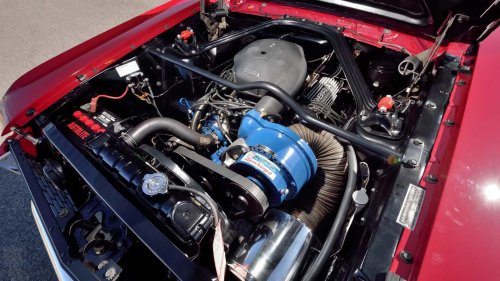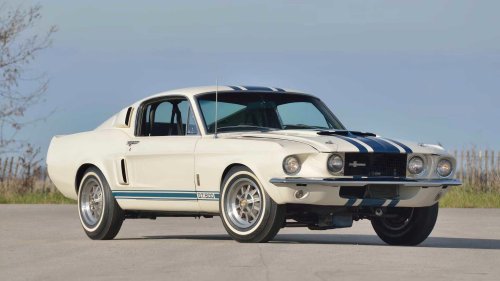










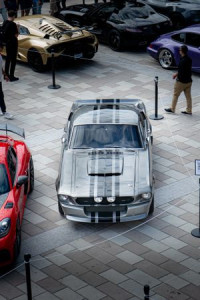








Shelby built only two Super Snake cars during the 1960s, each based on a different platform with a shared goal of pushing the limits of Ford’s 427 cubic inch V8. One focused on high-speed tire testing, the other combined race-spec hardware with forced induction for extreme straight-line performance.One of them used a naturally aspirated big block V8. While the other threw in not one, but two superchargers for good measure, making up to 800 hp! These muscle cars from two different philosophies are the rarest Super Snake models in existence, and remain in their original condition. As a result, both are classified and valued as multi-million-dollar rides. Two Of America's Rarest Muscle Cars Are Both Super Snakes 1967 Ford Shelby Mustang GT500 Super Snake, front quarter view, cream - blue stripesShelby American produced only two models bearing the Super Snake name in the 1960s. The 1966 Cobra 427 Super Snake, and the 1967 GT500 Super Snake based on the Mustang. Carroll Shelby converted two examples of the Cobra 427 Super Snake. One of which was totaled in a wreck, while chassis CSX3015 still survives in its original condition.The '67 GT500 Super Snake was built as a prototype for a tire test. A single example was manufactured, borrowing the engine from the Ford GT40-spec racecar that competed in Le Mans. In fact, both Super Snake models use Ford's iconic 427 big-block V8, but engineered with different philosophies and for contrasting purposes. Rare '60s Shelby Super Snakes Are Multi-Million Dollar Cars Today Today, both models are worth multiple-million-dollars due to their significance and rarity. While one of the Cobra 427 Super Snakes was wrecked, Carroll Shelby's crown jewel, the surviving chassis CSX3015, sold at a Barrett-Jackson auction in 2021 for $5.5 million. That price is $400,000 more than the car raised in 2015, and equal to the price it sold for in 2007.The one-of-one 1967 GT500 Super Snake, on the other hand, was auctioned by Mecum in 2019. The GT500 Super Snake went under the hammer for $2.2 million. It remains the most expensive Mustang ever sold at auction. The '67 Shelby GT500 Is The Rarest Super Snake Ever Made White 1967 Shelby GT500 Super Snake frontShelby American developed the 1967 GT500 Super Snake for a specific purpose: to support a high-speed tire durability test for Goodyear. The car used a 427 cubic inch V8 sourced from the GT40 Mk II program, the same engine that had just powered Ford to victory at Le Mans.During the test, the GT500 Super Snake ran continuously for 500 miles at an average speed of 142 mph on a closed circuit in Texas. The car reached speeds as high as 170 mph without mechanical failure or tire degradation. These results demonstrated the durability of Goodyear’s Thunderbolt tires and confirmed the car’s high-speed capability.Shelby only built one example of this GT500 Super Snake. Unlike other Shelby Mustangs, it never entered production or received additional builds for customers. Its one-off status, combined with factory documentation and a proven test history, confirms it as the rarest Super Snake Shelby ever produced. Lone Survivor: The '66 Cobra 427 Super Snake Is Highly Valuable Blue 1966 Shelby Super Snake frontThe 1966 Shelby Cobra 427 Super Snake used a modified version of Ford’s 427 cubic inch V8. Shelby added dual Paxton superchargers and tuned the engine to produce over 800 horsepower. He paired the engine with a heavy-duty 3-speed automatic transmission among other performance upgrades.Shelby developed the Super Snake as a high-performance road car that pushed the limits of street-legal performance. It was not intended for competition but rather served as a demonstration of what the Cobra platform could achieve with a massive twin-supercharged big block V8.Only two examples were built. Shelby kept one for personal use, while the other went to comedian Bill Cosby. Cosby later returned the car as it was a monster to handle. It was subsequently sold to another owner, who died in a high-speed crash, destroying the second unit.Today, only one 427 Super Snake remains, chassis number CSX3015. It retains its original configuration and features factory documentation. This car stands as the only surviving Super Snake of its type ever built by Shelby. Comparing Shelby’s Wildest 427 V8 Super Snakes 1967 Shelby GT500 Super Snake V8 engine Engine Specs (Source: Shelby, Hagerty, Barrett Jackson)The 1966 Shelby Cobra 427 Super Snake and the 1967 GT500 Super Snake used very different approaches to extract performance from the same 7.0-liter (427 cu-in) Ford V8 big block. While both engines share a common displacement and Ford’s FE architecture, their setups and engineering vary distinctly.In the GT500 Super Snake, Shelby used a single 780 CFM Holley four-barrel carburetor mounted on a high-rise aluminum intake manifold. This engine had a solid lifter camshaft and aluminum cylinder heads, as it borrowed the engine straight from the Ford GT40 that raced and won at Le Mans. It produced an estimated 520 to 550 hp at around 6,000 rpm, with torque figures close to an estimated 500 lb-ft. The compression ratio stood around 12.5:1, and the engine was tuned for high-revving track performance. It is one of the most legendary cars Carroll Shelby ever made.In contrast, the Shelby Cobra 427 Super Snake used dual Paxton superchargers fed into twin four-barrel carburetors. The twin-superchargers delivered boost to a lower-compression version of the same FE block, estimated at 10.5:1. This setup claimed to produce more than 800 hp and over 600 lb-ft of torque. The supercharged engine focused on raw acceleration and straight-line performance, with power coming in more aggressively under boost.The GT500 pairs its engine with a 4-speed Toploader manual transmission, ideal for controlled power delivery. The Cobra, on the other hand, used a 3-speed automatic, using a different approach, focused on brute force and accessible performance.While both engines share a common origin, their tuning and hardware reflect very different philosophies: one is built for sustained track use, while the other is engineered for short bursts of maximum power. Both stand as the rarest American muscle cars, showcasing how Shelby American pushed the limits of V8 performance using available technology in the mid-1960s.