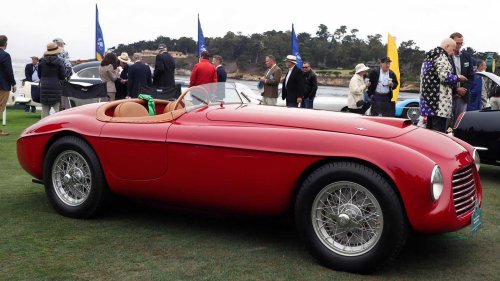
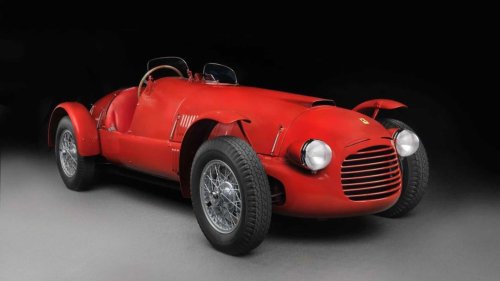
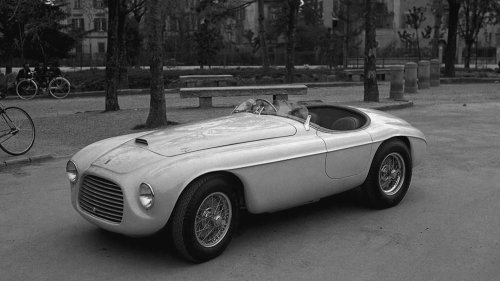
The United States is probably the most important overseas market for Ferrari, and the Italian company operates a large regional headquarters in New Jersey to serve its avid American fans. But while the company imports a large number of new vehicles each year in the modern era, the trail of incoming vehicles actually started all the way back in 1949.In January of that year, a 166 MM Touring Barchetta landed in the U.S. to be followed not long after by a 166 Spyder Corsa. And in 2026, these two trailblazers have reunited at a special event to offer a rare side-by-side look at where Ferrari's American story really began. The Cars That Started It All Prova MO / Wikimedia Commons Those two incoming Ferrari models had a big job ahead as they needed to show Americans exactly why Ferrari had such a good reputation overseas. And so, the first vehicle, the 166 MM Touring Barchetta, with its serial number 0002 M, arrived in the US in January 1949 after crossing the Atlantic aboard the Vulcania. Records show that Luigi Chinetti was the importer, and he then transported the car across the country to its new owner, Tommy Lee, in Los Angeles.The second chassis, with the serial number 0016 I, came into the country through Briggs Cunningham and became the first Ferrari to race in the United States. It scored the company's first U.S. victory at the Suffolk County Airport Race and thus started the legend of Ferrari in North America. Both of these newly arrived cars would write the first chapter for this bold brand in real time. America's First Ferrari Cavallino ClassicFerrari is very proud of the 166 MM Touring Barchetta and calls it one of its most important early sports-racing cars. It initially launched at the 1948 Turin Motor Show and featured a lightweight body with a compact V12, as the type of fundamental formula that made the name famous. This car was very capable in the right hands and certainly had enough speed to embarrass much larger machinery, but it also had plenty of evolutionary materials as a brand-proclaimed prototype. It had a fuller and more luxurious interior and even had windscreen wipers, although these details wouldn't automatically find their way through to all subsequent Barchettas. But for those who followed Ferrari's mindset, it was now clear that the company was trying to evolve beyond racing. In trumpeting the Barchetta's evolution, Ferrari, as a young company, had essentially created a rolling business card to help cement its footing on the world stage.The 166 MM program definitely delivered on the track, with victory at the Mille Miglia in April 1949, followed by Spa and Le Mans soon after. Chassis number 0010 M was successful at Spa, and 0008 M at the Mille Miglia, but 0002 M would carry the model’s torch for Ferrari's North American adventure. When it arrived in the US, it certainly made its mark and while it may have changed hands through various owners and eventually made its way into prized collections, it certainly announced the arrival of Ferrari in some style. The True Racer Follows Cavallino ClassicIf Ferrari's 0002 M was a trailblazer, its 0016 I was the hard-edged racer, to make Ferrari's American presence feel real with results. Luigi Chinetti had driven the car successfully in Europe before bringing it into the US with the help of Briggs Cunningham in 1949. And George Rand then took the car to the famed Bridgehampton race, setting the fastest lap, before Cunningham recorded a second-place finish at Watkins Glen. And that kind of activity underlined Ferrari's intent in the US. It wouldn't try and build its reputation by filling various showrooms with shiny cars, but it would build its record within the cut and thrust culture of racing instead.On the open road, the 0016 wasn’t a polished boulevard cruiser, and it could be a real handful. It was low, purposeful, and felt alive and would make you feel as if you'd earned every mile behind the wheel. But it continued its successful competition run in the US to build on its early endurance and sprint race successes in Europe. And as American road racing was still in its infancy in 1949 and 1950, this was the perfect time for Ferrari to show its mettle. When 0016 I won the company's first race in America, it did more than add a line of results to a sheet. Instead, it helped to turn Ferrari from a faraway curiosity into a credible domestic threat. Why The Car Reunion Matters Ferrari The famous Cavallino get-together in Florida is well known for headline-making and ground-breaking announcements, but the reunion of these two particular cars at the 2026 event was something else altogether. After all, it compressed history into something that you can actually stand in front of and feel, and it showed the very two cars that made Ferrari's prominence in the US possible. The first car opened the door, and the other one kicked it wider, and the Cavallino display is thought to be the first time that these two imported pioneers have been shown side by side.Enzo Ferrari never built cars to be museum pieces and so this reunion carries a deeper emotional hook. The big boss would probably have been proud to see how these cars forged a rough and tumble reputation and have gone on to impress ever since across the board. And he would surely have been impressed by their appearance in a combination of endurance races, road races, rallies, and concours shows, as all of that is deep within the very DNA of Ferrari itself.For enthusiasts today, this Cavallino reunion shows that Ferrari's identity was never simply about red paint and glamour. It suggests that the company always wanted to prove its speed in front of skeptical audiences and do it with cars that were beautiful enough to keep on a pedestal as well. And perhaps that's really why 0002 M and 0016 I matter so much, as they're not merely early Ferraris but proof that these cars can be both desirable and dangerous. What These Cars Say About Ferrari Ferrari Different automobile manufacturers have their own ways of building a brand reputation but, as far as Ferrari was concerned, that task would come down to one convincing drive at a time. The Italian company didn't flood the market with PR copy and abstract claims of excellence but instead, introduced two vehicles that became visual objects that people could dream about. And in the case of 0016 I especially, Ferrari showed that its daring cars could win, survive, and come back for more.Ferrari was never slow in connecting emotion to engineering with its early 166 offerings. The MM designation attached to early models points to the Mille Miglia's success and Ferrari always wanted to make the connection between speed and sales. In its early 166 vehicles, it turned out cars that were small and light enough to be quick but wrapped them in a shape that people would remember, long after the racetrack dust had settled.FerrariCollectors often chase rare badge prizes, but in truth, many of those targets lack a real story. But that's not the case with these two Ferrari pioneers, as they have the sort of provenance that reads like a successful movie. They came into America via the high seas to take part in early US races, scored some landmark wins, and subsequently passed between famous owners. And now, these vehicles have been part of a reunion that puts everything back into perspective, with both cars together giving us a stark reminder of how a legend can begin.The 166 MM Touring Barchetta is an elegant pioneer and the car that initially carried Ferrari's Italian flag. But the 166 Spyder Corsa is more of a fighter and the one that showed that a Ferrari could be just as adept on the racetrack, with its frequent visits to victory lane. Together, both cars tell a clean and compelling story and certainly paved the way for where Ferrari North America is today. Both cars arrived with a sense of purpose and plenty of speed, and a crucial taste for winning across the board.















 +38 others