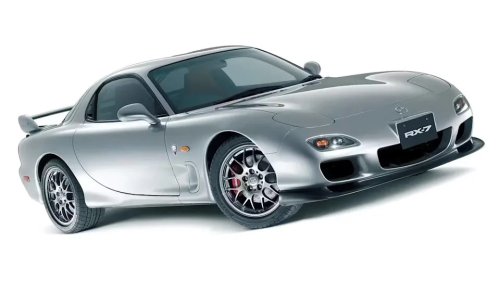
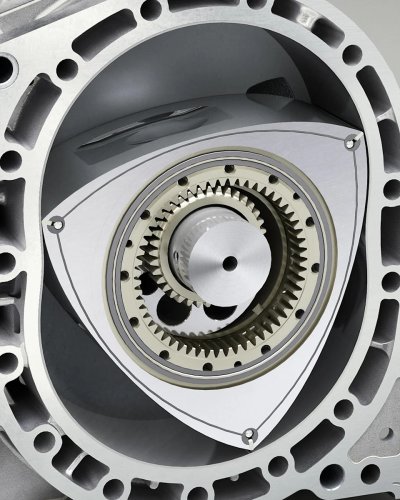
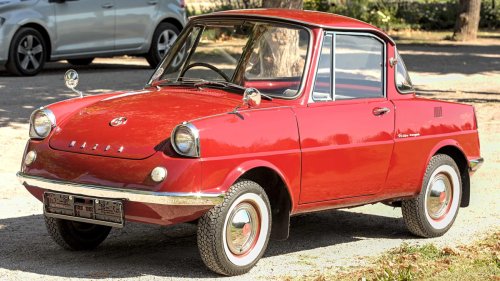
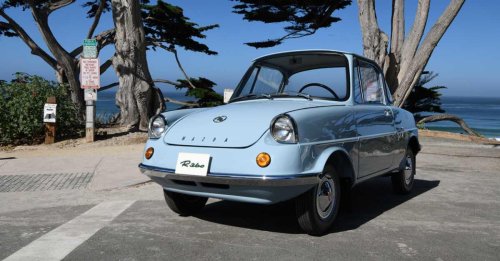
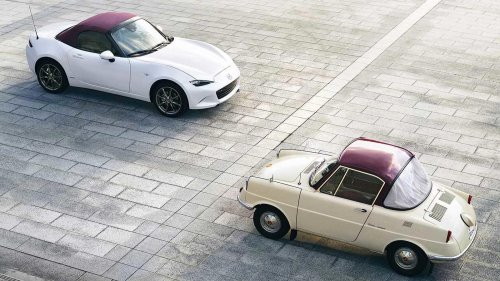
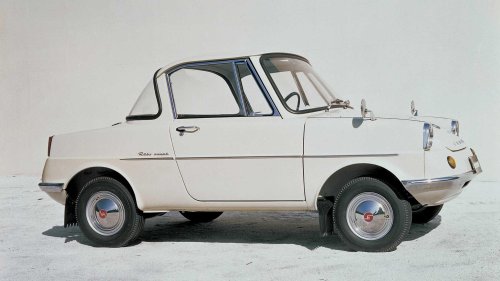
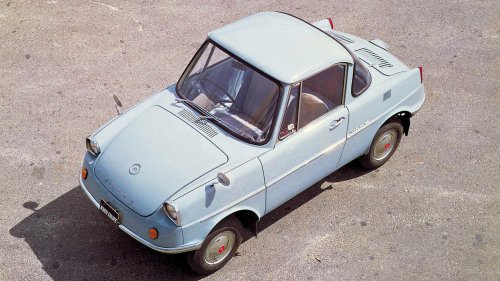
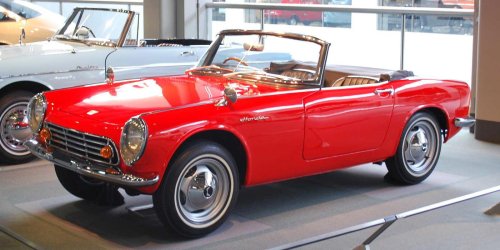
The JDM cars of the 1990s tend to be the most sought-after. These high-tech, turbocharged precision instruments certainly deserve the hype they're given, but much like the American muscle cars of the '60s, or the German sports cars of the '80s, you've heard all that jazz a million times before.What you may not be well-versed in, however, is the inception of these iconic Japanese companies. Mazda, for example, dates back long before the ground-breaking RX-7 or iconic Miata, and in this article, we're showcasing where Mazda's four-wheeled endeavor first began – a car that, while completely unique, laid the groundwork for the brand's mainstream success.In this article, historical information and factory specifications are sourced from the featured car's respective manufacturer. The Mazda R360 Coupe Was Their First (And Tiniest) Car Ever Alexander Migl via Wikimedia Commons Japan experienced a massive economic boom in the mid-20th century, really picking up steam in the early 1960s. Industries of all kinds had finally hit full swing after the war, and in order to accommodate more people, goods, and everything that makes a growing economy work, the government heavily promoted the production of small automobiles for both personal and commercial use.The Japanese government created a new class of vehicle specifically targeted towards citizens and their families. Known as the "Kei" car class (short for Keijidosha, which translates to "small vehicle"), these were first introduced all the way back in 1949, and were limited to engine displacements no larger than 150cc (four-stroke engines) and 100cc (two-stroke engines).Mazda wasn't quite ready to enter the game at the time, but about six years later, in 1955, the Japanese government upped the limit, allowing engine displacements to grow from a 150cc maximum to 360cc. Additionally, in 1954, the first All Japan Motor Show was introduced, incentivizing many manufacturers to build concepts to show to the public, and once the displacement rules were changed to allow the larger engines, the race was on. Mazda Had The Customers In Mind When Creating The R360 Even though incomes were higher by the late 1950s and early 1960s in Japan, personal vehicles were still seen as luxuries. The typical blue-collar folks, and even some white-collar salarymen, weren't able to purchase their own transportation. Mazda noticed this and saw a massive opportunity in front of them.And by May 1960, Mazda was ready to debut its first-ever car. Dubbed the R360 (designating the 360cc displacement), this adorable little city car was priced at an affordable 300,000 yen, or the equivalent of about $300 US dollars in 1960. Mazda's philosophy was simple: they wanted maximum lightness, with technologically sound engineering, at an affordable price.Due to this strategy, the R360 received a lightweight steel monocoque chassis as well as an aluminum hood and engine cover. Combined with other lightweight materials like magnesium engine components, the R360 was the lightest kei car on sale in Japan at the time, at just 840 pounds. Plus, it was one of the first "micro-mini" cars to use a four-stroke engine, which was a major improvement in smoothness and efficiency when compared to the run-of-the-mill two-stroke offerings from other manufacturers. Mazda R360 Specs And Design via Classic & Sports Car Speaking of that engine, what exactly was it? Well, under the "trunk" (the engine was in the rear) was a V-twin motor – basically a two-cylinder engine in a V configuration, much like a touring motorcycle might have. These kinds of engines tend to favor low-end torque, which was perfect for low-speed city driving. The R360's particular 360cc V-twin made a comically low 12 horsepower and 16 pound-feet of torque.The standard R360 came with a four-speed manual gearbox, but customers were also offered the choice of a torque converter two-speed automatic, the very first of its kind in Japan. Shockingly, this tiny little car (measuring a few inches short of 10 feet in length) was actually a four-seater, featuring two smaller rear seats that were likely only big enough for small children or pets.On the outside, it doesn't look like much, but the R360 was a triumph in design. They managed to make a pint-sized appliance look stylish and refined with the raked back B-pillar, well-placed body lines, and a spacious-feeling cabin. Before, During, and After The R360 Mazda Unlike most major automakers, Mazda didn't start out as an automobile company from the onset; heck, they weren't even in an adjacent field like airplanes, marine equipment, or military vehicles like a lot of others were. The company was founded in 1920 as the Toyo Cork Kogyo Company, and was a manufacturer of, you guessed it... corks.It wasn't until the early 1930s that the company began expanding into the automobile business, where they gained notoriety for their three-wheel motorcycles, and as we discussed earlier, the post-war era of Mazda included the design and integration of four-wheeled machines like the R360. The R360 Was A Massive Hit Mazda Weeks before the R360 was released to the public, Mazda received more than 4,500 orders for the microcar, and by the time the summer of 1960 came to an end, they were selling more than 2,000 R360s per month by August 1960. Already, this was the most successful endeavor Mazda had ever entered.By the end of the 1960 calendar year, the R360's sales were at a whopping 23,417 units, accounting for more than 64% of the kei car market share. Compare that to the numbers of Ford's world-changing Model T, which held a 61% market share in the early 1920s. Of course, the Model T's figures represent the American passenger car market as a whole, not a subset like the R360, but these numbers were revolutionary for Mazda and Japan.If you do want to zoom out on the Japanese auto market as a whole, the R360 represented about 15% of the entire market – still an incredibly impressive number for any car at any point in time. The R360's Philosophy Runs Deep Mazda The essence of the lightweight and compact R360 (as well as its design) would bleed into Mazda's future projects in the 1960s, most notably with the introduction of the Mazda Cosmo Sport and the R-100 Coupe. While both were rotary-powered rather than V-twin-powered, the philosophy was much of the same, and in the case of the Cosmo, specifically, it looks like a R360 that was just stretched from both ends (seriously, the design cues are almost identical).The R360 was technologically advanced for its time and class, and you can draw a direct line to many cars that its mantra inspired. Think of the RX-7; it was lightweight, compact, and used unique and advanced technology in the form of the Wankel rotary engine. The Miata also followed this path with its small engine, light body, and pure driving dynamics. Other Japanese Brands And Their First Cars The story of Mazda's first car is incredibly special, but as you could guess, 20th-century Japan also held many firsts for other automakers. Here are a few more first cars of well-known brands that you may not have heard of. Honda S500 Mytho88/Wikimedia Commons The same kind of bureaucratic processes that created the Mazda R360 had a heavy influence on Honda. In 1962, Japan's government was poised to pass a law restricting the number of automotive manufacturers to just three individual companies, forcing Honda to scramble and build a car (instead of motorcycles as they had been) that would qualify them as one of the chosen automakers.The law never passed (thank god), and despite the short timeline they had to develop their car, Honda's creation was immaculate. This is the S500 – a two-door sports coupe with a 521cc DOHC inline-four engine under the hood that could rev to 9500 rpm. Yes, 9500. It made about 44 horsepower, but still remains a pure driving experience thanks to its lightweight construction, incredible shifter, and of course, those revs. Toyota Model AA Pinterest A company's first car is always a fun nugget of information, but Toyota's is far more than just a fun fact. The 1936 Toyota Model AA was not only the brand's first automobile, but the first proper passenger vehicle to ever hit the streets of Japan. Like many early Japanese cars, the Model AA was designed and built with heavy inspiration (basically copies) from American car models. The Model AA's design, specifically, was drawn from Chevrolet and DeSoto cars of the time.It used a 3.4-liter inline-six that generated about 65 horsepower and also happened to be modeled very closely after a GM engine. Toyota itself has noted that the Model AA's design and engineering had a direct influence on the later Toyota Crown (known as the Toyopet Crown in the U.S.), which was an incredibly important success for the brand's popularity in global markets. Nissan DAT Nissan Bear with me for this convoluted and crazy backstory. As you may know, Nissan was called "Datsun" for decades before the 1980s. And before that, they were actually called "Datson," with an "O" instead of a "U." They changed that letter because "son" in Japanese carried a meaning of "loss," and "sun" seemed like a much better solution, considering the sun (as in the fiery ball in the sky) is also a deeply important piece of imagery in Japan.But what about the "Dat" part of "Datsun?" Well, DAT were the initials of the original investors of the company from before it was even called "Datson." That brings us back to their first car in 1914, when the company was named Kwaishinsha Motor Car Works. The model was called the DAT to honor the founders' names and was a small passenger car that featured a two-cylinder inline engine that made about 10 horsepower.Sources: Mazda, Honda, Toyota, Nissan.





















 +35 others