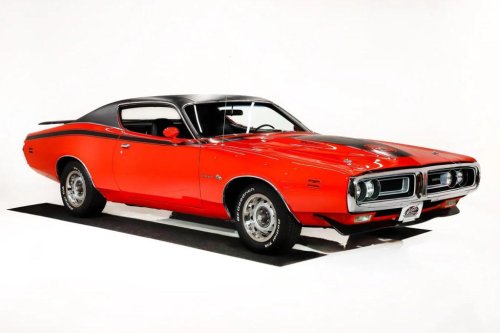
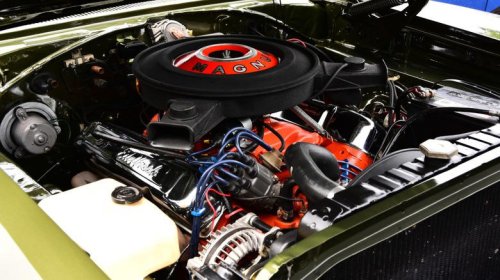
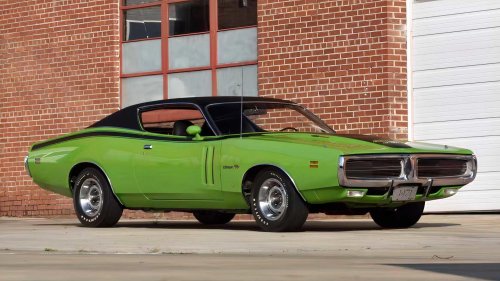
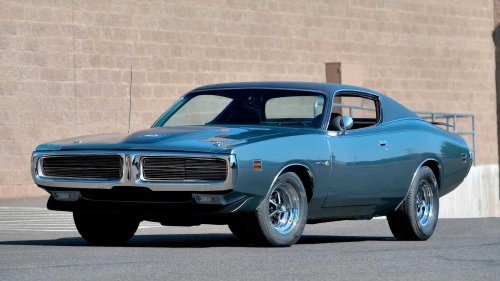
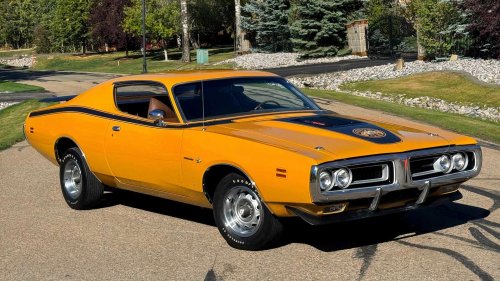
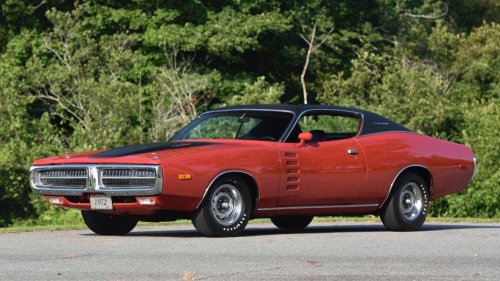
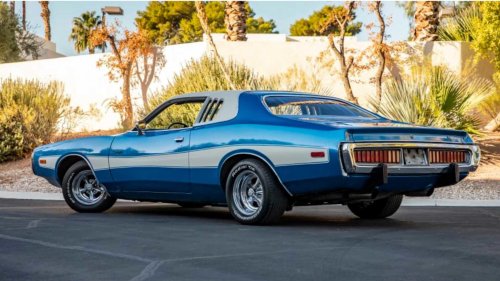
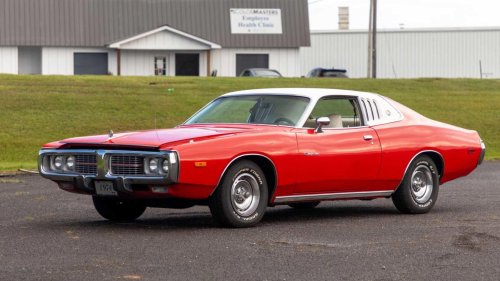
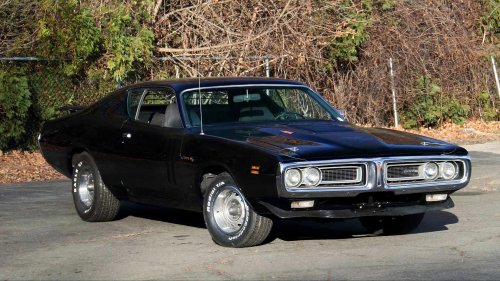
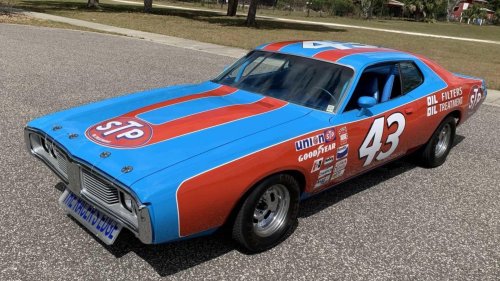
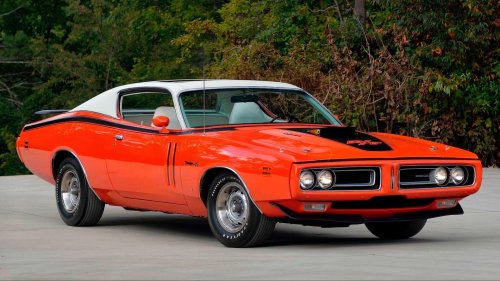
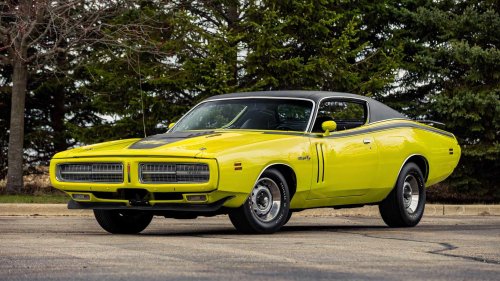
Thanks in part to starring in some iconic movies like Bullitt and the Fast & Furious franchise, the second-gen Dodge Charger, produced from 1968–1970, is the defining ride of the entire Golden Age of American Muscle. Many fans probably don't realize that there was a third-gen Charger that was, at least for a brief period of time, just as badass and even more popular, at the time, than the legendary second-gen. After 1971, things got strange across the muscle car segment as the Malaise Era of detuned engines and government emissions mandates set in, but the bold styling continued despite the dropping horsepower ratings. As the 1970s wore on, the Charger would eventually morph into a personal luxury ride, making the third generation the last time this venerated muscle car was available with a 440 big-block V8 and a four-on-the-floor manual transmission. Third-Gen Fuselage Dodge Charger Mecum For the 1971 model year, the Chrysler B-body muscle cars got a radical redesign with a "fuselage" body style, meant to mimic a military fighter jet. With a long hood and short decklid, it evoked a larger pony car silhouette, but with pronounced Coke-bottle curves. '71 marked the beginning of the third-gen Dodge Charger, which would be the last true muscle car for the nameplate until it was rebooted in 2006. Until recently, Mopar fans and collectors were not enthusiastic about the third-gen Charger, and for many years they mostly served as parts cars for second-gen builds due to the high degree of parts compatibility. As we'll see later, the third-gen Charger has come roaring back into popularity with enthusiasts, and is arguably now the king of the Dodge classics. End of the Golden Age Dodge In every measurable way, 1971 was the last great year of the Golden Age, as the detuning plague of the Malaise Era took over. For Mopar, it was the final year for the 426 Hemi and 440 Six-Pack V8s, which were two of the most fearsome engines of the classic era. While the Hemi retained its street-dominating 425 horsepower and 490 lb-ft of torque, the Six-Pack was down five hp in '71 to 385, and the underappreciated 383 V8 dropped from 335 to 300 hp. All of these engines that made Dodge muscle cars the kings of the streets were still legend-makers, but it was their last hurrah. It wasn't just Dodge and Plymouth on the cusp of decline, as all the big-name muscle cars started to lose power in '71, from the Buick GS 455 to the once-dominant Chevy Chevelle SS 454, which lost a whopping 85 hp from 1970 to 1971. ’71 Charger Super Bee Mecum Introduced in mid-model year 1968, the Coronet-based Dodge Super Bee was a bare-bones street machine that came with a powerful engine and not much else. The Coronet R/T and Super Bee were discontinued after 1970, but the latter carried on as a trim on the third-gen Charger. The 1971 Super Bee was the last great performance-only package on the classic Charger, and it came standard with a 383 V8 but could be optioned with a 426 Hemi or 440 Six-Pack, both of which are some of the rarest Golden Age Mopars. Technically, the '71 Super Bee did not have a 370-hp 440 Magnum V8 option, but 26 of them somehow made it out of the factory, making yet another unicorn for the trim. The '71 Super Bee came equipped with a three-speed manual, with a four-speed manual and A727 TorqueFlite automatic on the options list. Pairing the four-speed with any of the rare engine options transforms the '71 Super Bee from a unicorn to a Holy Grail car. ’72 Charger Rallye Cry Mecum In 1972, the Super Bee trim was gone and the R/T was replaced by the Charger Rallye, but the biggest change was the shocking drop in power. The Hemi had been retired, as well as the 440 Six-Pack, but there were actually a small number made that year, and the 383 was replaced by a 225-hp 400 V8. As for the 440 Magnum, it was down from a 370-hp wild beast to a domesticated 280-hp house pet. Now, here's the thing about 1972: it's when horsepower ratings went from gross to net, which was really just a different way of measuring output. For example, the 440 in 1972 had a 280-hp rating, which is equivalent to around 340 gross horsepower, so it didn't actually lose 90 hp, but was definitely less powerful than it had been the year before. Luxe Special Edition Mecum The Charger took its first step towards a luxury ride in 1973 with the upscale SE trim that offered, among other things, a landau vinyl roof and three opera-style rear-quarter windows. That Charger SE pictured above doesn't look too bad because it has some wide Cragar SS wheels on it, but with the wire wheel covers, it was the first time in Charger history that it actually looked underwhelming. It did come standard with bucket seats, power everything, and an upgraded interior, which turned out to be quite popular, but at the same time it was when the Charger stopped feeling like a Charger. Now, here's possibly the strangest thing about the '73: while both the 440 and four-speed manual transmission were available, they couldn't be paired. You could get a 400 with a four-speed, but for whatever reason, Dodge restricted the stick for the 440. Last of the 440 Chargers Mecum 1974 saw the 440 Magnum V8 drop to 275 hp and 375 lb-ft of torque, which had the Charger limping to a 7.3-second 0-60 time as well as a 15.5-second quarter-mile. This was the final year for the third-gen Charger and the last chance to get one with a 440ci engine, though like the '73, it was not available with a four-speed manual transmission. As per this article's title, 1972 was the last time you could order a Charger 440 four-speed, so that year really was the end of the classic Mopar's muscle car reign. The 440 would actually live on under the hoods of Dodge Ramchargers until 1978 and the fourth-gen Charger would max out with a 190-horsepower 400 V8, also until 1978. Despite lacking the kind of power that made the Charger a legend, the third-gen was still handsome in its final few years, and there's nothing stopping anyone from modifying them with powerful engines and manual transmissions to give them the snarl they deserve. Best-Selling Charger Gen Mecum The third-gen Charger doesn't get nearly the respect the second-gen icon does, but in its day was actually more popular with buyers. From 1968–1970, Dodge moved 235,067 Chargers while the 1971–1974 third-gen sold 351,402 units. Yes, the third-gen did get an extra year of sales, but it was still flying off dealer lots at a more rapid pace than the second-gen. The best year for the second-gen was its debut in 1968, when 96,100 buyers fell in love with the Charger. 1973, however, was a banner year for the third-gen with 119,318 sales and, ironically, that was the first year you couldn't get it with a 440 and 4-speed. This is definitely not a competition, but rather a counterintuitive point to show that the third-generation Charger was not a second-class Mopar. In the grand scheme of things, Dodge sold over a half-million Charger muscle cars in just seven years, which is a testament to how truly special this Golden Age legend really was. NASCAR Superstars Mecum In another win for the third-gen Charger, it was actually Richard Petty's favorite car, and he dominated the NASCAR circuit in it. In 1973, Petty switched full-time from his iconic Plymouth to a Dodge Charger and promptly took the checkered flag at the Daytona 500, beating Bobby Isaac by two laps in his #43 car. He won his fifth NASCAR championship in 1974 and then his sixth in 1975 with this car, and racked up a total of 35 wins between 1972–1977 in it. Petty loved this ride so much that he kept driving a third-gen Charger until 1977, which was three years after it had been discontinued. Also, for whatever reason, the fourth-gen Dodge Charger's design wasn't compliant with NASCAR rules, so Petty actually got an exemption to keep rocking and rolling with the third-gen. Additionally, drivers like Buddy Baker, Bobby Isaacs, and Dave Marcis all tasted NASCAR victory in third-gen Chargers. Mopar Auction Kings Mecum In another twist of fortune, third-gen Chargers are now the most valuable of the bunch, beating second-gens on the auction block by a lot. That Hemi Orange 1971 Charger Hemi R/T pictured above is the most heavily optioned example, with just 35,738 miles on the odometer, and sold for an astounding $550,000 at Mecum Kissimmee 2023. The most a second-gen, excluding Daytonas, has gone for at auction is $352,000 for a low-mileage survivor car 1970 Charger Hemi R/T. There have been three third-gen Hemi R/Ts to beat that high bid, and a half-dozen that have come close. Even the no-frills Super Bee is bringing the thrills at auction, with at least five dropping the gavel at $200,000-plus. The third-gen V-code Charger Six-Pack R/T has an auction champion with a '71 that sold for $242,000 in 2023, and a more common 440 Magnum R/T made a notable showing by nearly hitting the $100,000 mark in 2026. Legacy Of The Charger 440 R/T Mecum The 426 Street Hemi V8 is intrinsically linked to the Dodge Charger, but in reality was an extremely rare option, with only 1,473 of them being equipped with it from 1966-1971. The vast majority of Charger R/Ts came with a 440 Magnum, so really that's the engine that should be synonymous with the nameplate. Dodge built 61,177 Charger R/Ts between '68-'71 and 46,612 of them were 440 Magnums. The black 1968 R/T villain car from the Steve McQueen action thriller Bullitt put the Charger on the map and was equipped with a 440 Magnum. The 440 isn't just the defining engine of the R/T, but of all the second- and third-gens, as it's the only big-block that stayed with the Charger throughout. The Hemi and Six-Pack bowed out in '71 while the 383 was replaced by the 400 in '72, but the 440 was always there.Sources: Dodge, Hagerty



















 +51 others