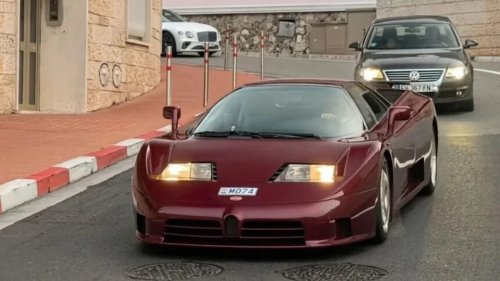
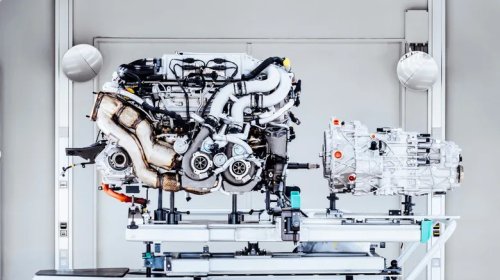
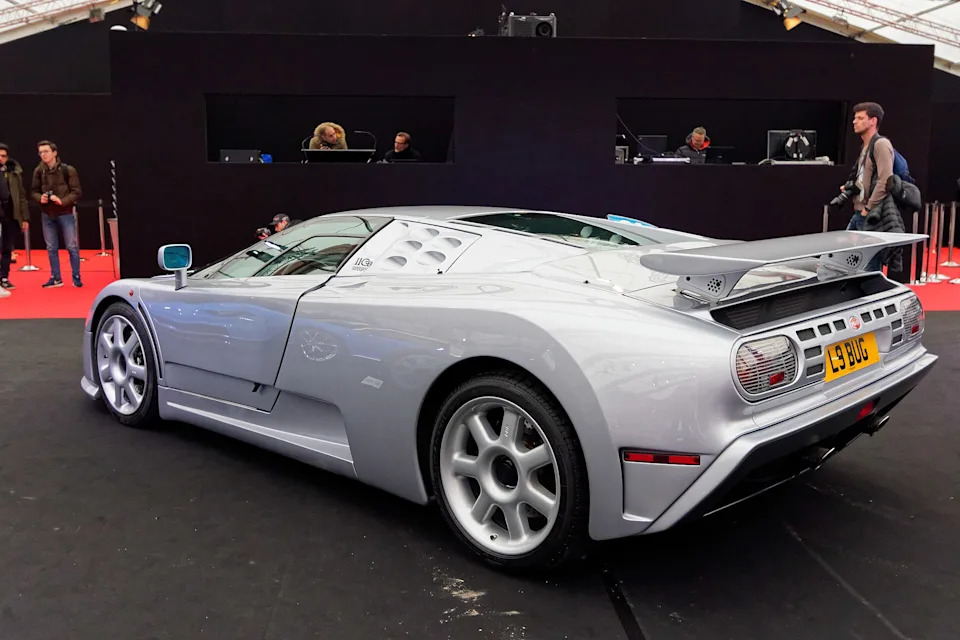
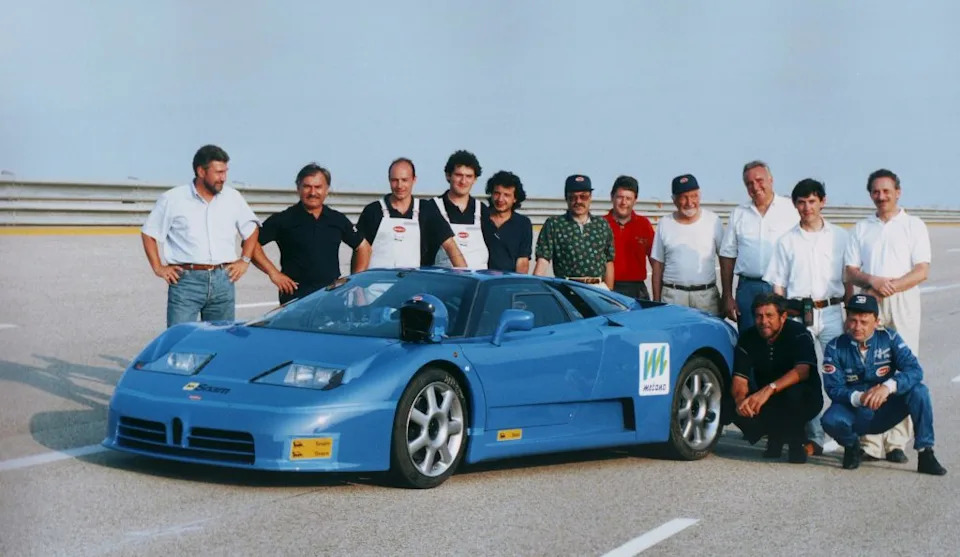
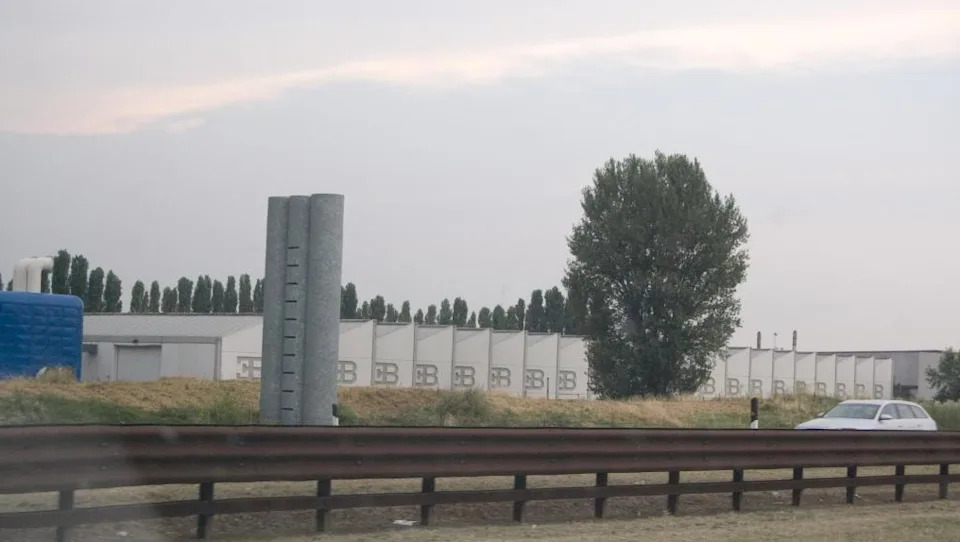
Today in Car History: The Quad-Turbo Bugatti That Launched on a Birthday and Died in Four YearsBackfire NewsJohn LloydTue, September 15, 2026 at 11:02 PM UTCAdd us on GoogleThirty-five years ago today, roughly 2,000 people stood around in Paris and waited for a sheet to come off. Under it sat the Bugatti EB110: a mid-engined V12 with four turbochargers, sixty valves and a carbon fiber tub from an aerospace firm. The badge on the nose belonged to a company that had not built a road car since 1956. Then three of them drove down the Champs-Élysées.The date of the Bugatti EB110 debut was no accident. September 15, 1991 marked the 110th anniversary of Ettore Bugatti's birth. They named the car for the date. And the man behind all of it had already pulled the same stunt exactly twelve months earlier.Romano Artioli Planned the Bugatti EB110 Debut Around One Day on the CalendarArtioli was an Italian collector and sports car dealer. He bought the rights to the Bugatti name in 1987, then did the least sensible thing available to him: he built a brand-new factory, from scratch, to make a brand-new supercar. He put it at Campogalliano, just outside Modena, in the middle of Italy's supercar belt.AdvertisementAdvertisementBugatti's own account of the era notes that the plant opened on September 15, 1990 — Ettore's 109th birthday. Artioli hung the original entrance door from the old Molsheim works at the front of it.A year later, to the day, the car arrived. That is not marketing garnish. A man spent four years and an enormous amount of other people's money making the calendar cooperate. It tells you how seriously he took the badge he had bought. The Bugatti EB110 was the first new model to wear the badge in 35 years.The Engineering Was Genuinely Unhinged, and It Still Holds UpA 1993 EB110 Super Sport prototype on the block in Paris. The louvred deck hides a 3.5-litre, 60-valve, quad-turbo V12. Photo: Thesupermat / CC BY-SA 4.0Start with the engine, because everybody gets this one wrong. It is a 3.5-liter V12. Not a 6.0. Not an 8.0. Three and a half liters, split across twelve cylinders, with five valves each for sixty valves total. Four turbochargers and their own intercoolers feed it between 1.05 and 1.2 bar of boost. It revs to 8,250 rpm. The GT made 560 PS; the Super Sport made 610.Why Four Turbochargers on 3.5 LitersToday you would not do this. But hang one large turbo off a V12 in 1991 and you got lag you could time with a calendar. Four small ones, each handling three cylinders, carry far less rotating mass. They spool early, and they stop a tiny engine from feeling hollow below 4,000 rpm.AdvertisementAdvertisementThe Bugatti EB110's five-valve head does related work. A 3.5-liter V12 has cylinder bores about the size of a shot glass. You cannot fit enough valve area in there with four valves to breathe properly at 8,000 rpm. It is a packaging fix wearing an exotic badge.A Carbon Tub in 1991, and All-Wheel Drive Before Anyone ElseThe chassis is the part that dates this car forward instead of backward. Aérospatiale — yes, the Airbus people — made the monocoque out of carbon fiber. It weighs 125 kilograms. In 1991 carbon tubs lived in Formula 1 and essentially nowhere else on a road car. The McLaren F1 would not arrive for another year. Bodywork mixed aluminum, carbon and aramid. The fasteners were titanium. The wheels were cast magnesium.Then there is the drivetrain, and the rest of the industry spent two decades copying it. The Bugatti EB110 runs all-wheel drive. A viscous locking center differential splits torque 27 percent front, 73 percent rear, with a limited-slip diff at the back and a six-speed manual in between.That split leans rear on purpose. It lets the car behave like a mid-engined rear-driver when you are having fun. It also keeps 610 PS from vaporizing the rear tires the first time you get greedy out of a damp second-gear corner. Quad-turbo, all-wheel drive, carbon tub. Write that on a napkin and you have described a Veyron, a Chiron, and most of what followed.AdvertisementAdvertisementFor the opposite philosophy, look at what Gordon Murray does with a naturally aspirated V12 and no driven front wheels in the T.50. Both approaches work. Only one became the industry default, and the EB110 got there first.The numbers, per Bugatti's own anniversary release: 0-100 km/h in 3.26 seconds, and a top speed of 351 km/h (218 mph) in its quickest form.The Bugatti EB110 Also Set a Speed Record on Natural Gas, Because Obviously It DidNardo, 2 July 1994: the methane-fuelled EB110 and the Campogalliano crew right after setting the natural gas speed record. Test driver Loris Bicocchi is crouched at lower right. Photo: Bugatti / CC BY 2.5Bugatti's record book credits the Bugatti EB110 with clearing 300 km/h in 1992 at 342 km/h. In 1993 it beat itself: chassis 008, a 610 PS Super Sport, ran 351 km/h.The weird one landed on July 2, 1994 at the Nardò test bowl in Puglia. An EB110 burning methane hit 344.7 km/h, a record for natural gas vehicles. Test driver Loris Bicocchi did the honors. The photo above is the factory's own shot of the crew right afterward, and it is about as 1994 as a photograph gets.AdvertisementAdvertisementThere is a real engineering reason it worked. Natural gas carries less energy per unit volume than gasoline, which costs you power. But it resists knock enormously well — far better than pump gas. So you can lean on boost and compression in ways a gasoline engine of that era could not survive. On a motor already built around boost, that trade is nearly free. Bugatti proved it in 1994. The rest of the industry started caring roughly twenty years later.It Raced Le Mans, and It Drove Itself to ScrutineeringIn 1994 an EB110 S turned up at the 24 Hours of Le Mans with Alain Cudini, Éric Hélary and Jean-Christophe Boullion aboard. The ACO's own history of the entry records a 17th-place qualifying run. Overnight the trio climbed as high as sixth overall. Then a turbocharger let go, and the car retired with 45 minutes left.Here is the detail enthusiasts actually remember. The ACO notes the car wore license plates, because Hélary drove it to scrutineering on public roads. A works Le Mans GT1 car, in traffic, on plates. Try that today and you will meet several regulators.Four Years Later the Whole Thing Was GoneCampogalliano: assembly on the right, engine department on the left. Artioli opened it on 15 September 1990 and hung the original Molsheim factory door at the entrance. Photo: Cariafraweb / public domainThe supercar market of the early 1990s collapsed, which was bad. Artioli had also bought Lotus, which was worse. The liabilities stacked up faster than the cars did. Production stopped in 1995. Bankruptcy proceedings closed in September 1997. Campogalliano shut its doors in 1998, and it has spent nearly three decades since as an industrial ruin that photographers cannot leave alone.AdvertisementAdvertisementHere is a genuinely useful wrinkle for anyone chasing one. Bugatti's own figures do not agree with each other. One factory release puts the run at roughly 128 cars: 96 GT and 32 Super Sport. Another says about 134 including prototypes, split 95 GT and 39 SS. Both are official.Neither is wrong, exactly. They count prototypes, development mules and part-built chassis differently. That is what happens when a company stops existing mid-production and the paperwork scatters.Practically, the build ledger cannot settle a Bugatti EB110's identity the way a Ferrari's can. Chassis history, service records and a modern Bugatti Certificate of Authenticity do that job instead. Cars with clean documentation trade at a real premium over cars without. That is not a collector-market abstraction. It is a six-figure difference.Why Enthusiasts Still Care About the Bugatti EB110Because the car was right. Not commercially — commercially it was a disaster — but technically. All-wheel drive. Forced induction instead of displacement. A carbon monocoque. And a brand willing to spend absurd money proving a point. That is the recipe for every hypercar since, and a small Italian factory with a borrowed French name published it in 1991.AdvertisementAdvertisementBecause it refused to fully die, too. Leftover Campogalliano hardware and expertise fed the Dauer-developed EB110s and B Engineering's Edonis, both riding on EB110 architecture, both built by people from the original program. Volkswagen bought the Bugatti name in 1998 and built the Veyron on the same quad-turbo, all-wheel-drive logic. In 2019 Bugatti built the Centodieci — literally "one hundred ten" — as an open tribute. Ten cars, EB110 silhouette and all.The Money Finally Caught UpA 1994 Super Sport sold for $2,755,000 at RM Sotheby's in Monterey in 2021. This year a bare-carbon example bid to $5.5 million at Mecum and still did not sell, which tells you where owners think the floor sits.Meanwhile the modern version of the company is a very different animal. Porsche has cashed out of Bugatti Rimac, and the first Solitaire is still tangled in homologation. Enormously more competent. Enormously better funded. Not once has it hung a hundred-year-old door on a building because that felt like the right thing to do.Artioli's Bugatti EB110 program lasted four years. It built fewer cars than a mainstream automaker turns out before lunch on a Tuesday. It also called the next three and a half decades of supercar engineering almost exactly right. Not bad for a launch party booked around a birthday.AdvertisementAdvertisementMore from this series: the car that killed Isadora Duncan wasn't the Bugatti everyone remembers.Image credits: Alexandre Prévot (CC BY-SA 2.0); Bugatti (CC BY 2.5); Cariafraweb (public domain); Thesupermat (CC BY-SA 4.0).


















 +43 others