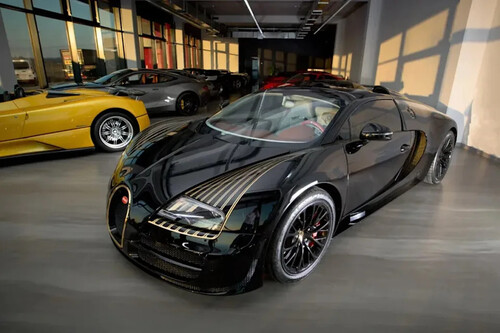
Bugatti Brouillard Homologation: Why The First Solitaire Still Isn't DeliveredA year after Bugatti pulled the sheet off the Brouillard at Quail Lodge, the car still hasn't gone home with the man who paid for it. That isn't a scandal, and it isn't a delay in the normal sense. It's what happens when a manufacturer builds exactly one of something and then has to convince a government it's a car.Start with Molsheim's own words. When Bugatti announced Programme Solitaire on August 7, it described a division capped at two commissions per year, each riding on an existing Bugatti powertrain and chassis with bespoke bodywork and cabin. The Brouillard uses the 1,600 PS quad-turbo W16 and the corresponding carbon fiber and aluminum structure. Design boss Frank Heyl's brief was proportion over aggression — no sharp creases, reflection-driven surfacing meant to read like muscle under a horse's skin, with the lower third rendered dark so the body appears lighter and the wheels larger. It's a genuinely clever bit of visual trickery and it works.Related ArticlesStellantis Patent Adds Crash-Triggered Bumper Beacons For Rolled-Over CarsStone Cold Steve Austin Rolled His Race Rig in the Nevada Desert, and the Supercharged Engine Underneath Is the Real StoryAdvertisementAdvertisementNow the part nobody reads. Buried in Bugatti's year-in-review release from January 7, 2026 is a compliance footnote stating that the Brouillard falls outside EU Directive 1999/94/EC — the consumer fuel-economy labelling rule — because type approval hadn't been granted. That's Bugatti telling you, in regulatory boilerplate, that as of this past January the car was not yet legally a road vehicle anywhere in the European Union.How you homologate a car that exists onceA one-off can't go through normal type approval, because type approval certifies a type. The route is Article 44 of Regulation 2018/858, which covers EU individual vehicle approval. Three details matter to anyone who's ever wondered how these cars get plates. The application can be filed by the owner, the manufacturer, its representative or the importer. Member states are barred from running destructive tests to prove compliance and must work from the applicant's own data instead — meaning nobody is crash-testing a car worth more than the building it was assembled in. And once a valid certificate exists, member states must permit registration and entry into service.That last clause is the finish line. Everything before it is Bugatti assembling a documentation package thick enough to satisfy an approval authority that a hand-built coupé with unique bodywork, unique lighting and a unique roof structure meets the same requirements as something built ten thousand times.AdvertisementAdvertisementWhich brings us to the running. Any car doing final validation on the roads around Molsheim before it has a registration is doing so under a W garage certificate. Article 9 of the French arrêté of February 9, 2009 spells out the permitted uses, and prototypes undergoing study or technical testing sit at the top of the list, along with technical trials and development work from the moment construction is complete. The certificate belongs to the business, not the car, runs for the calendar year, and only covers one vehicle in motion at a time. One more wrinkle worth knowing: under an amendment that took effect January 1, 2026, those temporary plates are now black on pink rather than the old red. If you're scanning spotter photos for provenance clues, the plate color now dates the image.Why the third car beat the first one out the doorHere's the genuinely interesting bit. Bugatti revealed the Destrier on August 6, 2026, and by Monterey it had already been handed over — presented privately to its owner and his family at Pebble Beach before the public saw it at The Quail. Third Solitaire delivered before the first.The explanation is structural. The Destrier is built on the Bolide's carbon monocoque and carries the Bolide's complete W16 package, and Bugatti's own emissions disclosures classify the Bolide as a racing vehicle not intended for public roads. A track car doesn't need individual vehicle approval. It doesn't need a registration. It needs a transporter and a circuit booking. The Brouillard is a road coupé, so it needs all the paperwork the Destrier gets to skip.AdvertisementAdvertisementWhat owners and buyers should actually take from thisBugatti has never published a price for any Solitaire commission, so treat every dollar figure attached to the Brouillard as an outsider's estimate rather than a fact.Related ArticlesTim Curry's Car Collection Remains a Mystery, but Rocky Horror Had a Strange Little GarageDolly Parton's Most Meaningful Vehicles Weren't About FlashThe practical stuff is more useful. Pre-delivery validation on these cars is not a formality — Bugatti has described the final Bolide going through intensive pre-delivery track testing by a dedicated quality team before handover, and the same discipline governs anything leaving Molsheim. Those validation miles land on the odometer, which matters more than it should for a car whose future value partly rests on a delivery-mileage reading.Insurance is where one-offs get awkward. Agreed-value coverage is mandatory here because there is no comparable sale, no auction record and no book. Underwriters price the risk off the repair exposure, and the repair exposure on a one-off is brutal: a cracked splitter or a curbed rocker isn't a part number, it's a tooling job. The W16 underneath is the well-understood part. The bodywork is the liability.AdvertisementAdvertisementThe Brouillard's last public appearance under Bugatti's own banner was its European debut at Wheels Mariënwaerdt in the Netherlands, where the marque noted it stood at the head of more than 30 cars from the Perridon Collection. Read into that what you will about where it's headed once the plates go on.Images Via: ab_mediaaa on Instagram