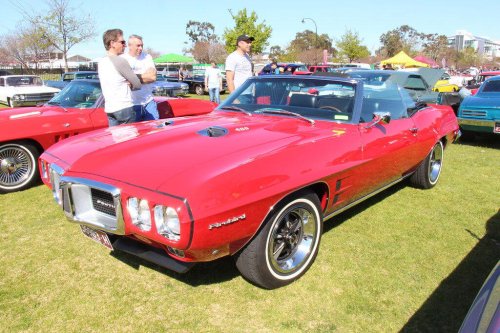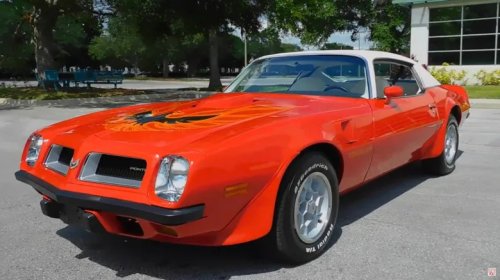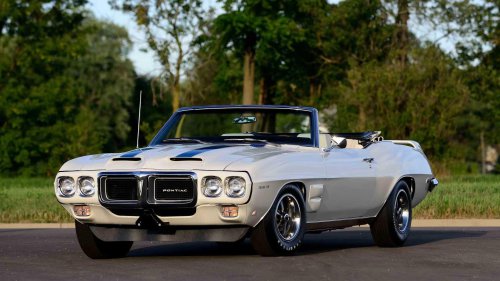
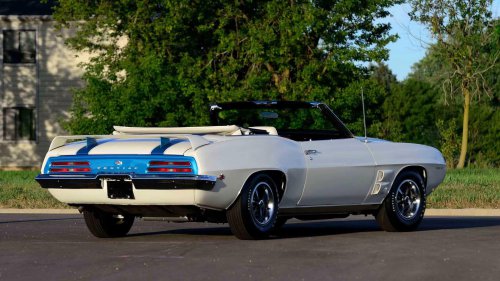
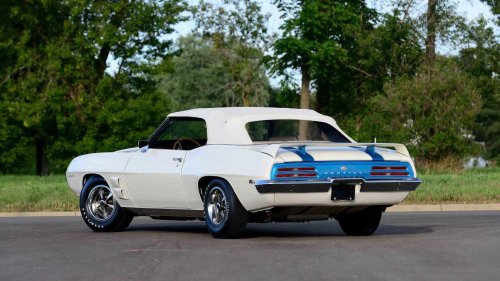
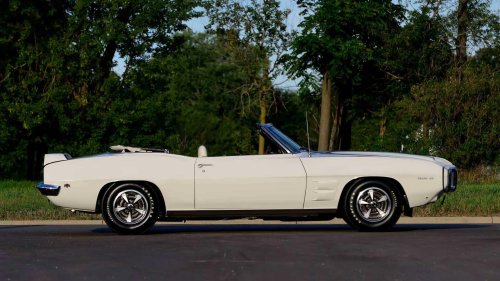
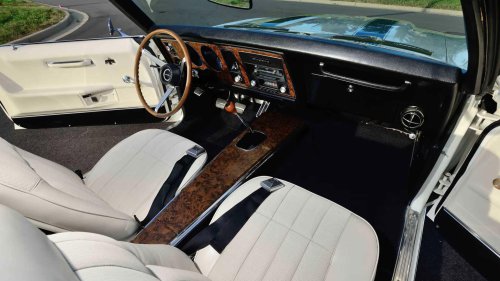
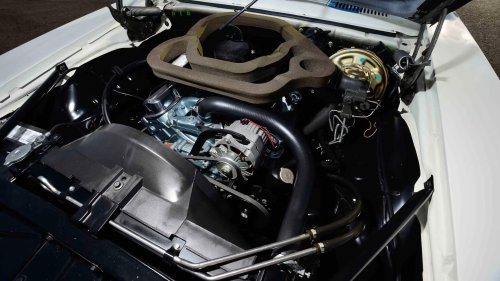
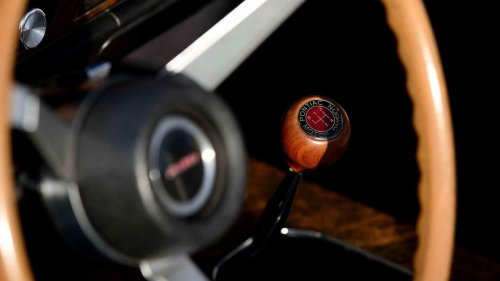

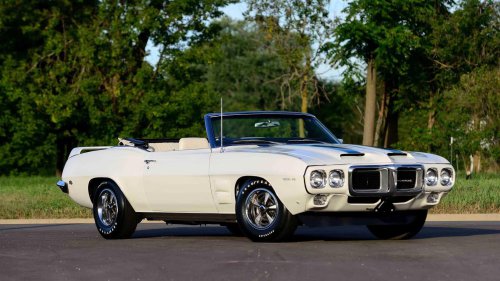
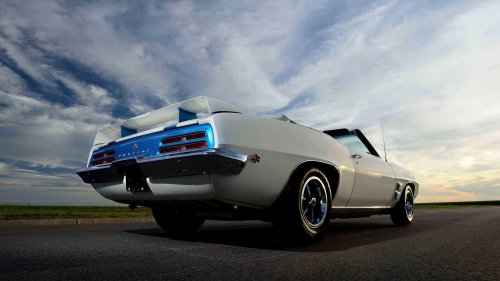



















During the golden era of American muscle cars, Pontiac established itself as a true powerhouse. The brand became synonymous with raw speed and aggressive styling, churning out legendary machines like the GTO and the Firebird that defined a generation of muscle cars.However, tucked away in the shadows of their mass-produced success lies a vehicle so elusive it is often regarded as a myth. While thousands of muscle cars rolled off the assembly lines to roar through suburban streets, this specific Pontiac vanished almost as soon as it arrived, never to be built again. It remains a haunting enigma for collectors today. Why The 1969 Pontiac Firebird Trans Am Convertible Earned Mythical Status Via: Mecum Auctions In the world of classic performance, some cars are legends because of their speed, while others achieve a haunting, spiritual status due to their scarcity. While Pontiac moved nearly 700 Trans Am coupes during the model's inaugural year, the convertible variant exists on the razor's edge of reality.Only eight open-top 1969 Pontiac Firebird Trans Am Convertibles were ever manufactured before the body style was excised from the F-body platform in 1970. This tiny production run makes the vehicle less of a consumer product and more of a spectral presence in automotive history.Via: Mecum AuctionsTo see one is to witness a ghost. Adhering to a strict, uniform aesthetic, all eight units were finished in a chilling Polar White paint scheme accented by dual blue racing stripes. This icy palette, combined with their vanishingly small numbers, is perhaps best fit to call the "Great White Ghost" of the muscle car era. They were born without the fanfare of massive advertising or heavy promotion. Instead, they slipped into the market quietly, destined to become the most sought-after muscle cars among the collector circuit.Via: Mecum Auctions The rarity descends even further into the realm of the impossible when you look at the drivetrain and interior options. Out of the eight cars produced, only four were equipped with a 4-speed manual transmission, making the row-your-own experience a true one-in-a-million opportunity. One specific example even features a Parchment Custom interior, marking it as a true one-of-one masterpiece. They were built just as the convertible era was sunsetting for Pontiac. These eight Trans Am Convertibles represent a final, breathless gasp of high-performance luxury that Pontiac would never truly replicate again. The Rare 69 Trans Am Convertible Was The Last Of Its Kind Via: Mecum Auctions The 1969 model year represented a pivotal moment in Pontiac history. It served as the grand debut for the Trans Am nameplate, yet it also acted as a final curtain call for the first-generation body style. In 1970, the model witnessed a radical transformation.The F-body platform was completely redesigned with a more aerodynamic, European-influenced shape that favored a long hood and a fastback roofline. However, during this transition, the convertible option was unceremoniously dropped from the lineup. This meant there was never a successor to the original 1969 Trans Am convertible, making it a true unicorn of the muscle car era.Via: Mecum Auctions The rarity of this vehicle is difficult to overstate. It sits at the very top of the Pontiac hierarchy, often considered far more elusive than even the most famous GTO variants. To put its scarcity into perspective, the highly coveted 1969 GTO Judge convertible saw 108 units produced. Even the rarest GTO Judge is the convertible from 1971, famous for its low production of just 17 units, seems common when compared to the eight Trans Am convertibles.Because these eight cars represent the only time the Trans Am name was paired with the classic first-generation drop top, collector demand has reached a fever pitch. Enthusiasts view them as the ultimate prize because they capture the raw, aggressive spirit of the sixties just before the industry moved toward the heavier designs of the seventies. They remain the rarest of the rare. The Firebird Trans Am Convertible Used The 400 ci Ram Air III Via: Mecum AuctionsBeneath the chilling Polar White exterior of these rare convertibles lay the heart of a true predator. Every one of the eight units produced came equipped with the formidable Ram Air 400 cubic inch V8 engine, specifically the Ram Air III variant. This naturally aspirated V8 was a masterpiece, officially rated at 335 horsepower.To feed this massive engine, Pontiac equipped all eight convertibles with fully functional Ram Air hood scoops. These dual inlets channeled cold, dense air directly into the carburetor to maximize combustion and ensure the car lived up to its aggressive visual promises. Only four of the eight convertibles used the 4-speed manual transmission, while the remaining four examples featured the three-speed automatic.Via: Mecum Auctions While the Ram Air III was the standard powerhouse for the Trans Am that year, it is often discussed alongside the even more exotic Ram Air IV, with key differences. The latter featured high-flow round-port cylinder heads and a more radical camshaft, pushing the boundaries of what a street-legal Pontiac could achieve. However, the Ram Air III provided a perfect balance of brutal low-end torque and daily drivability that defined the golden age of the brand.Via: Mecum Auctions There is a deep irony embedded in the mechanical identity of this car. It was named after the SCCA Trans-Am racing series, a competition focused on handling and endurance. However, the rules of that series capped engine displacement at 305 cubic inches. Because Pontiac insisted on using the 400 cubic inch V8 to satisfy American buyers' hunger for displacement, the car was technically illegal for the very races that provided its name. It was a performance machine without a home on the professional circuit, further cementing its status as the elusive ghost of the muscle car world. How Valuable Are The Eight Original 1969 Trans Am Convertibles Via: Mecum Auctions Because these vehicles are so elusive, they rarely hit the open market, and when they do, the automotive world stops to watch. To understand their staggering worth, one must look at the broader market. Hagerty currently values a standard 1969 Trans Am coupe in good condition at approximately $182,950. While that is a significant sum for any classic, it is merely a fraction of what the convertible variant commands.The most famous example of this "ghost" car appeared at a Mecum auction in 2016. As the first of the eight ever produced, it reached a high bid of $1.9 million. Despite that astronomical figure, it resulted in no sale, as the owner likely understood that a car of this magnitude is essentially irreplaceable. With the passage of time and the continued rise of high-end collector interest, one can only imagine the figure it would take to actually pry one away from a private collection today.Via: Mecum Auctions According to current Hagerty valuation data, these Trans Am unicorns are worth $835,000 in good condition alone, which is hard to fathom. If you are lucky enough to find a concours condition example, the value soars to $1,450,000. While rare tribute models or high-quality recreations often sell for over $100,000, they cannot touch the prestige of the original eight. For the four lucky owners who possess the manual transmission versions, they hold what is arguably the most valuable piece of Pontiac history in existence.Sources: Mecum, General Motors Archives, Hagerty