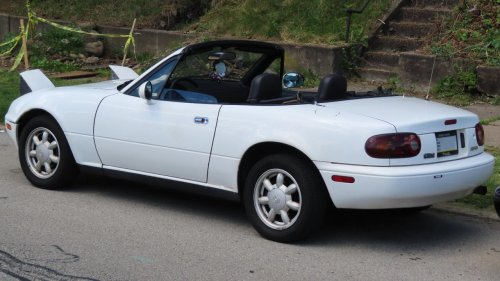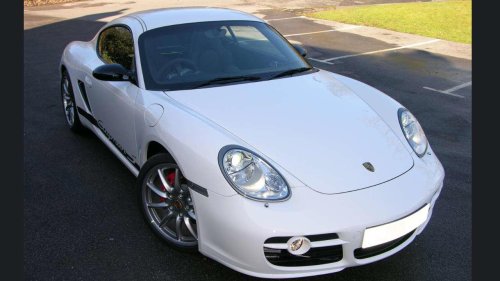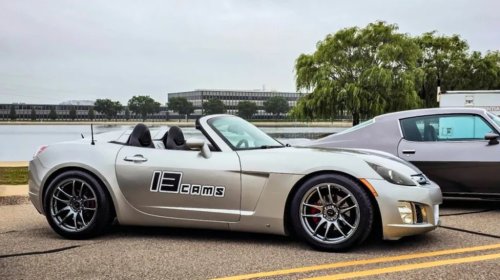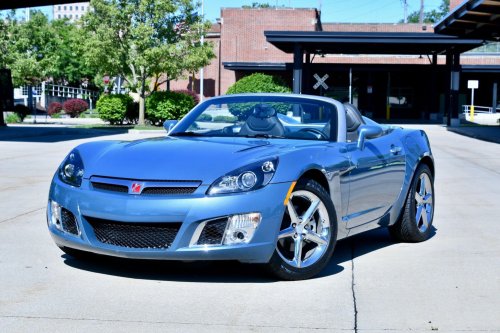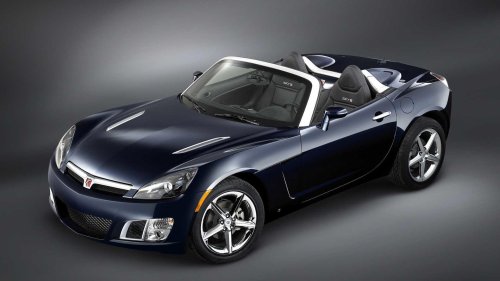
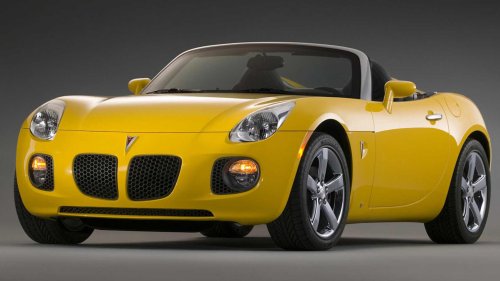
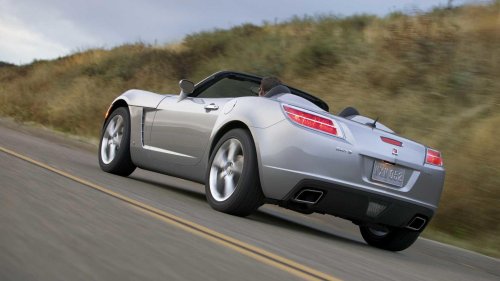
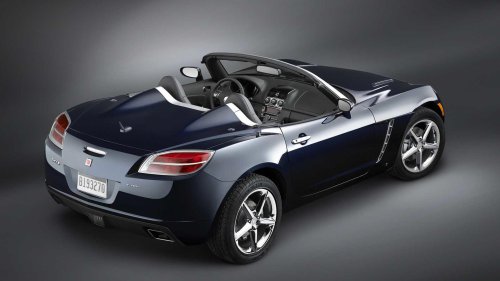



















With the sun starting to make more of a common appearance, the temptation to splash some of your hard-earned cash on some form of drop-top sports car can be difficult to resist. Once you've finally given in to the devil on your shoulder, there comes the decision of which machine to focus your attention on. Powerful six- or eight-cylinder options may quicken your heart rate, but they can cost a ton of money when the time comes to visit the nearest gas station, which will be fairly often.A turbocharged four-cylinder-equipped car provides intoxicating grunt while also being better for your wallet, though many of the options available can perhaps be a little, well, obvious. The Saturn Sky Redline fits the brief nicely, but offers looks and a badge that even seasoned gearheads may have to take a second glance at. As a bonus, it also offers a level of refinement that many driver-focused alternatives struggle to match. Saturn's Slick Sports Car Can Shift Confidently GMThe Sky is one of General Motors' more forgotten experiments, as it was essentially created to provide its Japanese import alternative, the Saturn marque, with a higher-end sports car to attract more attention from the buying public. While it may be easy to assume it was based on one of GM's uninspiring compact or coupe offerings around the mid-2000s, the Sky's potential was immediately boosted by its use of the company's specially designed Kappa platform. Having initially been designed for the Pontiac Solstice sports car, GM decided to extend its use to the Sky.The Sky was offered with either a naturally aspirated 2.4-liter inline-four engine or a more potent turbocharged 2.0-liter unit, depending on the Redline variant. The latter is the one we recommend, not only because its 260 horsepower can get it to 60 mph in a rapid 5.5 seconds, but because it's dialed in to be more driver-friendly. The front-engined, rear-wheel-drive configuration ensured the vehicle provided confidence-inspiring yet balanced handling. At the same time, the choice of either a five-speed automatic or manual transmission made it versatile.The Redline also got an uprated suspension setup, including larger stabilizer bars and stiffer spring tuning, which made it more engaging and agile than its standard sibling. The Redline also looked racier, while handy extras like brake vents cut into the front fenders helped to keep the brakes cool under heavy use. These modifications didn't make the Sky a Miata-beater in the bends, but it was arguably the more stylish option. Plus, it was faster. The Sky Has A Near-Identical Twin PontiacThe Sky may look familiar, and it's not just because the Saturn uses the same underpinnings as the Solstice. Other than the exterior and interior styling, it was essentially a rebadge of Pontiac's offering, though there was more to it than that. The Sky was envisioned as the more luxurious option of the two vehicles, whereas the Solstice would remain as the sportier offering.The Sky was thus graced with more upmarket styling to set it apart from the Solstice, as well as more standard features. Whereas you had to pay extra for a cruise control, limited-slip differential, and a leather steering wheel with the Solstice, all these extras and more were provided at no cost if you opted for a Sky. Aside from that, the two cars shared the same technical underpinnings, including the engine and gearbox. Saturn's Sports Car Is A Bargain In 2026 General MotorsThe Sky Redline wasn't particularly cheap when new, as its $29,785 translates to over $46,000 in today's money. That doesn't mean it's still a costly endeavor today, though, as Hagerty's Valuation Tool reports that you can pick up a tidy example for around $12,700, which is less than half its original MSRP. If you're happy to opt for a machine that needs a bit of work, you can hand over less than $10,000. If cutting to the chase and buying a mint specimen appeals to your tastes, expect to put down north of $30,000.Better-looked-after Skys are valued lower than similar Solstice GXPs. Cheaper examples are priced a few grand higher on average. This shouldn't come as a huge surprise, given that the Sky is the more luxurious and better-equipped. As for the reason why nicer Solstice GXP's are worth more, well, just 8,500 were ever produced, making it rarer than the Saturn, of which just over 11,000 were built. The Sky's Budget Badge Hasn't Helped It Retain Value Saturn Either way, the Sky represents excellent value compared to when it was shiny and new just under two decades ago. The likely reason is that the Saturn badge was never the coolest on the market, primarily because it was established to conquer the affordable compact car market. As a result, a luxury-focused sports car sporting the badge failed to provide the same gravitas as something like an Audi TT or Mercedes-Benz SLK, which were priced higher but sold in much greater numbers.The situation has impacted the vehicle's used value, as it simply doesn't have the same aura as other sports cars from the era. Still, the positive is that you can get a well-equipped, interestingly styled, and fast drop-top sports car for peanuts. The Sky Shouldn't Cost A Lot To Maintain GMBeing so small yet powerful, it runs hot, which puts pressure on the cooling system to keep it at optimal temperature. If the car hasn't been topped up with coolant on a consistent basis, the powerplant can easily overheat and cause severe internal damage. One of the most common weak points once this happens is head gasket failure, which will cause major engine damage unless it's quickly dealt with. When looking for a used example, be sure to examine its service history, as this will tell you whether the engine has been cherished or not.Aside from this, just make sure to check the usual service items that can let any car down. This sentiment is backed up by RepairPal, which reports that you should only have to spend around $459 per year to ensure the Sky can keep living up to its Redline label. There's More Power Waiting To Be Extracted From The Sky SaturnThe Sky Redline also offers plenty of options when it comes to adding more performance to the potion. Even a standard Stage 1 engine remap can unlock north of 40 hp by increasing the turbo's peak boost from 16 psi to 21 psi, a tune that also improves throttle response for a more thrilling driving experience. There are plenty of aftermarket air filters that can also help free up some extra grunt, though we'd recommend investing in an upgraded cooling system if you intend to make such upgrades.Since the engine already runs hot, forcing it to handle extra power and boost could compromise long-term reliability unless you are very careful. Allowing the powerplant to run cooler should help in this regard, while also allowing the engine to run even harder should you so wish. New charge pipes and an enhanced intercooler are popular upgrades in this category, enabling a Sky to give high-end first-gen Porsche Caymans a run for their money. But for a fraction of the price.Doesn't sound like a bad deal, right?