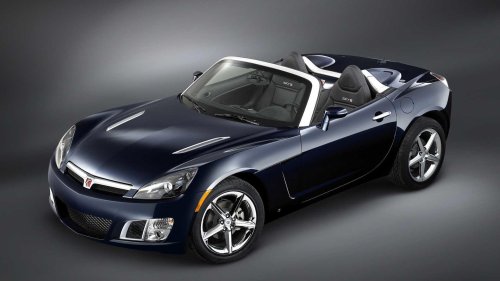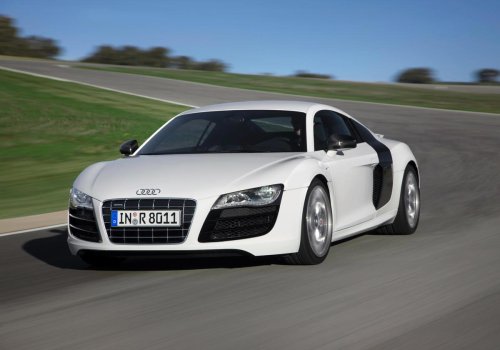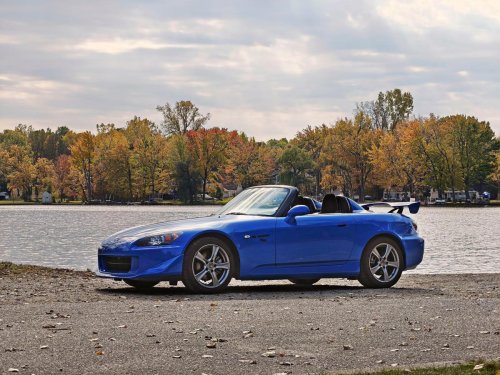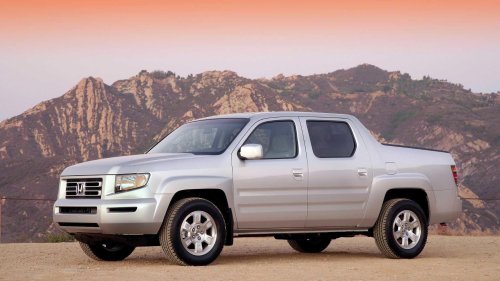
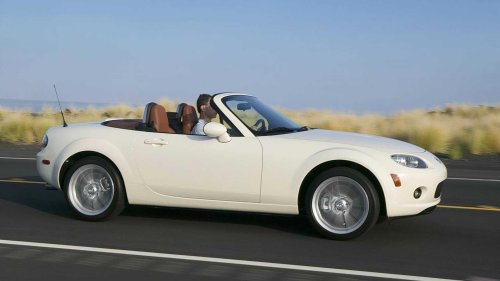
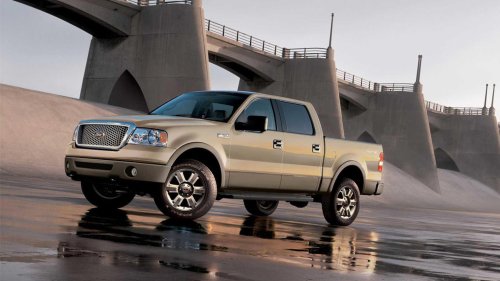
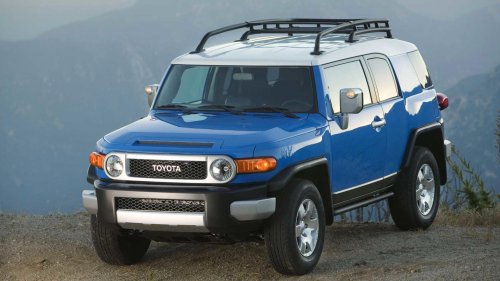



















At the risk of putting you face-to-face with the unstoppable and rapid march of time, 2006 was 20 years ago. Daniel Powter's "Bad Day" was the biggest song of the year; the likes of Casino Royale, Night at the Museum, and Cars were hits in theaters; and the Motorola Razr still occupied the top spot among the list of most popular cell phones.Meanwhile, the world's car manufacturers continued their usual cycle of new products, with 2006 heralding a wide variety of new vehicles. Twenty years later, we are taking a look at some of the biggest new cars of the year, the impact they made, and why you should still care about them today. We focused on models that went into production during the calendar year 2006, or had 2006 as their first model year. We used Kelley Blue Book data for average values in 2026 across all trim levels. Honda Ridgeline The Coolest New Truck 2006 - 2008 Honda Ridgeline - front 3/4 angleHonda's first North American foray into the all-important truck market, the 2006 Honda Ridgeline didn't really look like any other pickup on sale in the US when it was revealed. The Ridgeline wasn't built like any other, either, eschewing the tried-and-true body-on-frame setup for a more car-like unibody construction. The underpinnings led to plenty of die-hard truck fans dismissing it from day one.They were never the audience Honda was chasing with the Ridgeline, though. The automaker wasn't trying to tempt people out of their Rangers, Colorados, and Tacomas, and knew that people doing serious hauling or off-roading would look elsewhere. Instead, the Ridgeline aimed to appease people who wanted to blend the accessibility of a car-based crossover with the utility of a pickup. The admittedly small target audience meant sales were always relatively limited, but those who jumped on board found plenty to like.The unibody chassis meant the Ridgeline had a smoother, more car-like driving experience than its body-on-frame rivals. This factor was naturally a plus for people who'd otherwise have been turned off by inherently truck-ish handling. A front- and rear-independent suspension offered a comfier ride than the leaf springs employed by most rivals. It packed some neat features, too, with the party piece being the lockable trunk that was hidden beneath the regular truck bed. The space allowed for the secure storage of things drivers might not have wanted to have on show in their beds.Performance was decent thanks to a 255-hp, 3.5-liter VTEC-equipped V6, which drove all four wheels via a five-speed automatic transmission. Despite the non-traditional construction, the Ridgeline still performed respectably at typical truck stuff. The towing capacity was 5,000 pounds, and it could take a 1,550-pound payload. What's more, the vehicle has proven reliable in the years since, although the engines in some early cars were occasionally afflicted with a cylinder failure issue.Thanks to a loyal following, the first-generation Ridgeline lived a long life, staying on sale until 2014. Clearly, it was well-received enough for Honda to revive the name for a more conventional-looking (but still unibody) second generation a few years later. The funky looks of those first-generation trucks make them all the more appealing now, especially since 2006 models can be picked up for under $7,000. Mazda Miata (NC) The Hottest Affordable Sports Car 2006-2008 Mazda MX-5 MiataThe sports car market was in a great place in 2006, a year that saw the original Audi R8 and Ferrari 599 go into production. At the lower end of the market, the Porsche Cayman and Pontiac Solstice enjoyed their first model years. Also, fresh for the 2006 model year was an all-new version of the daddy of affordable sports cars: the Mazda Miata.The third-generation Miata (known internally and among fans as the NC model) was noticeably bigger than its petite predecessor. However, through what Mazda called the "gram strategy," where engineers worked to trim away any tiny little bit of mass that wasn't necessary, the new model was only 27 pounds heavier than the old one. The larger size meant more interior space. There were also more safety features, including side airbags standard across the range for the first time. The minor weight gain was also more than made up for with 170 hp made by the new 2.0-liter inline-four engine – a 24-hp gain over the previous generation.Everything else that had made people fall in love with the first two Miatas was still present and correct. There was a beautifully balanced front-engine, rear-wheel drive chassis. The powerplant now sat farther back in the car for a better weight distribution. There was also a standard five-speed manual transmission, an optional six-speed on some trims, and a six-speed automatic joined the range in 2007.Owners could quickly throw the roof back and whizz about with the wind in their hair. It all just happened to be blended with a greater level of usability than the model had ever enjoyed, with a wider range of seat and steering wheel adjustment, and more interior storage.In 2006, the Miata Power Retractable Hard Top launched for the 2007 model year. This, for the first time, added an electrically folding solid roof to the model, further broadening the model's appeal for those willing to trade a few extra pounds for a little more refinement.On sale until 2015, the NC has garnered a perhaps unfair reputation as the least loved of all the Miatas. The fourth-generation model that succeeded it wound up losing even more weight. Arguably, the sharper styling of the new model was more attractive than the rounder NC, too. These factors are relative because the vehicle is still a Miata, a model whose appeal has never really dimmed in the 37 years it's been on sale. That's especially the case when as little as $6,000 can get you into an NC today. Ford F-150 The Bestseller 2006 - 2008 Ford F-150 - front 3/4 angle Things have changed a lot since 2006, but some things seemed destined to stay the same, and the unending popularity of the Ford F-Series truck is one of them. Just as it had been since 1982, and indeed has been since, it was America's favorite vehicle in 2005, during which the 2006 model year had come on song.An eleventh generation of F-150 had been introduced just a couple of years earlier for 2004, and sensibly, Ford hadn't really changed much of what made people love the truck. The company still offered a range of cab styles and bed lengths. The traditional two-door F-150 had been replaced by a model with narrow rear-hinged doors to access the space behind the seats. The trim levels included the workhorse XL and the plush Lariat, which was superseded at the top of the range by the King Ranch for 2005.By 2006, the base powerplant was a 4.2-liter V6. There were also two versions of the much-lauded Modular V8, displacing 4.6 or 5.4 liters, featuring the truck-specific Triton branding. A move to rack-and-pinion steering, meanwhile, helped make the new truck easier to live with during day-to-day driving.The F-150 remained pretty much the same for 2006, where changes were minimal. The front bumper received a light redesign, and a Flex-Fuel version of the range-topping 5.4-liter V8, capable of running on E85 ethanol-blended gas, was added. Perhaps the biggest change was the return of the high-end Harley-Davidson edition, one of a series of collaborations between Ford and the Milwaukee motorbike manufacturer.The evolution, not revolution, approach then helped the F-150 retain its insurmountable spot as America's favorite vehicle. The result goes to show that the American market really isn't so different now from the way it was in 2006 – or even 1982. Nowadays, a basic regular-cab 2006 F-150 will set you back from around $6,000, with the most coveted versions like the Harley-Davidson upping that entry point to around $10,000. Toyota FJ Cruiser The Investor's Choice 2007 Toyota FJ CruiserAs much as we believe cars are for driving, we all sometimes wish we had a crystal ball that would tell us which new car to buy now and stash away, with a view to checking out with a healthy wad of cash years down the line. Had such a thing existed in 2006, there's a good chance it would have told us to buy a Toyota FJ Cruiser.Arriving as part of the wave of retro-styled cars kicked off by the Volkswagen New Beetle, it seemed like a recipe for success: take the proven, off-road capable underpinnings of a 4Runner, and drape them in vintage-tinged bodywork inspired by the iconic 1960s FJ-series Land Cruiser.The reception to a concept version shown off at the 2005 Chicago Auto Show was so overwhelmingly positive that the decision was quickly made to put the SUV into production in near-unchanged form. The first of them were 2007 model year products, but were on sale during the 2006 calendar year. Power came from a 4.0-liter, 239 hp V6, and while pricing started at $21,710, that would only get you an automatic, rear-wheel-drive version. The one you really wanted, a manual 4x4, kicked off at a still-reasonable $22,980.Once the FJ Cruiser actually went on sale, though, things went less well. It had a decent 2007 model year, but beyond that, sales routinely struggled to top 20,000 a year, when the Jeep Wrangler was regularly doing four or five times that.Folks who bought FJ Cruisers, though, loved them, and for good reason. They combined the highly capable underpinnings of the 4Runner and the legendary Toyota reliability with styling that was just darn cool, which was a surefire route to a cult following. These factors perhaps account for the FJ Cruiser's remarkably long production run, which lasted from the 2007 to 2014 model years in the US but stayed in production until 2022 in some markets.Since then, multiple factors have come together to make FJ Cruiser values go haywire. Its relative scarcity, reliability, and funky looks, combined with an explosion in the overlanding scene and the market for adventure-capable 4x4s, have made it one of the most sought-after trucks of its era.While Kelley Blue Book puts the fair market value of a 2007 model as low as $13,450, it's not unusual to see later, cleaner models listed well north of $40,000, asseen on CarBuzz's marketplace. Given that's more than the original 2007 MSRP – even adjusted for inflation – anyone who bought one new 20 years ago and kept usage to a minimum must be feeling pretty pleased with themselves today.