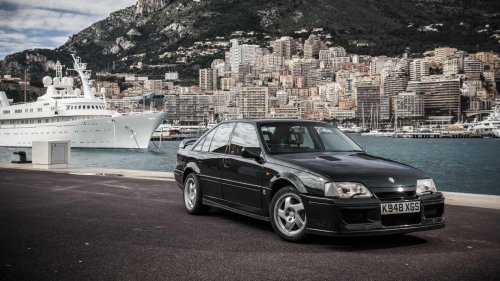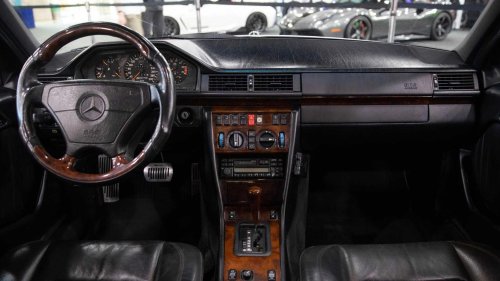
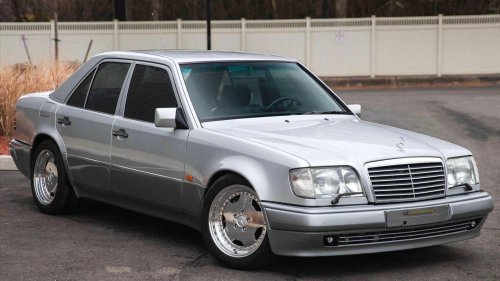
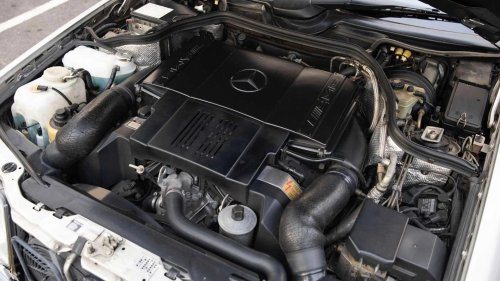
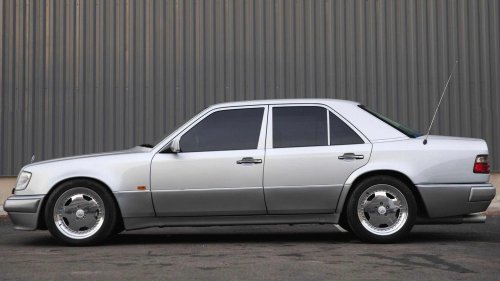
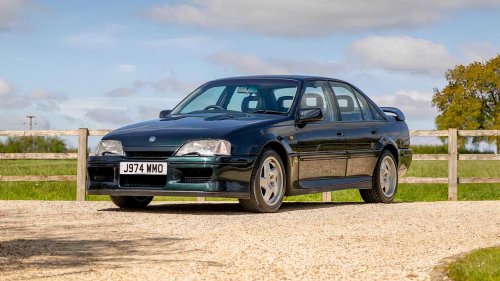
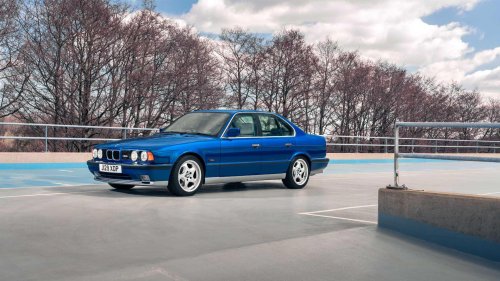
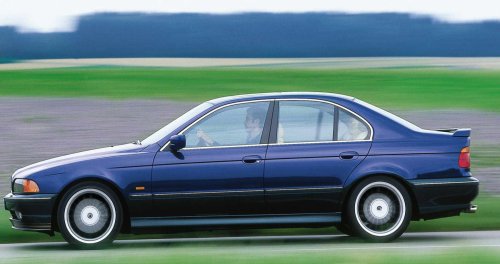
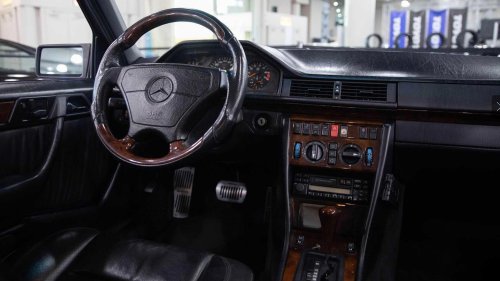
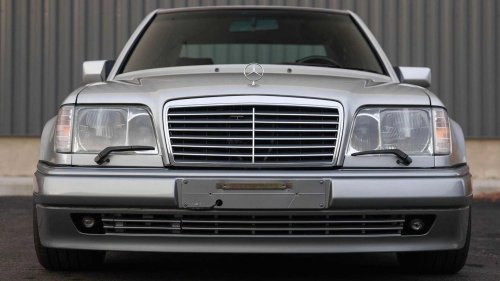
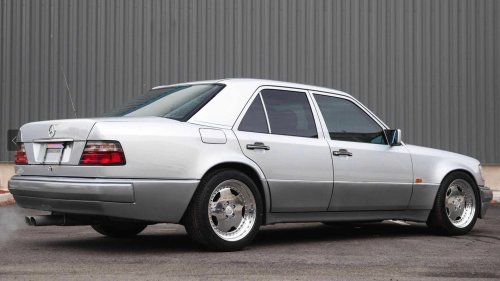



















Cast your mind back to the 1990s performance car landscape. The Supra Turbo was making headlines. The Honda NSX was rewriting what a supercar could be. Ferrari was doing Ferrari things. And the car press was largely busy chasing all of it.But while that conversation was happening, a certain Mercedes saloon was sitting on the road wearing its corporate clothes, blending into traffic with the kind of presence that gave absolutely nothing away. It looked like something a well-paid accountant might lease. It had four doors, a sensible stance, and not a single styling flourish that would cause a second glance. And underneath all of that? Something quite spectacular.Fewer than 150 of these sleeper cars were ever produced in any form, and the number of true factory-built examples is believed to be a fraction of that. Most people who drove alongside one in the 1990s had no idea what they were looking at. A lot of car enthusiasts still don't. That changes now. How Mercedes Built the Blueprint for the Ultimate Sleeper Via: Cars and Bids Before we get to the star of the show, you need to understand its foundation, because this story actually starts a few years earlier, and it starts with Porsche. In 1990, Mercedes-Benz introduced the 500E. On the surface, it was an E-Class saloon. But fitting a 5.0-liter V8 from the SL-Class into the narrower W124 body required serious engineering, and Mercedes turned to Porsche to solve it. Porsche engineers sorted the packaging problem and then went a step further, hand-building every 500E at the Zuffenhausen facility before shipping each car back to Mercedes' Sindelfingen plant for final finishing. The whole process took 18 days per car.The result was a 322 hp saloon that looked, to the untrained eye, like any standard E-Class on the road. The car press was immediately onto it, and the 500E earned a reputation as one of the finest drivers' saloons of its era. But it wasn't the end of the story. Not even close.AMG was still an independent tuning house in the early 1990s, years before Mercedes absorbed it in 1999, and they had been watching. They had a rather better idea of where to go next. If you want a deeper look at how the 500E came together, TopSpeed has a thorough breakdown of the W124's history and its Porsche connection worth reading. Meet the Mercedes-Benz E60 AMG: The W124 in Its Ultimate Form Via: Cars and Bids So here it is. The Mercedes-Benz E60 AMG. The car that took the 500E's already formidable foundation and did something extraordinary with it.Produced in extremely limited numbers between 1993 and 1995, the E60 AMG was the product of AMG operating at the peak of its independent, uncompromising era. The starting point was a customer ordering a standard E500 and ticking option code 957, the AMG Technik-Paket, at a cost equivalent to around $22,000 in today's money on top of the base price. When that box was ticked, the W124 chassis would be routed from Porsche in Zuffenhausen, through the Mercedes paint shop in Sindelfingen, and then north to AMG's Affalterbach factory. As we covered in our look at the greatest sleepers, very few factory performance cars of this era pulled off the sleeper trick as convincingly as the E60. What AMG Actually Did To It Via: Cars and Bids AMG replaced the 5.0-liter V8 with a hand-built 6.0-liter version of the same M119 engine, producing 381 hp and 428 lb-ft of torque, a gain of 59 hp and 74 lb-ft over the 500E it started life as. AMG also reworked the suspension with uprated sway bars, springs, and dampers, added a bespoke exhaust with polished twin square tips, and widened the front track by 1.5 inches while dropping the ride height by 0.9 inches.Most documented examples also carried the 958 Limited appearance package, which added 17-inch forged wheels originally developed for the 190E Evo II, plus two-tone black and gray leather across the seats, steering wheel, gear shifter, and owner's manual pouch. From the outside? Still just an E-Class. Nothing gave it away. That was entirely the point. How The E60 AMG Stacked Up Against Its Contemporary Rivals Via: Cars and BidsThe early-to-mid 1990s produced a handful of extraordinary performance saloons, and the E60 AMG arrived right in the middle of that era. On paper, it sat in genuinely elite company and it held its own against every one of them. The Lotus Carlton Historic Auctioneers The most obvious benchmark is the Lotus Carlton, built between 1990 and 1992 in a run of around 950 cars. Lotus took a Vauxhall Carlton, enlarged the Opel straight-six to 3.6 liters, bolted on twin Garrett T25 turbochargers, and produced 377 hp and 419 lb-ft of torque through a six-speed ZF manual, the same transmission used in the Corvette ZR-1. The result was a 176 mph saloon that was quicker in a straight line than the E60 AMG and sparked genuine controversy in the UK press over whether a family car should be capable of those speeds. It was a sledgehammer where the E60 was a scalpel.The Carlton traded subtlety for outright speed; the AMG gave up nothing in the other direction and stayed entirely invisible doing it. As TopSpeed has detailed in its coverage of the Lotus Carlton, the car was so fast it outran pursuing police vehicles and ended up the subject of a parliamentary debate. The BMW E34 M5 BMW The BMW E34 M5 was the mainstream benchmark for the performance saloon segment throughout this period. In its final 1994 specification, it produced 340 hp from a 3.8-liter naturally aspirated straight-six, with a 0-60 mph time of around 5.9 seconds and a limited top speed of 155 mph. It was the driver's choice: six-speed manual, rear-wheel drive, with handling credentials that the automatic E60 AMG couldn't directly match. But the M5 was also significantly less powerful, far more recognisable, and available in considerably greater numbers.The E60 AMG was rarer, faster in a straight line, and had the significant advantage of looking completely unremarkable. HotCars' breakdown of the greatest BMW M5 generations puts the E34 in context as one of the finest M cars ever built, which makes the E60 AMG's ability to match and better it on power all the more striking. The Alpina B10 Biturbo alpina-automobiles.com The car that perhaps came closest to the E60 AMG's overall formula was the Alpina B10 Biturbo, built on the E34 platform between 1989 and 1994 in a run of just 507 examples. Alpina fitted twin Garrett turbochargers to a modified BMW M30 engine to produce 355 hp and 384 lb-ft, with a claimed 0-62 mph time of 5.6 seconds and a top speed in excess of 180 mph. Like the E60 AMG, it was a hand-built, low-volume specialist car that wore its performance entirely on the inside. The B10 Biturbo was quicker at the top end, but it came at nearly twice the price of an E34 M5 and was far less anonymous in appearance than the AMG. Just How Rare Is the E60 AMG? Via: Cars and Bids This is where the numbers get genuinely remarkable. Record-keeping from AMG during this era was famously inconsistent, and Mercedes has never published official production totals. What the experts and collectors broadly agree on is that somewhere between 100 and 150 cars were produced across all configurations, but of those, only around 45 are believed to be true factory-built examples carrying the proper 957 option code on their build sheet, as confirmed by Hagerty's deep-dive on the E60 AMG.The distinction is critical. A significant number of E500 cars were subsequently converted to approximate E60 specification, by AMG and by independent workshops, after the fact. A genuine factory E60 AMG carries the 957 designation on its data card, proof it was routed through Affalterbach from new, not upgraded later. Get that paperwork wrong and you are looking at a very different car in collector terms.The original sticker price tells the full story of what this car was. According to market data, a fully optioned E60 AMG cost $108,700 at the time, equivalent to around $236,300 today. This was not a sleeper by accident. It was a car built in tiny numbers, available only to those who knew to ask for it, with no marketing push and no press release moment. What The Mercedes E60 AMG Is Worth Today Via: Cars and BidsCollector values for the E60 AMG have risen sharply, driven by growing appetite for pre-merger AMG cars alongside the wider boom in 1990s performance vehicles. Provenance is everything here. A documented, factory-coded 957 car commands a serious premium over conversions, and buyers absolutely need to verify authenticity before committing.Recent auction data tracked by Classic.com shows an E60 AMG selling for $124,444 in May 2023, while a separate Broad Arrow Auctions listing in March 2024 attracted a highest bid of $108,000 before going unsold. An RM Sotheby's sale in 2020 achieved $93,500 for another example. At the top end, private asking prices on immaculate, low-mileage cars have climbed well into the $200,000-plus territory.Put the original $108,700 new car price alongside today's market and it makes sense. The best examples have broadly held their value in real terms over 30 years. But the market is still finding its level, and with only 45 or so true factory examples believed to exist, supply is as tight as it gets. The E60 AMG's Place in AMG History Via: Cars and Bids The E60 AMG sits at a specific and unrepeatable point in the timeline. AMG was still independent, still hand-building engines one at a time, still operating with the kind of conviction that only a small specialist outfit can sustain. This car arrived just before the pre-merger generation gave way to officially badged AMG products, and it represents the last full expression of that independent spirit at its very best.When Mercedes completed its acquisition of AMG in 1999, the brand became something bigger and more systematic. The cars got faster and far more numerous. But the hand-built intimacy, the tiny production numbers, the routing of individual cars through three separate factories to reach final spec: none of that survived the transition. You simply cannot replicate what the E60 AMG was within a large corporate structure.It also had the misfortune of arriving at the very end of the W124's life cycle, meaning it barely had time to build a public profile before it was gone. The W210 that replaced the W124 in 1995 dominated the conversation instantly. The E60 AMG slipped out of production almost without trace. A handful of cars. A handful of owners. Almost no press coverage at the time. Its absence from the mainstream performance car narrative remains one of the great oversights of the era.The collector market is correcting that now. As pre-merger AMG cars attract serious attention, with Hammer variants trading for hundreds of thousands at auction, the E60 AMG is finally getting the recognition it has always deserved. It spent three decades in relative obscurity. That era is over.Sources: Hagerty, Classic.com, Broad Arrow Auctions, automobile-catalog.com, RM Sotheby's, Lotus, Autoevolution, Mecum, Bring a Trailer.