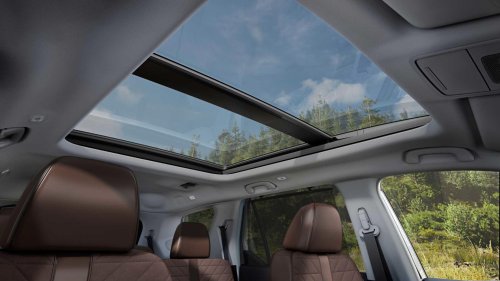
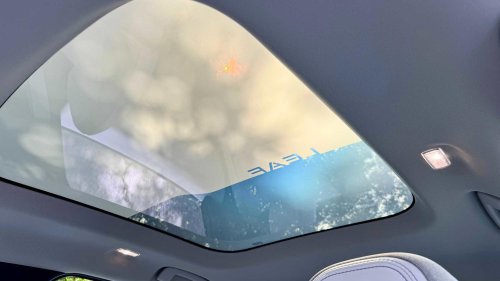
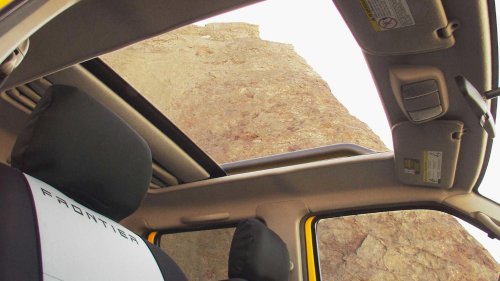
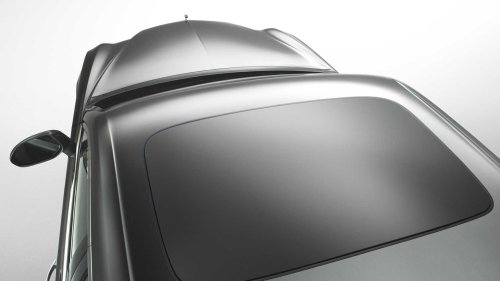



















Jump LinksSunroof: Big Departure From Original MeaningMoonroof: Common Sight On Modern VehiclesThe phrase sunroof or moonroof may appear on a regular basis when you are looking through the spec sheet of a new vehicle. While in modern people's minds those terms simply mean the difference between a fixed glass roof that you would find on vehicles such as a Tesla Model Y or an opening glass roof on certain luxury vehicles, the terms actually meant something quite different when they first came along.No matter whether you're trying to catch a breeze of fresh air while driving or letting in more sunlight that'll brighten your day, a sunroof or moonroof is a lovely feature that you wouldn't want to miss in your car. In case you are wondering how the difference between sunroof and moonroof might be, we are here to walk you through how their meanings have changed, their original purpose, and the types of roof that are commonly found on modern vehicles.This article examines the key differences between sunroof and moonroof according to their original meaning with an explanation of their current definition. The article also includes different types of sunroof and moonroof that can be found on modern vehicles. All information has been sourced from the manufacturer and credible sources. Sunroof & Moonroof: What Are They Really? Sunroof: Big Departure From Original Meaning 2026 Honda PilotA sunroof, in the modern world, normally refers to as any panel that is installed into the roof of a vehicle that can be manually or electronically opened to allow airflow or light into the vehicle. It is a common feature that can be found on many luxury vehicles or higher-spec models. Having a roof that can be opened brings plenty of benefits to the vehicle itself, such as natural airflow that helps keep the cabin cool and fresh even without the air conditioning turned on. When the vehicle is parked under the sun for a long period of time, the benefit of having a sunroof also allows you to release the heat that was trapped inside the vehicle faster compared to a vehicle without a sunroof.The other obvious benefits include the extra sunlight that helps light up the cabin and provides a better view while driving. While all the benefits above are valid for a sunroof, the term itself was not exactly the same when it was first introduced on a vehicle. A sunroof originally referred to an opaque panel that could be removed from the vehicle itself, often made out of canvas or metal. The traditional sunroofs normally match the color of the vehicle's exterior and block the sunlight directly when closed. To put it simply, the 'sun' in the sunroof basically means no light or air when the roof is closed, marking its differences from the modern definition clearly. Moonroof: Common Sight On Modern Vehicles Jared Rosenholtz/CarBuzz/Valnet While the original and modern definition of a sunroof can be a bit confusing to some people, a moonroof is more straightforward and easy to understand. It is a type of transparent or tinted glass panel that cannot be removed from the vehicle itself. The feature itself has become a common sight on modern vehicles, such as the panoramic roof that we see on Tesla models and newer electric vehicles."The feature has become mainstream and has now grown, quite literally, into one of the biggest trends and glass panels you'll find on modern cars."- Roger Biermann, Managing Editor, CarBuzzThe key benefit of a moonroof is its ability to allow natural light into the cabin even without opening the roof itself. The lack of a sliding mechanism on certain models also reduces the complexity and maintenance cost of the vehicle. However, due to the fact that no car manufacturers sell a car with a removable opaque roof anymore, the terms sunroof and moonroof are used interchangeably in modern society. Sunroof vs Moonroof On A Car: Key Differences Explained 2001-2004 Nissan Frontier InteriorBut while the terms mean practically the same thing now, there are still some key differences that we can use to tell them apart -- the first being the material that the roof is made of. Traditionally, the material of a sunroof would be a solid opaque panel that is made from either canvas or metal. A moonroof on the other hand, is made mainly from tinted glass to allow sunlight to pass through into the cabin. The simplest way to differentiate them is to remember that the sunroof will block the sunlight from entering the cabin and the moonroof is a glass panel that you can see through and allows light to pass through into the cabin.Another key difference apart from the visibility is the operation of the roof itself. While it's no longer a common sight on many modern vehicles, a sunroof is removable on certain models. The feature can be found on some early iconic sports car models, such as the Toyota Supra or Nissan 300ZX as they both have a sunroof that can be removed from the vehicle itself. The moonroof is another different story. While it can tilt or slide open on certain vehicles, it can't be removed from the vehicle itself, which marks another key difference.However, it's worth noting that all the differences we have mentioned above are based on the original definition of the sunroof and moonroof. In the modern world, where the boundaries have become blurred, not all the differences above apply to the sunroof and moonroof as they are used interchangeably nowadays. Sunroof And Moonroof Types In 2026 2011 Bentley Mulsanne Top View SunroofDespite the close relationship between the sunroof and moonroof, car manufacturers still manage to produce different types of each with their own unique characteristics and functions. Here are several different types of sunroof and moonroof that are commonly found on modern vehicles.Built-in: This is a type of roof design that's commonly found on luxury vehicles. The roof can be retracted electronically between the roof and the headliner. There is another option that raises the rear of the panel to allow airflow through the cabin. Spoiler: The most common roof design that can be found in modern vehicles due to its lower cost. The spoiler roof has a glass panel that slides or pops up for ventilation. But unlike the built-in sunroof, the glass roof is not stowed between the roof and the headlinder, it slides open above the vehicle's roof. Pop-up: Pretty self-explanatory, the pop-up roof is a type of roof that pops open at the back to allow airflow or ventilation into the cabin. Being the simplest and oldest roof design, the pop-up roof is normally found on earlier models such as the BMW E30 or older Honda Civic. Lamella: A type of roof design that features numerous opaque panels or glass panels that slide back like Venetian blinds to allow ventilation. The design was later proven problematic due to its complexity, only offered on a couple of models such as the Mercedes-Benz ML SUV and Pontiac G6. Panoramic: The most common roof design that can be found on modern vehicles. A panoramic roof normally spans the length of the cabin, allowing more sunlight to enter the cabin. The front section can be opened on certain models, while other models such as the Lucid Air offer a fixed-glass roof. Folding Fabric: A feature that's more commonly found in European models such as the Fiat 500 or Citroën's iconic 2CV. The roof is made from fabric and retracts backward, which creates a bigger opening when compared to conventional sunroof. Electrochromic Dimmable: A type of moonroof that can dim itself without a physical sunshade. A new type of roof that can be found on premium models such as the Porsche Taycan or BMW iX. The glass roof of the vehicle can change its transparency electronically depending on the mode selected by the driver.