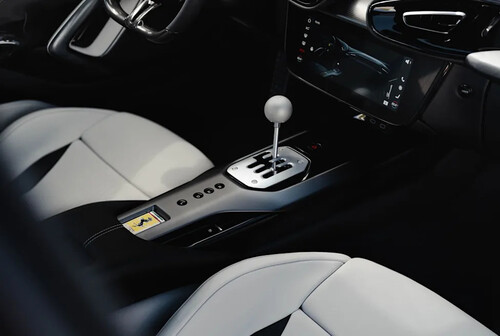
5-speed manual transmission shifter on blurred backgroundIf you're shopping for a new car or you're looking to get into trucking or logistics, you've probably seen the term "automated manual transmission" pop up once or twice. Obviously, it's different from a traditional manual, otherwise there would be no need to bother with the distinction. It's also not an automatic, at least not in the usual sense. As the name implies, an automated transmission, or AMT, offers a certain level of automation over a common manual transmission; the specific amount of automation varies from gearbox to gearbox, but all AMTs generally include automatically controlling the clutch.It's that clutch which separates automatics from manuals. Having a third pedal, something that's getting increasingly common in modern cars, is a point of pride of many enthusiasts; others enjoy the speed and convenience of computerized operation. And it's true – a computer will operate a clutch faster than any human ever could, but that's not the sole reason behind why AMTs exist, or indeed the only difference between one and a standard manual. Some AMTs automate shifting entirely, rendering it effectively an automatic with a manual mode, meaning you need different connections between the shifter and transmission itself.In truth, there are pros and cons for each style of transmission, especially when it comes to specific driving conditions. Standard manual transmissions do better in city driving where precise clutch control is valued, whereas the automation of an AMT helps boost fuel economy on longer journeys. Despite looking and functioning superficially similarly, these transmissions are a world apart; here's why. How AMTs and manuals workInternal gear mechanism of manual and AMT gearboxesBoth transmissions, at least on the surface, perform identical functions. They each have a clutch, flywheel, and a standard gearbox, as opposed to the planetary gearbox in an automatic transmission, which functions entirely differently.The main difference lies in driver interaction. In a typical manual transmission, the driver operates the clutch pedal to manually press the clutch with the flywheel, transferring power from engine to transmission. The more the pedal is pressed down, the more disconnected it is. A driver must engage the clutch when setting off or changing gear, allowing the engine to spin at a different speed than the transmission before the latter catches up or slows down to match. That's the clutch's job, and it's identical for both transmission types.AMTs simply automate this process, as the name suggests, eliminating the need for a clutch pedal. The level of automation varies from car to car; for instance, Saab's Sensonic transmission still has a traditional H-pattern shifter, with the only automation being the clutch itself. More modern passenger car systems offer what is often labelled as a traditional D gear (sometimes A), effectively turning the AMT into a traditional automatic as far as the driver's concerned. The same applies to the trucking industry, where companies like Detroit and Cummins are fielding AMTs built specifically for logistics services.Because modern AMTs generally shift electronically, there's no direct connection to the transmission like there is with a manual shifter. Instead, you shift an AMT by a directional shift handle, paddle shifters, or other indirect means, with the car's computer doing all the hard work for you. Pros and cons of AMTsAMT shifter, right-side viewStarting with the obvious: AMTs benefit drivers who are working long shifts and would otherwise be constantly changing gear in traffic. Let's say you want to be a trucker, and you end up working in the city for eight hours. Would you rather be pressing a heavy clutch and rowing through high and low gears all day long, or letting the AMT do the work? We're only human. We're not perfect, we won't do optimal gear changes every time, we won't always be in the correct gear, and we'll get tired. AMTs directly address this, promising improvements in fuel efficiency, driver fatigue, and engine wear.Moreover, because an AMT is computerized, it combines the benefits of an automatic and manual, at least in theory. An AMT will invariably shift more smoothly than any human could, but the computer still needs time to think about it, leading some to be labeled as feeling laggy. Likewise, AMTs lack the flexibility of a traditional manual, meaning they don't do well under hard acceleration or towing heavy loads when they have to shift down multiple gears. Put simply, AMTs don't have crystal balls; they can't anticipate what a driver is about to do like some dual-clutch automatics can, only reacting to what the driver is currently doing via data inputs.There are various methods used to mitigate these issues. For instance, ZF offers manual clutch control systems for use in urban applications like buses. Passenger cars still have more trouble, often requiring use of the handbrake to keep the car from moving when you let your foot off the brake on a hill, much like a manual car with the clutch in. The solution here is, simply put: Practice makes perfect. Want the latest in tech and auto trends? Subscribe to our free newsletter for the latest headlines, expert guides, and how-to tips, one email at a time. You can also add us as a preferred search source on Google.