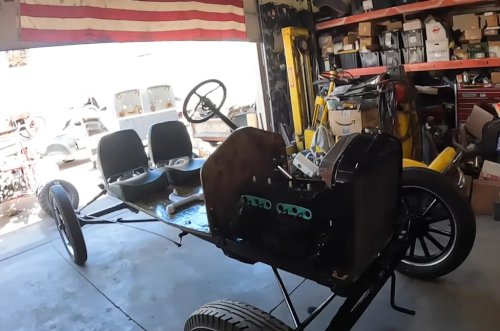
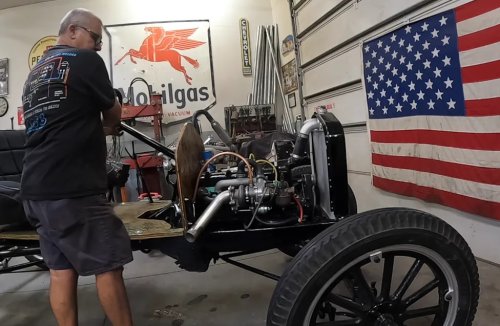
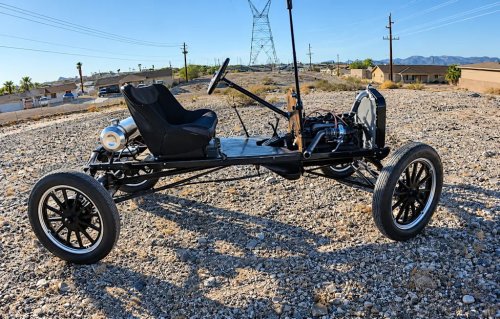



















Mad Scientist Straps a Tractor Turbo to a 100-Year-Old Ford Model T—and It Actually WorksMotorBiscuitRahaan MazumderThu, September 10, 2026 at 3:00 PM UTCAdd us on GoogleThe Ford Model T is the car that famously put America on wheels. With its primitive 2.9-liter sidevalve inline-four engine, wooden spoke wheels, and a top speed that routinely gets passed by modern e-bikes, it is a relic of early automotive history. But what happens when you introduce Henry Ford's 100-year-old engineering to forced induction?Mechanic Merlin from the YouTube channel Merlins Old School Garage decided to find out."I'm doing something crazy," Merlin admitted early in his recent build video. "I've decided I am going to turbocharge a Model T".Now, building a custom forced-induction system for an antique car is a logistical nightmare. Because the engine was never designed to handle extra pressure. From the factory, a brand-new Model T made roughly 20 horsepower. However, accounting for a century of wear and drivetrain loss, Merlin's "Project X" car was putting out significantly less.AdvertisementAdvertisement"Originally these cars made about 20 horsepower; I've had them on the dyno, they make 12 to the ground," he noted.But the biggest hurdle wasn't just fabricating a custom manifold—it was keeping the turbocharger from immediately blowing up. Turbos require a steady, highly pressurized flow of oil to keep their bearings lubricated while spinning at tens of thousands of RPMs."Fun fact: Model T's don't have an oil pump; they don't have oil pressure," Merlin explained.To bypass the Model T's primitive "splash" lubrication system, Merlin engineered a wild DIY fix. He tapped a fitting into the engine block so that centrifugal force from the spinning flywheel would throw oil up into a custom copper tube. That tube feeds oil directly into the top of the turbocharger before a gravity drain siphons it back into the front of the engine block.Sourcing a Tractor Part and The Road TestTo match the incredibly low exhaust flow of the antique engine, a massive modern car turbo simply wouldn't spool. Instead, Merlin sourced a tiny unit from heavy machinery.AdvertisementAdvertisement"This turbo is from a Kubota tractor 3-cylinder," he revealed.After fabricating a low-rise intake manifold that mounted upside down and attaching a wastegate, he hooked the entire contraption back up to the original Model T carburetor. Against all odds, it fired right up.Taking the century-old, open-cab vehicle out onto the streets of Havasu, the tiny Kubota turbo actually managed to spool up and push air into the engine without immediately blowing a head gasket."That was a little over 28 mph; it was headed for 30," Merlin said from behind the wheel, fighting the bouncy suspension. "We picked up 5 m an hour with the turbo".AdvertisementAdvertisementBy the end of his multi-mile test run, the setup proved to be a hilarious, completely functional success. "It actually pulls about 6 lbs of boost, and it's happy," he confirmed.As he shut off the engine back in the shop, viewers could clearly hear the iconic, high-pitched whine of the turbo spinning down. It's an incredibly modern sound coming from a vehicle that predates the Great Depression. While Merlin admits the turbo will likely wear out prematurely due to the low-pressure oiling trick, the sheer fact that a 1920s engine can handle forced induction is an absolute mechanical marvel.