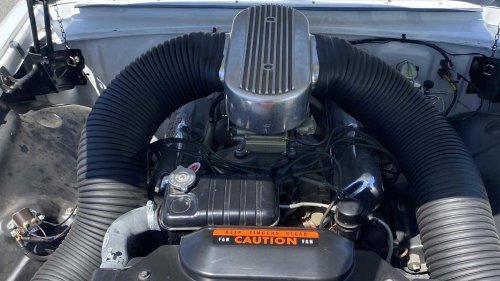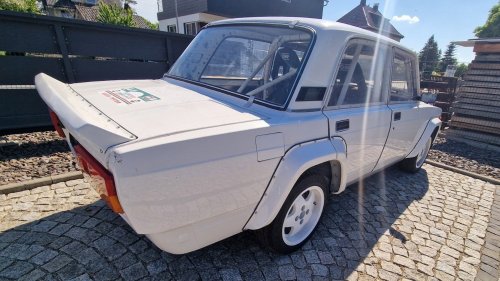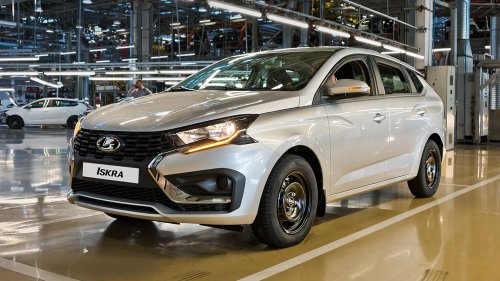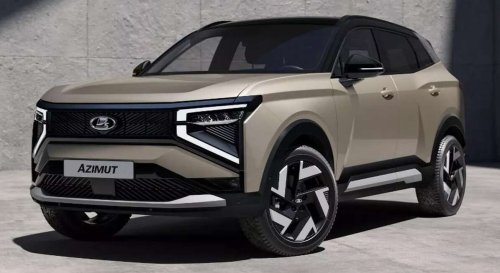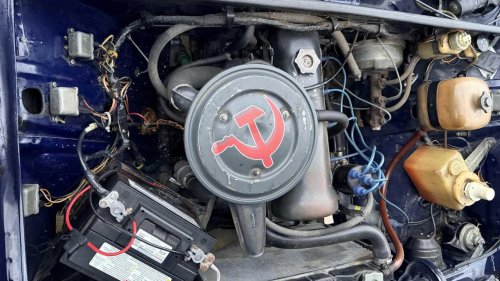
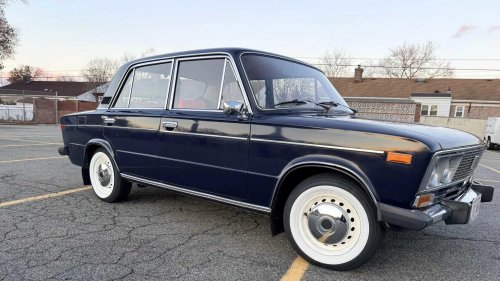
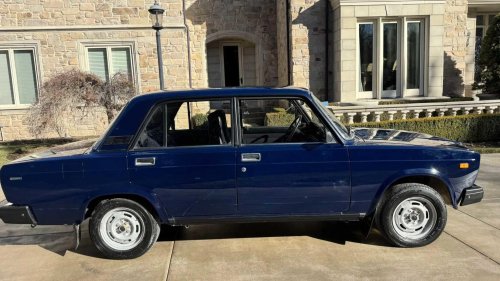
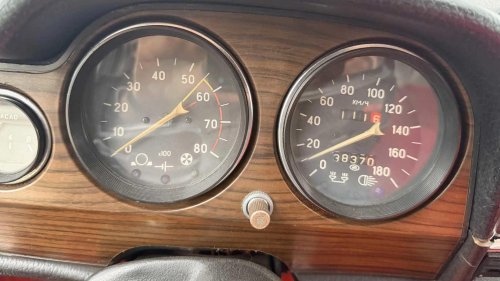
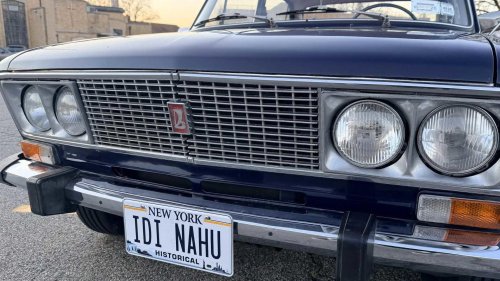



















You've probably got a few gearhead friends with a taste for the exotic. Maybe they've got an imported Nissan Skyline, or they've got their eye on something European, like a charming little Renault or a German-spec Volkswagen Beetle or even a Suzuki Carry for farm work. These collectors are almost never all that interested in Soviet-era city cars, though, are they? Dacia, Lada, Zaporozhets, these sound less like automakers to the American ear than like the names of Russian satellites.It's fitting, because, culturally speaking, Russia might as well be another planet when it comes to the open road. The longevity of the dinky four-cylinder engine found in the Lada VAZ-2106, powering these sedans from the early 1970s all the way into the 21st Century, is to be admired. You probably won't see one on an American highway, but, for a time, the 2106 was to its native Russia as the Ford F-150 is to the US. The VAZ-2100s Start With Fiat Bring a Trailer The story of the VAZ engine starts with NAMI, the Soviet Union's Scientific and Research Automobile and Engine Institute, reaching out to Fiat to see about adapting one of the Italian automaker's vehicles for use in Russia. NAMI would go with the 124, a then-new sedan from the Italian brand.This collaboration would result in the 1970 VAZ-2101, also known as the Zhiguli, and nicknamed the Kopeyka by Russian drivers, for the 1/1000 Russian ruble coin. At a glance, the Zhiguli looks just like the Fiat 124, but the Russians made a number of changes to suit the car to treacherous Russian roads, which weren't always as neatly paved as Italy's sprawling Autostrade highway.The VAZ-2101 added aluminum brake drums to the rear wheels, the suspension was raised, the chassis was reinforced with heavier steel, and the car's manufacturer, the state-founded AvtoVAZ, or Lada, would introduce an engine of its own design, replacing the Fiat 124's 59-horsepower 1.4-liter straight-four. The 2101 would instead run on a 1.2-liter four-cylinder, which produced the same hp as the one found in the Fiat, but which had been built to function in rough Russian weather. The VAZ-2106 Was Truly The People's Car Bring a Trailer More powerful iterations of the engine would follow, eventually resulting in the 1,568-cc straight-four that was first introduced in the 2103, aka the Lada 1500, and which would go on to power the 2106. The 2106 was also known as the Lada 1600, the Lada 2106, or, our favorite, simply The Sixth One, being the sixth of the 2100 series.The 2106 would be one of the longest-running cars in any market, staying in production for an incredible 30 years, from 1976 to 2006. To be clear, we're not talking about one car across three or four or five generations. We're talking about one car that remained wildly popular with Russian drivers for three decades with the same engine, the same body design, and the same performance specs.An estimated 4,175,000 VAZ-2106s were produced over its 30-year run, and the car never had any engine under the hood over all that time except for the 1.6-liter straight-four. The VAZ-2106 Engine Found A New Home In The 2107, And Beyond Bring a Trailer The VAZ-2106 is sometimes reported to have had a 25-year run. In fact, it was produced for 25 years at the VAZ plant in Tolyatti, with the final five model years being produced at Izhevsk, for three decades total. The VAZ-2107 is named as the car's successor, but the two were produced alongside one another for a long time, with the 2107 remaining in production from 1982 all the way to 2015, with its last few model years being produced for the Egyptian market.The Lada 2107 was part of the broader Lada Riva lineup, which offered engines in a wide range of displacements, if you consider 1.2 to 1.7 liters a wide range, that is. The 2107 was available with several of these motors, including the same 1.6-liter found in the 2106. The 2106 Block Has Been Tuned Up To 300 hp The VAZ-2106's engine was always – to put it politely – a bit of a wimp, producing 75 hp across five decades of service. But, there have been specially built Ladas over the years that managed to get a lot of power out of these engines.Lada's Samara-EVA, for instance, was a mid-engined rally car built in 1987 that managed to produce 300 hp from a turbocharged 2106 block. Of course, the engine that went into the car had almost nothing in common with the VAZ-2106 besides the block itself, but it goes to show how durable these engine blocks really were. Lada built the motors to withstand the relentless cold and high altitudes of Russia, but they turned out to be just as capable at containing the explosive power of a rally-focused turbocharger.The 2106 engine's durability, combined with solid fuel economy, averaging up to 30 MPG, should help to illustrate why Russian drivers stuck by this motor for so long. As the rest of the world moved forward with more sophisticated ECUs and turbochargers, Russia stood by the powerplant that got them through the Cold War and the dissolution of the Soviet Union. By The 2010s, The VAZ-2106 Was Simply Too Far Out Of Date Bring a Trailer Believe it or not, it wasn't dwindling sales that eventually put the VAZ-2106 engine out to pasture. The basic architecture for the car dates back to the 1960s, so even though it was certainly out of date by the 2010s, people were still driving them. What really killed the Lada Rivas was the fact that these cars simply weren't meeting modern safety standards.The VAZ 2106 and 2107 were never built with factory-equipped airbags, their crumple zones were antiquated by the start of the new century, and their steering columns were not collapsible, but they were pointed straight up at the driver to ensure a quick and painless death should you be tossed forward at high speed.All these years after the fall of the Soviet Union, Lada retains its position atop the Russian auto industry with more modern vehicles like the Lada Granta, a subcompact powered by a range of 1.6-liter straight fours (not directly related to the 2106 motors), producing up to 106 hp, depending on your trim and model year. Lada also has a crossover in the works, the Lada Azimut, a long-belated follow-up to the Lada Niva, which is considered to be the first mass-produced off-road SUV. These Cars Were Unsafe In The 2010s By Any Country's Standards Bring a Trailer The passing of the 2106-powered Rivas should serve as an illustration that, no matter where you go, supply and demand is only one part of the equation in keeping a car on the market. At a certain point, if you're not making your safety and emissions organizations happy, your days are numbered. In Russia, they have Road Safety Russia, a non-government organization, not unlike our own IIHS, focused on safety culture, safety standards, and public initiatives.As you might guess, safety regulations are relatively relaxed in Russia, compared to almost all the standards automakers have to meet here in the US, and that should help to explain why you almost never see Russian cars on American roads. You can import whatever you want after it clears the 25-year rule, but adapting Russian vehicles to American expectations of safety and efficiency has historically been more trouble than it's worth.These days, you still see Rivas on Russian roads. They're especially common in rural areas. But it's a bit like spotting a Geo here in the US, a relic of another time.Sources: Lada.