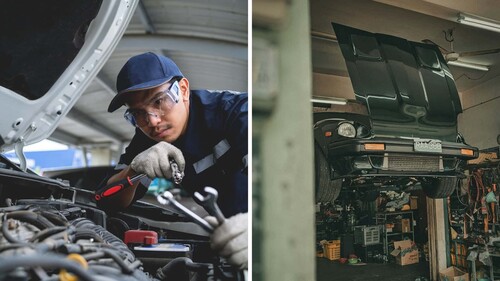
Every mechanic knows the frustrating experience of trying to remove a part that simply won’t budge. One recently shared a surprising trick involving a crayon that has people both impressed and skeptical. A mobile mechanic’s reaction to the crayon trick for loosening stuck auto parts has racked up over 150,000 views on Facebook. It’s also inspired debate about whether it’s the wax or the heat that does the real work. My Mobile Mechanic 978 (@MyMobileMechanic) is a Massachusetts-based mobile mechanic whose page promotes his services through Carferno, a platform connecting local mobile mechanics with clients. He posted a Facebook reel in which he reacts to footage from fellow creator Salcido D Mechanic using a melted crayon to free a seized tie rod thread. With his face superimposed over the original clip, My Mobile Mechanic 978 walks viewers through what they’re seeing. “If you’ve ever worked on cars, you guys know that that job right there can be a bear,” he says. “You can spend hours trying to get that out.” He explains the simple fix, which is to heat the stuck part, apply a crayon to the hot threads, and let the melted wax do its work. “You put heat, sprays, you put some crayon, it comes out like butter,” he says. He signs off with the line,“You don’t choose the crayon, the crayon chooses you.” Do Crayons Work On Stuck Threads? The technique shown in the video relies on a principle that mechanics and tradespeople have known about for a long time. When a threaded fastener seizes due to corrosion, heat alone can break the bond between the two metal surfaces by expanding them at different rates. Adding wax from a crayon, a candle, or a block of paraffin introduces a lubricant that can be drawn into the tiny gaps between the threads through capillary action, making the stuck part easier to turn. According to Crayola, crayons are made from paraffin wax, which is the same material used in canning, candle-making, and industrial lubrication. The heat melts the wax on contact, and the liquid is wicked into the threads before it can evaporate. Is It The Wax Or The Heat? Not everyone was persuaded. The video’s comment section turned into an argument between mechanics who swear by the trick and those who say it’s the heat doing all the heavy lifting. “I think the heat did wayyy more than the crayon,” wrote Joshua Workman, kicking off a thread that drew dozens of replies. My Mobile Mechanic pushed back. “You are so wrong bro. The heat alone would free it up, but you would hear the thread, screaming and creaking,” he responded. Daniel Ferguson, who identified himself as a heavy mechanic with 30-plus years of experience, was unconvinced. “Crayons, wax do nothing; it’s been proven in a few tests. You can find those tests on YouTube,” he wrote. But Troy C. Gray countered with his own set of credentials, writing, “I worked at Detroit Diesel Reman East for 16 years and used paraffin wax religiously on bolts and other stuck parts. Heat alone wouldn’t do it.” Chris Clay offered a middle-ground explanation, which is also the one best supported by the evidence. “They both play a big part. The heat breaks the bond while simultaneously the wax fills the void and greatly reduces the effort to turn it, even in high heat,” he wrote, adding “Old school machinists were doing this a long time ago.” Several commenters correctly invoked capillary action as an explanation to explain why the wax penetrates where sprays cannot. “It’s why you can solder copper pipe even with the fitting facing down and still get a good joint,” wrote Oscar Arroyo. Is One Crayon Better Than Another? The comments also became an unofficial guide to wax sources for the garage, with multiple commenters writing that they keep candles or paraffin blocks in their toolboxes rather than crayons. “I’ve been using candle wax for years,” wrote Steve Oetzel. Charles Butler added, “I kept a candle in my box for forty years. It would work when nothing else would.” Others suggested beeswax, birthday candles from a dollar store, or even paraffin blocks from the canning aisle at the grocery store. “Emergency candles that can usually be found in camping aisles or dollar stores are normally made with paraffin wax and very cheap,” wrote Johnny Fritz. When one commenter asked whether Crayola or off-brand crayons work better, My Mobile Mechanic quipped, “Off-brand because Crayola hasn’t sponsored me yet.” Marine Rations No conversation about crayons is complete without a reference to the long-running joke that US Marines eat crayons. “Careful this can burn your Jarhead friends if they don’t let it cool,” wrote Corey Eiynck. The cascade of replies to that comment included Dale Hagarie’s response, “As a Marine I still find this funny.” Eric Shewmon offered a crossover between the two themes, writing, “I had the shop owner’s father teach me that, just after I got out of the Marines. At first I thought it was snack time.” Brit McCracken reported from the home front, posting, “My husband is upset. He said don’t use the green ones. They’re his favorite flavor.” A Trick Worth Trying? The debate in the comments may never be settled, but several commenters reported firsthand success with the method. Luis Alberto wrote that he used crayons to remove three out of four O2 sensors from a V-8 “in less than 20 minutes.” Craig Watanabe said he used it on the outer tie rods of a 2013 Honda Pilot, and that it “worked like a charm and yes I used a blue one.” Travis Long went further, writing, “I just blew minds the other day using a crayon to get a crankshaft pulley off.” The humble crayon appears to have found a permanent place in at least a few toolboxes. As Don Sherburn put it, “Reason why there’s a box of crayons on my pegboard with my tools.” Motor1 reached out to My Mobile Mechanic 978 via Facebook direct message for additional comment. We’ll be sure to update this if he responds. We want your opinion! What would you like to see on Motor1.com? Take our 3 minute survey. - The Motor1.com Team