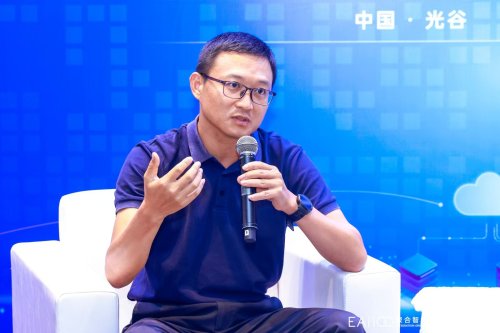
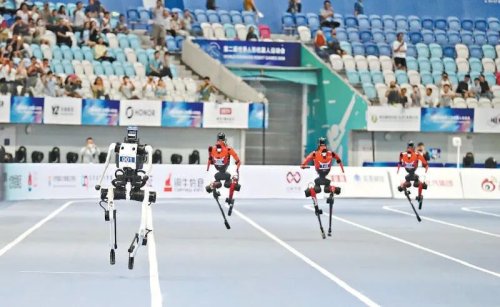
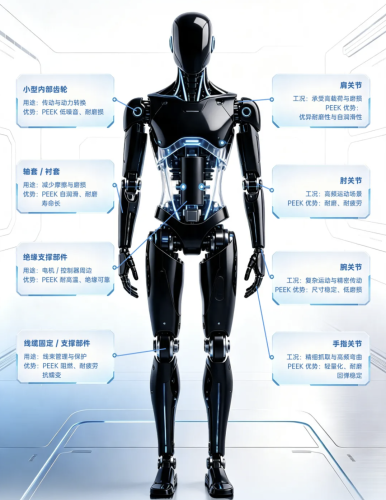
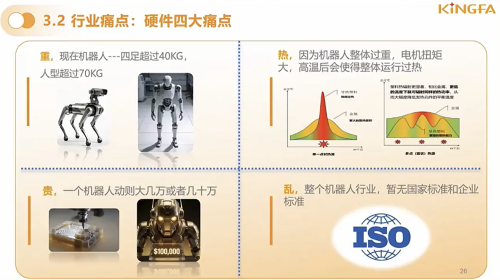
Gasgoo Munich-"Most of the current application of PEEK in the field of embodied intelligence is hype."That assessment from Yu Fei, technical general manager for the robotics sector at Kingfa Tech, has thrown a bucket of cold water on the feverish excitement surrounding PEEK in humanoid robotics.PEEK, short for polyether ether ketone, is a specialty engineering plastic known for high-temperature resistance, self-lubrication, and high specific strength.Thanks to those properties, PEEK has been widely hailed over the past two years as a "master key" to unlocking better robotic performance. The supply chain has chased it aggressively, and related concepts have repeatedly surged in capital markets.Yet, material suppliers at the very top of the supply chain see a starkly different reality: the near-1,000 yuan price tag per kilogram for PEEK simply doesn't match the practical benefits it can deliver at this stage.The controversy over PEEK is just a microcosm of the broader challenges in humanoid robot materials.Constrained by overall production volumes, the industry currently faces a tangle of issues: a lack of standards, highly customized solutions, and a constant tug-of-war between cost and reliability. The entire sector is stuck at a critical bottleneck, trying to move from small-batch prototyping to mass production.Yu Fei, Technical General Manager of the Robotics Industry at Kingfa TechHumanoid Robot Materials: 80%–90% Highly CustomizedAccording to the latest statistics from Counterpoint Research, global shipments of humanoid robots surpassed 22,000 units in the first half of 2026 — a near-triple increase from the same period in 2025.Extrapolating from current trends, Wang Xianbin, vice president and partner at Gasgoo Institute, predicts global shipments will hit 60,000 units this year. China alone will account for about 50,000, more than doubling the 18,000 units recorded in 2025.Yu Fei is even more optimistic. He believes total shipments could reach around 100,000 units this year, climbing to 200,000–300,000 next year, before entering a "window of explosive growth" between 2028 and 2030."From what I've observed in the second half, many projects are moving forward," Yu Fei said. "The market is much better than the first half, and overall installation volumes are definitely set to rise."But zoom in on the corporate level, and the picture looks quite different.Yu Fei notes that while nearly 400 companies in China have dipped their toes into humanoid robotics, only a handful can produce more than 1,000 units annually. Aside from a select few like Unitree, Zhiyuan Robotics, and UBTECH, most players are still stuck in the lab iteration or small-batch trial phase.This level of industry maturity has trapped material suppliers in a double bind: "high customization" and "missing standards."First, small downstream production volumes mean upstream demand is extremely fragmented and non-standard."Currently, 80% to 90% of humanoid robot material solutions are highly customized, making it very difficult to reuse across different customers," Yu Fei points out.For instance, two different OEMs might need a material for the exact same joint component. But because their structural designs, load conditions, and lifespan requirements differ, the material formulas will vary — making it nearly impossible to supply one solution to multiple clients.Especially at this stage, most OEMs prefer developing proprietary structures. They rarely consider material compatibility in the early design phase, leaving upstream suppliers to follow along with custom development.Image source: Beijing E-TownSecond, the lack of industry standards is another major constraint.Unlike mature industries like home appliances or automotive, which have relatively complete systems of industry and corporate standards, humanoid robotics is an emerging field without a unified set of norms.Without standards, OEMs often have to run multiple schemes in parallel."Clients will give us one to five material schemes at a time for testing," Yu Fei explains, "just to distinguish whether the failure comes from the structural design, the material itself, or both."The result is a back-and-forth process. From prototyping to final mass production specs, material formulas and robot structures often need 3 to 5 rounds of iteration before a solution is locked in.Crucially, these two problems reinforce each other: no standards lead to individual customization, and individual customization makes it harder to establish standards. Ultimately, the development cycle and costs for the entire chain are driven up in tandem.Yu Fei estimates that a single humanoid robot currently uses about 6 to 10 kilograms of plastic. At current market prices for modified plastics, that translates to a material cost of over 1,000 yuan per robot.But because order volumes per customer are small, many products require separate formula development and validation, making it hard to amortize the unit development costs.So, how can the industry break out of this high-cost trap created by customization?In Yu Fei's view, the key doesn't lie with material companies alone; it depends on a scale jump in downstream manufacturing."As the industry scales, processing will shift gradually from CNC machining to mold opening and injection molding," he says. "That will slowly bring down supply chain and material costs."This means cost reduction through scale is the result — the prerequisite is that downstream OEMs must first achieve significant volume shipment."Plastic Gold": More Hype Than UtilityOver the past year, PEEK has undoubtedly been the hottest buzzword in humanoid robot materials.And the industry has good reason to chase it.With a density of about 1.3g/cm³ — roughly half that of aluminum alloy — PEEK offers self-lubrication, wear resistance, high-temperature tolerance, and high specific strength. It hits the complex requirements for robotic gears, reducers, bearings, and dexterous hands: light, durable, and heat-resistant.Image source: Tinci MaterialsConsequently, many OEMs, including Tesla, Unitree, and Zhiyuan Robotics, have started introducing PEEK into their humanoid robots.The supply chain is following suit. Beyond material makers like Kingfa Tech, Wote, Youju New Materials, and Tinci Materials, component firms represented by Chaojie, Changying Precision, and Ningbo Huaxiang are also rushing to stake their claim.For example, Huaxiang Qiyuan developed a modified PEEK planetary reducer. Aside from core metal transmission parts, the main body uses modified PEEK, bringing the assembly weight down to just 270 grams — a 70% reduction compared to metal equivalents. By applying PEEK structural parts across the board, Huaxiang Qiyuan achieved a total weight reduction of 5.3 kilograms per robot.Related forecasts suggest the global PEEK market will grow rapidly from 6.1 billion yuan in 2024, driven by downstream upgrades and lightweighting trends. The humanoid robot sector alone is expected to contribute over 4 billion yuan in demand by 2027.Yet Yu Fei remains calm."At this stage, most PEEK applications in embodied intelligence are hype."His judgment rests on two main points.First, there is an objective physical gap between PEEK and metal."The dimensional characteristics of PEEK and metal differ vastly, and fatigue performance differs by at least two orders of magnitude," Yu Fei says.Fatigue performance essentially refers to a material's ability to withstand millions of repeated stress cycles without failing. Since robot joints require high-frequency reciprocating motion, this shortcoming is hard to bypass.Second, the cost calculation.As "plastic gold," PEEK sits at the top of the material pyramid, costing around 1,000 yuan per kilogram. This means that in current application scenarios, using PEEK not only increases costs for customers but may not deliver significant returns."Therefore, we prefer to recommend solutions that offer better cost-performance and fit the customer's actual needs," Yu Fei says.Despite his caution on short-term applications, Kingfa hasn't stopped preparing capacity. Yu Fei reveals the company has built a 1,000-ton-per-year PEEK production facility, placing it in the first tier domestically.However, he believes the true window for large-scale PEEK adoption depends on whether future robot structures undergo major redesigns.Auto Experience Is Instructive, But Not a Copy-Paste JobIn this humanoid robotics wave, "crossover manufacturing" is unavoidable, and the integration of the automotive supply chain with embodied intelligence deserves particular attention."Over 90% of the OEMs and Tier 1 suppliers I've contacted are laying out plans for embodied intelligence," Yu Fei notes. "Some have gone all in, dropping auto business entirely; others are shifting more gradually, but they're all entering this space."As a global leader in modified plastics, Kingfa Tech itself has benefited deeply from the automotive chain. In the first half of 2026, Kingfa sold 1.4744 million tons of modified plastic products, up 12.65% year-on-year, with revenue of 18.167 billion yuan, a 10.28% increase. Global sales of automotive materials reached 616,700 tons, up 10.07%.The rush of auto supply chain firms into embodied intelligence is driven by a consistent logic: smart cars and humanoid robots share a highly homologous technical architecture, supply chain system, and engineering methodology. Both are built from sensors, computing platforms, motors, and batteries, allowing for reuse across multiple dimensions."For example, some experience, methods, and supply chain elements from the auto industry can be reused," Yu Fei says.But the materials themselves cannot be simply transferred.Yu Fei estimates the overlap in material categories between automotive and humanoid robots is only 20% to 30%.The deeper difference lies in the nature of the working conditions. Cars operate in low-frequency scenarios, while humanoid robots face high-frequency conditions. Robot joints need continuous, high-swing movement, demanding higher standards for strength, drop resistance, and thermal conductivity — leading to distinctly different material requirements.For instance, the auto industry uses standard nylon PA6 and PA66 extensively, whereas humanoid robots rely more on high-grade specialty engineering plastics like LCP, PPS, and PEEK."Even for that overlapping 20% to 30%, direct reuse is difficult because the motion dynamics are different," Yu Fei points out. In other words, reuse isn't a simple copy-paste; it requires a "two-way street" of material performance upgrades and structural optimization.Lightweighting is a classic case of "looks easy to copy, but isn't."In the auto industry, lightweighting to improve range has been fully validated over the past decade. Now, that logic is playing out in humanoid robots. But even with auto industry experience, Yu Fei believes the path to lightweighting robots remains long.The reason is simple: lightweighting isn't just swapping steel or aluminum for plastic. It involves redesigning the entire product structure. Currently, across the industry, neither OEMs nor material suppliers have accumulated enough engineering case studies."So the general direction of lightweighting is right, but the specific path to implementation will take three to five years to figure out," Yu Fei says. "After all, much experience can't be directly copied. Large models and AI can help speed things up, but the necessary trial-and-error process can't be skipped."Beyond technology and experience, whether humanoid robots should directly adopt mature automotive-grade standards is another hot topic.Yu Fei's take: direct application is generally safe and low-risk because automotive standards have undergone massive validation and offer complete reliability.But cars and robots are different industries. Automotive specs might be redundant for robots — a bit like using a sledgehammer to crack a nut.A more realistic path is "apply first, optimize later." In the long run, the robotics industry still needs to establish its own dedicated standards.Four Hurdles Blocking Humanoid Robot Mass ProductionWhether it's the customization trap or the PEEK controversy, the issues in humanoid robot materials point to the same practical hurdles in hardware development.Image source: Kingfa TechThe first hurdle is weight.Current humanoid robots rely heavily on metals like magnesium and aluminum alloys. While reliable and mature, these materials are denser than engineering plastics, keeping body weight high.Weight reduction directly affects stability, speed, and load capacity. For industrial robots, it means faster cycle times and higher production efficiency.But as mentioned earlier, "replacing steel with plastic" isn't a simple material swap; it requires a complete structural overhaul.The second hurdle is heat dissipation.At the humanoid robot marathon in Beijing's E-Town earlier this year, many robots needed dry ice cooling halfway through — a stark illustration of the problem.High-power joints move continuously at high frequencies, concentrating heat inside the cramped chassis. Cooling remains a weak industry-wide link, and material thermal conductivity is a critical lever for solving it.The third hurdle is cost.The humanoid robot industry is young, with limited development experience. Structures require repeated iteration before finalization. Especially in small-batch mode, development costs for parts and materials are hard to amortize over scale, amplifying the economic pressure of customization.The fourth hurdle is standards.With both industry and corporate standards absent, new entrants lack a unified frame of reference.Without a unified testing and evaluation system, defining material performance and determining qualification requires OEMs and material suppliers to grind through every project individually — which, in turn, exacerbates the customization burden.Kingfa is actively deploying strategies to address these challenges.The company established a dedicated robot material R&D team in 2025 and is engaged in collaborative development with leading enterprises. Some material products are already in bulk supply, and multiple production lines related to robotics are expanding.Yu Fei emphasizes that Kingfa's core competitiveness isn't just selling materials; it's providing a full solution package ranging from material selection and structural design to mold tooling and post-processing.Addressing the "four trends" in humanoid robots — lightweighting, aesthetics, heat resistance, and smart safety — Kingfa is pursuing a "top-down" path for plastic substitution. This means starting with non-load-bearing parts like face masks, upper arms, and chest cavities.As for core load-bearing structures in the lower body, like legs, Yu Fei admits, "Currently, no company globally has truly achieved plastic-for-steel replacement."On the thermal front, Kingfa has developed high thermal conductivity materials reaching 15W/(m·K). Combined with structural optimization, this "basically solves most heat dissipation issues."Still, behind the massive incremental market, material suppliers face objective risks.On one hand, the humanoid robot business is a strategic play for Kingfa, unlikely to contribute significant revenue growth in the short term. On the other, while the supply side is hot, downstream OEMs haven't crossed the mass production threshold, and technical routes haven't converged. This means material suppliers can't simply apply the standardized mass production logic of traditional industries.Consequently, even if material suppliers prepare capacity and formulas in advance, there remains significant uncertainty as to whether that will translate into orders.ConclusionBehind the PEEK controversy lies the collision between idealism and reality in the humanoid robot materials sector. The market always expects a "magic material" to solve everything at once, but industrial implementation is never that simple.PEEK has impressive performance but is constrained by cost and fatigue limits. Automotive engineering expertise is instructive, but material formulas can't be copied. The cost reduction the industry awaits isn't a proposition material vendors can solve alone; it ultimately depends on downstream volume to deliver.Therefore, before true scale arrives, upstream players would be better off focusing on crafting high-cost-performance solutions that fit real-world working conditions, rather than chasing the hype of star materials.



















 +42 others