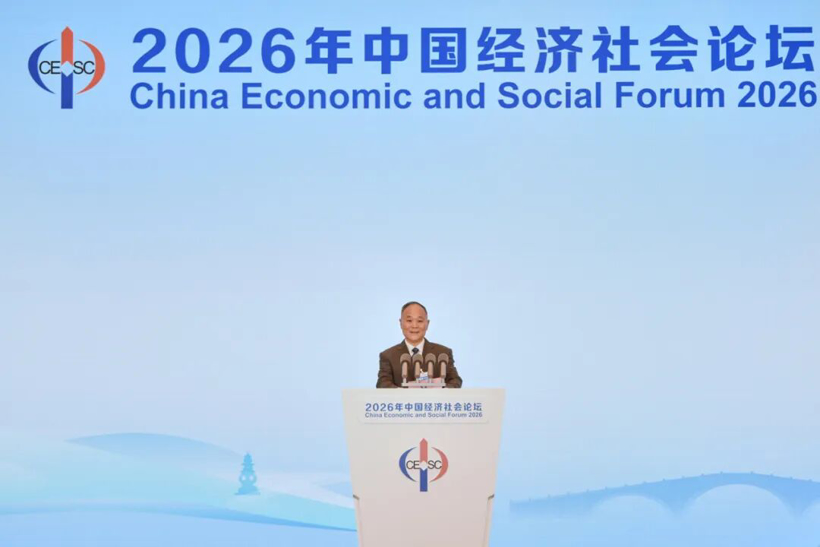
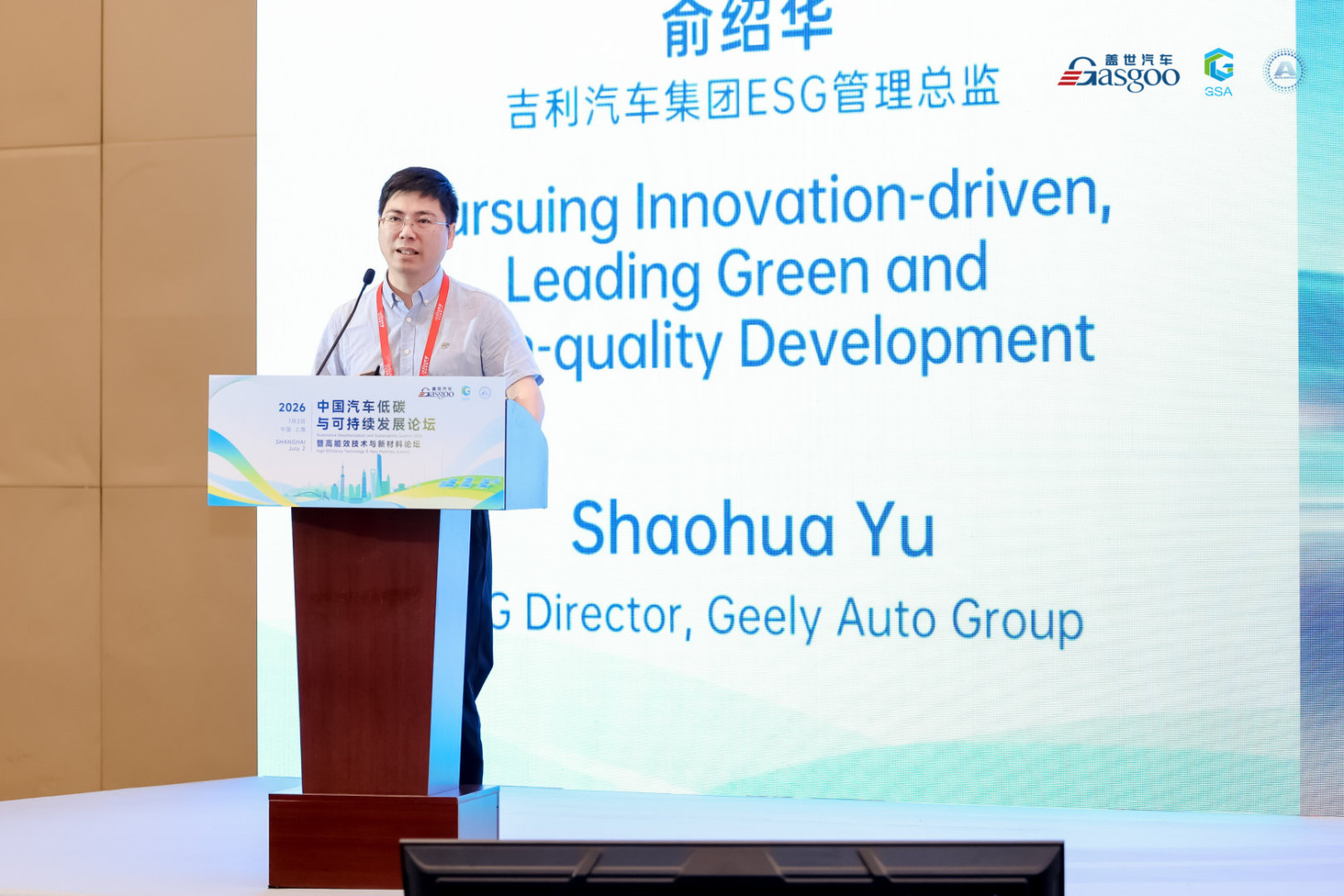
Gasgoo Munich- "Geely is pursuing a path of integrated carbon reduction across three fronts: usage, manufacturing, and supply." On July 2, at the "2026 China Automotive Decarbonization and Sustainability Summit and High-Efficiency Technology & New Materials Forum," hosted by Gasgoo, Yu Shaohua, ESG management director at Geely Auto Group, laid out the company's core decarbonization framework right from the start.Geely Auto Group ESG Management Director Yu ShaohuaIn his view, electrification is only part of the answer. The real solution lies in managing carbon footprints across the entire lifecycle—from design, procurement, and production to usage and scrapping. Every stage must be factored into the decarbonization equation.Back in 2021, Geely outlined its "dual carbon" roadmap under the "Smart Geely 2025" strategy: setting five-year reduction targets in the short term, with a long-term goal of achieving full-chain carbon neutrality by 2045. By 2022, Geely had become the first Chinese automaker to detail a "three-end integrated" decarbonization path covering a product's entire lifecycle. By 2025, the company aimed for a 25% reduction but actually hit 25.5%—with manufacturing emissions down 61%, usage emissions down 32%, and supply chain emissions down 20%. Progress was made across all three fronts.Do the Math Before Cutting CarbonThe first step in cutting carbon is balancing the books. Yu emphasized that to lower a vehicle's emissions, you must first define its carbon footprint clearly. Whether it's usage, supply, or manufacturing, the emissions for each segment cannot be estimated—they must be backed by data. Using 2020 as a baseline, Geely conducts carbon inventories and manages lifecycle emissions in accordance with national standards.Geely's self-developed digital carbon management platform, "Ji Carbon Cloud," serves as the central nervous system for this precision management. Yu revealed that more than 600 suppliers have already connected to the platform, enabling data interoperability. To date, carbon footprints have been calculated for 6,880 core components, and over 50 key suppliers have switched to 100% green electricity, resulting in a cumulative reduction of 1.476 million tons of carbon emissions on the supply side.Data is the prerequisite for management. Yu placed particular emphasis on "source control" during the design phase, promoting an internal strategy of "two restrictions and two elevations": limiting vehicle fuel or power consumption and battery carbon emissions, while increasing the proportion of recycled and new materials. On the sustainable materials front, Geely is actively developing bio-based and recycled options. This logic establishes "hard constraints" for carbon reduction as early as the product definition phase, which are then transmitted to the supply chain during sourcing—creating a complete closed loop from design to execution."Internally, we call this the 'two restrictions and two elevations,'" Yu explained. "Every product team is required to advance according to these targets." This mechanism of "quantification, target setting, and breakdown execution" has shifted Geely's decarbonization efforts from vague perception to precision management.From Suppliers to the Circular LoopPrecise carbon footprint data gives the three-end strategy its leverage. In his speech, Yu broke down the practical details of the supply chain and circular economy initiatives.On the supply side, Geely embeds green requirements into "hard indicators" for procurement. Tier-1 core suppliers are mandated to use 100% green electricity, with targets for recycled material ratios set at the sourcing stage. Take the Galaxy M9: it uses 30% recycled plastic. The Lynk & Co Z20 utilizes 30% recycled aluminum and 23% recycled steel. Yu also highlighted a breakthrough in low-carbon logistics: Geely has purchased 50 methanol transport vehicles for active service and is piloting methanol and natural gas to replace traditional fuels in overseas shipping, extending decarbonization efforts to the logistics chain.The results on the manufacturing front are equally tangible. By the end of 2025, Geely had established 15 national-level green factories, 12 zero-waste factories, and three zero-carbon factories. Solar installation capacity across vehicle bases reached 482 megawatts, covering 26% to 30% of electricity consumption. The share of renewable power in vehicle production hit 100%, with any shortfall covered by green certificate trading and direct power purchases. Energy consumption per vehicle dropped 35% from 2020 levels, while carbon emissions per vehicle fell 61%.Yu explained that Geely uses two internal systems—the "EMS 2.0 Energy Management Platform" and "Ji Carbon Cloud"—to conduct benchmark analysis on every workshop, production line, and even individual piece of equipment. Optimal parameters are identified and rolled out across all bases. "When producing the same component, you won't see one factory running at high pressure while another runs low," Yu said. This data-driven lean management squeezes out every gram of carbon emissions.The circular economy acts as the "fourth dimension" of this three-end strategy. Yu noted that Geely is the first OEM in the industry to establish a circular industry center, coordinating end-of-life vehicle recycling, reuse of parts, and material regeneration. A prime example is the closed-loop steel recycling system built in partnership with Shougang: stamping scrap from factories is sent back to the steel mill, processed, and returned to the automaker, creating a "car-to-car" cycle.In 2025, Geely processed nearly 6,000 end-of-life vehicles in a compliant manner, with over 60,000 reused and remanufactured parts returning to the market. Sales of recycled materials exceeded 13,000 tons. Take bumpers, for instance: 15 models—including the Geely Xingyao 8, Galaxy M9, Lynk & Co 900, ZEEKR 7X, and ZEEKR 9X—now incorporate 30% recycled materials, cutting carbon emissions per vehicle by 7% to 10%.Methanol, Another Answer to DecarbonizationIf the supply, manufacturing, and usage ends form the horizontal framework of this strategy, Geely also has a vertical track it has cultivated for 20 years: methanol vehicles. Yu stressed in his speech: "Geely has dedicated 20 years to methanol vehicles and has mastered the core technology. We are the only automaker in the world mass-producing them."Why bet on methanol? Yu offered two sets of data: Geely holds over 400 core methanol patents, has developed more than 20 methanol models, and has over 60,000 methanol vehicles in operation across the country, with cumulative mileage exceeding 25 billion kilometers. From an economic standpoint, the fourth-generation Emgrand methanol hybrid has reduced consumption to 9.2 liters, with a cost per kilometer below 0.3 yuan—making it a "benchmark for low-cost, low-carbon mobility."In Yu's view, the value of methanol lies not just in technological maturity, but in its energy properties. It can be produced from renewable energy and serves as a liquid carrier for green hydrogen, generating far lower carbon emissions than traditional gasoline or diesel when burned. It works as a power source for passenger cars as well as commercial vehicles and logistics transport, aligning naturally with Geely's low-carbon logistics strategy. Yu revealed that Geely has deployed methanol logistics vehicles in actual operations and is experimenting with methanol as a substitute for traditional fuels in overseas shipping.This technological track is finding resonance in both policy and the market. Data shows that in 2025, Geely's new energy vehicle sales reached 1.688 million units, accounting for 56% of total sales—a 90% year-on-year increase. According to Yu, that figure jumped to 67% in June 2026. This diversified technology roadmap is translating into tangible market competitiveness.



















 +20 others