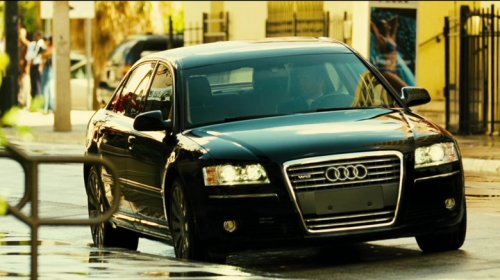
























Jason Statham built his brand on a simple formula: no wasted words, precision strikes, and the kind of screen presence that makes violence look clean and calculated. He's not loud, not flashy, and rarely smiles, yet he owns every frame on the screen. Before Hollywood came calling, Statham competed as a professional diver and worked as a model. His break came when Guy Ritchie cast him in Lock, Stock and Two Smoking Barrels, but today he plays a key role in the Fast & Furious franchise, and has dabbled in various movies that involve cars.Statham is a martial arts expert and, quite evidently, also one of the few action stars who can actually drive. From Death Race to Hobbs & Shaw, and even The Expendables, Statham’s characters are always behind the wheel of something fast, usually while under fire or breaking laws.What’s interesting is how often his roles seem to blur the line between outlaw and delivery driver. He has even played a character who transports “goods” with a code of ethics, but no patience for nonsense. Think of him as the world’s most dangerous DoorDash or Uber driver. In one of his most iconic roles, Statham didn't drive muscle cars or exotics. His weapon of choice were German luxury sedans built for CEOs, not shootouts and car chases.But thanks to Statham, two specific models went from executive transport to silver-screen action legends. Let’s look at how that happened. Jason Statham's Transporter Turned The BMW 7 Series And Audi A8 Into Action Icons Via: 20th Century FoxThe Transporter trilogy gave Jason Statham a franchise, but also German executive sedans their moment in the Hollywood spotlight. Across three films, Statham plays Frank Martin, a no-nonsense professional high-profile delivery driver with a military background and a strict code: never change the deal, never open the package, and never get involved. Naturally, he is forced to break all three rules, often while behind the wheel of a full-size luxury sedan, doing things most owners would never attempt.In the first film, The Transporter (2002), Frank drives a BMW 735i E38. At the time, the E38 represented the peak of BMW’s flagship sedan: subtle, powerful, and sharply balanced. But in Statham’s hands, the 7 Series featured heavily in chase scenes that included a reverse-driving getaway, narrow parking garage escapes, and surgical drifts through European alleys. The E38’s rear-wheel-drive layout and near 50:50 weight distribution helped make those scenes believable, especially when paired with its 3.5-liter V8.Via: 20th Century Fox In Transporter 2 (2005), Frank switched rides to an Audi A8L W12; a longer, heavier car that brought all-wheel drive and twelve-cylinder firepower. The second film’s standout moment involved Frank launching the car into a crane to remove a bomb from its undercarriage. In Transporter 3 (2008), a facelifted version of the A8L W12 took center stage again, this time for tighter urban chases and more elaborate stunts. With a 6.0-liter W12 engine, the Audi gave Frank more speed and grip, thanks to Quattro all-wheel drive and advanced suspension tuning. However, rated at 15 miles to a gallon, the massive W12 engine may have cost the production more in terms of fuel bills.Statham driving these cars helped redefine the image of full-size sedans as more than just high-end cruisers for the wealthy. After The Transporter, they were seen as tools of precision and power in the hands of a trained professional who knew how to push them past their intended limits. The Transporter Turned The Classy BMW 735i E38 Into A Street Assassin Via: BonhamsIn The Transporter (2002), the BMW 735i E38 was Frank Martin’s primary weapon. Throughout the film, the 7 Series proved itself as more than a luxury cruiser. It handled high-speed chases, reverse-driving escapes, tight alley maneuvers, and multi-car standoffs with the precision of a purpose-built stunt car. Its understated looks helped it blend in, but when things got loud, the car always delivered.The specific model used featured a 3.5-liter V8, sending 282 hp and 325 lb-ft of torque to the rear wheels through a 5-speed automatic transmission. Weighing around 4,300 pounds, the E38 balanced size with agility thanks to a near 50:50 weight distribution and a chassis engineered for autobahn cruising. That setup gave the film’s stunt drivers a solid platform for the kind of real, tire-smoking driving sequences that defined early-2000s action films.Via: Bonhams One reason the E38 worked so well on screen was its analog nature. It didn’t have the electronic filters and driver aids found in modern sedans. That gave it a raw, connected feel, perfect for showcasing Frank’s skill behind the wheel. The car’s final moment came during the climactic sequence, where Frank drives it off a bridge onto a moving truck. After a brutal chase, the car is rigged with explosives and detonates in a fiery end.After blowing it up, Frank didn't buy another 7 Series, perhaps due to the high-rate of depreciation. iSeeCars data reveals, a BMW 7 Series loses about 67% of its value after five years. Repairs after all that stunt damage probably didn’t help. Between the explosion and the maintenance bills, switching to an Audi A8L may have been the financially responsible move, even for a professional driver who blows up his rides. The Audi A8L W12 Played A Supporting Role In Transporter 2 & 3 Via: Cars & Bids In Transporter 2 and Transporter 3, the Audi A8L W12 replaced the BMW from the first film and became Frank Martin’s new tool of choice. The 12-cylinder A8L played a key role in shaping the tone and action of the sequels. The switch to Audi aligned with the German brand’s broader strategy of positioning the A8L as a performance-focused luxury sedan with the strength to handle more than just chauffeur duty.The version seen in Transporter 2 featured Audi’s 6.0-liter W12 engine, making around 450 hp and 428 lb-ft of torque. With a curb weight of over 4,500 pounds and Quattro all-wheel drive, the A8L delivered consistent grip and impressive stability. Frank used it to chase kidnappers, outmaneuver helicopters, and in one infamous scene, spin the car off a ramp to dislodge a bomb using a construction crane. Unlike the BMW from the first film, the Audi survives to the end, with some battle scars. Frank Upgrades To The Audi A8L W12 Facelift In Transporter 3 Via: Cars & BidsTransporter 3 introduced a facelifted D3-generation A8L with a sharper front fascia, updated LED lighting, improved suspension tuning, and a more refined infotainment system. Not that Frank seemed to care about screen resolution while dodging RPGs, but the upgrades were noticeable. The car once again carried the 6.0-liter W12, paired with the same Quattro system, but showcased even tighter stunt coordination across rougher European terrain.In both films, Audi leaned hard into product placement, using the A8L as central to Frank’s identity. By keeping the car intact through both sequels, Audi reinforced the image of the A8L W12 as a durable, powerful, and precise machine. For American viewers, it shifted perception: this wasn’t just a German executive sedan. In the hands of Frank Martin, it became a controlled weapon with leather seats. The Transporter Trilogy Redefined Sedans Of The 2000s Via: 20th Century Fox Jason Statham driving the BMW 735i E38 and Audi A8L W12 in The Transporter trilogy turned them into precision weapons. These full-size sedans weren’t just props; they became part of Frank Martin’s identity. They looked discreet, blended into city streets, and had enough power and balance to handle everything from hairpin chases to train-track escapes. That balance of elegance and aggression made them the perfect fit for the character.Now, imagining Frank in anything else is near impossible. An SUV would be too bulky, a muscle car wouldn’t handle European roads with enough precision, while an exotic supercar would draw too much attention. The sedans worked because they had the performance and discretion in equal measure.Today, both the E38 and the A8L W12 hold a special place in car culture. They’re remembered not just for their engineering, but for the roles they played on screen. The E38 brought analog precision, while the A8L showed how technology and power could coexist in one heavy, fast-moving package.Neither of these sedans were built to drift through alleys or dodge missiles. But Statham made sure they did it anyway. In doing so, he changed how we look at executive sedans from the 2000s.