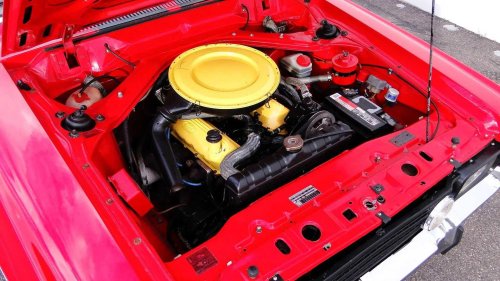
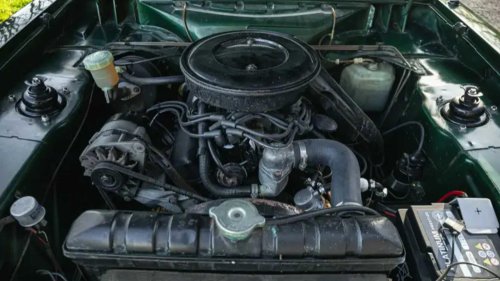
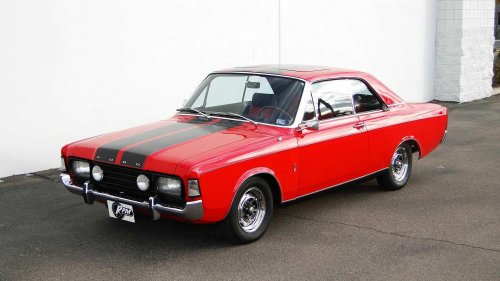
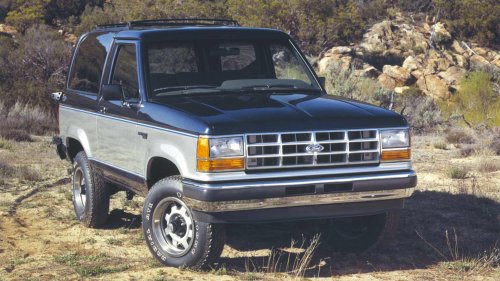
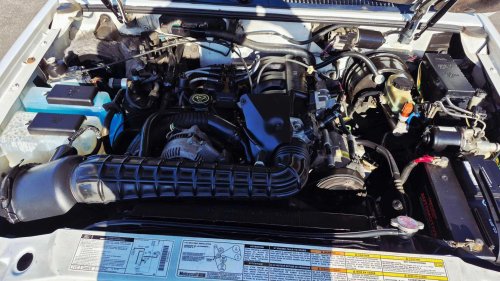
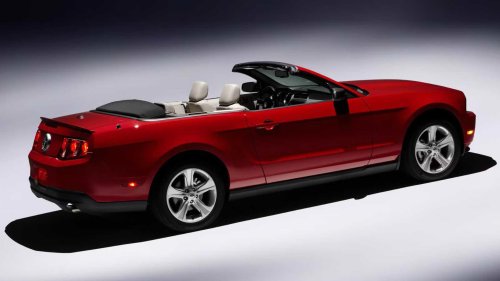
Most automakers have at least one engine that they're famous for. Think of mills like Chevrolet's small-block V8 or Jaguar's XK inline-six. These engines, along with some other tried-and-true powerplants, served their owners and automakers well in both longevity, durability, and, in some cases, power output. Not to mention, owning a model equipped with an engine such as the Chevy small-block V8 means parts are easy to find and inexpensive.Ford is no stranger to building iconic, long-lasting engines, either. The Modular engine, which has been in continuous production since the early 1990s, is one such mill. However, a lesser-known titan of Ford's engine repertoire is the Cologne V6. It was in production for a whopping 49 years and served numerous worldwide markets. It was also one of the most reliable V6 engines ever produced by the Detroit Giant. Humble, European Beginnings Bring A Trailer Ford Cologne V6 Key Points Introduced in 1962 Originally built at Ford's engine plant in Cologne, Germany Officially used in the US since 1972 Some variants offer turbocharging or supercharging Axed following the 2011 model year In the late 1950s, Ford's German market was in need of some new muscle. At the time, the most popular Ford mills on offer were 1.5-liter and 1.7-liter inline-fours, neither of which made all that much power. Apart from those two, the company didn't offer any larger or more powerful mass-produced powerplants. By the early 1960s, German Ford buyers were clamoring for more power, so the Detroit Giant set about giving them what they wanted.Ford of Germany's answer to the issue of power and engine options came in 1962 with the introduction of the Cologne V6. Its name was derived from its place of origin, a practice Ford is well known for with other mills like the Cleveland and Windsor V8s. This original iteration of the V6 displaced just 2.0 liters. Its layout mimicked the Ford Taunus V4 engine in several ways, such as rear main bolt pattern, engine mounts, and similar cylinder head designs.There were two exhaust outlets per side, but this feature proved inefficient and rendered the early Cologne V6 underpowered. This first iteration was found in Western Continental European Ford models, such as the 20M, Capri, and Taunus. However, models offered in the United Kingdom did not include the Cologne V6, instead using the UK-made Essex V6. Origins (1960s–1980s) Bring A Trailer 2.0-Liter (1962–1985) The original 2.0-liter version of the Cologne V6, along with sharing numerous aspects with the Taunus V4 engine, was designed to be extremely simple. The decision to create the power plant in this way was made because of the type of customer projected to buy models with the mill. Average folks, who weren't interested in complex or powerful propulsion. These customers placed a high value on ease of repair and part prices, and Ford delivered. 2.3-Liter (1967–1985) Bring A TrailerFive years after the original Cologne mill debuted, Ford unveiled a larger, 2.3-liter iteration. By this point, the Cologne engine was gaining popularity, so the Blue Oval was likely interested in diversifying its Continental European engine lineup. The 2.3-liter version was one of the most popular, with over 15 models using the engine at one point. A "Super High Compression" variation was introduced for certain models, which bumped the power output to 123 hp. 1.8-Liter (1968–1971) Ford produced the smallest iteration of the Cologne V6, a 1.8-liter, for just three years. This version of the engine was used only in the Ford 17M P7, a successor to the Taunus. Ultimately, the mill was phased out abruptly due to a very small number of them being sold, along with rising fuel-economy standards. 2.6-Liter (1969–1977) The final and largest member of the Cologne V6's first generation was the 2.6-liter engine, introduced for the 1969 model year. Only four models ended up utilizing the 2.6-liter: the Ford 20M RS, 26M, Capri, and Granada. A high-performance variant called the 2.6 RS was produced between 1970 and 1973 and was used only in the Ford Capri 2600 RS. It would be the only fuel-injected first-gen Cologne engine. Famous Years (1970s–1990s) Bring A Trailer 2.8-Liter (1974–1985) The first iteration of the second-gen Cologne V6 hit the market in 1974. It was the largest iteration yet and was also the first to be built specifically with the US market in mind. It offered carburetion, mechanical, and electronic fuel injection throughout its life and was used in nearly 20 Ford models, including the then-new Fox Body Mustang. A limited number of turbocharged iterations, around 150 in total, were produced for the Ford Capri Turbo available in Europe. 2.9-Liter (1986–1992) FordOne of the most popular Cologne V6 engines for the American market arrived in 1986. The 2.9-liter mill gained fame for being one of the main engines of choice for both the Ford Ranger and Bronco II. It was also designed with heavier-duty use in mind. It boastedrevamped exhaust ports and a revised exhaust valve setup meant to eliminate hot spots, or portions of the cylinder head that become too hot due to exhaust gases.A special Cosworth-tuned version of the 2.9-liter V6 was produced for use in the Ford Scorpio Cosworth 24V. Thanks to numerous upgrades, the mill was capable of producing 192 horsepower and 203 lb-ft of torque. The Final Cologne V6 Bring A TrailerIn 1990, Ford unleashed what would be the final all-new Cologne V6 variation. It would also be the first Cologne engine designed wholly for the US market, despite still being produced in Germany. Between 1990 and 1997, the 4.0-liter mill was used in the Explorer, Ranger, and the Aerostar minivan.However, in 1998, Ford introduced a single-overhead-camshaft version of the 4.0-liter Cologne engine, whereas the original had a pushrod layout. This new iteration increased power output considerably, with 1998 models producing about 210 horsepower and 254 pound-feet of torque. This SOHC version would replace the original 4.0-liter entirely and would live on until the engine range's final axing in 2011. Between 2000 and its final year, the Cologne mill could also be found in the Mustang, Courier, Ranger, Explorer, and the Land Rover Discovery 3.FordWith the close of the Cologne V6's 49-year tenure, Ford needed to provide a suitable replacement for its famous, long-lasting mill. The engine given this Herculean task was the Cyclone V6, which had already been in production since 2006. It was developed with help from Mazda, and continues to serve Ford to this day. As of this writing, the Cyclone V6 has done a good job of holding its own in terms ofreliability and durability. In other words, it seems the Cologne V6's reputation lucked out with a suitable replacement.



















 +28 others