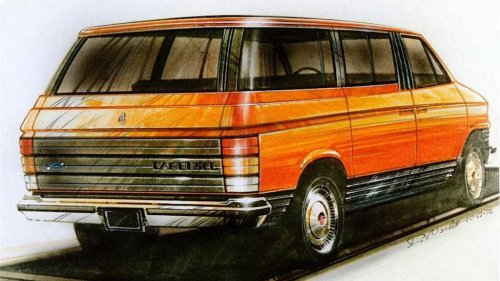



















Ford Carousel: The Minivan That Could've BeenRyan Lugo - MotorTrendSome of automotive history's true turning points are notable for what didn't happen rather than what did. For every bold decision taken by a corporate board, designer, or engineering team, there are just as many roads not taken that could have dramatically changed the fortunes of a particular brand for the better. These missed opportunities often lead to massive shifts that favored rivals more willing to take risks rather than stick to the status quo.In retrospect, some of these checked swings can seem completely baffling, whether for the lack of foresight exhibited by an automaker's leadership team, the relatively small potatoes investment required to test out a new model, or the transparent stubbornness to stay the course.The story of the Ford Carousel is the perfect example of a whiff on what the public wanted that had major repercussions not just for the Blue Oval's fortunes but also for a rival seeking to claw its way out of bankruptcy. If this vehicle had hit showrooms as planned, an '80s American icon never have reached the road, and Detroit would likely feature far fewer badges for sale today.A People's VanThe Carousel project was part of Ford's early-1970s attempt to come up with a people mover for the masses. Inspired by the success of the Volkswagen Microbus, whose friendly styling and versatile practicality convinced customers to overlook its incredibly underpowered drivetrain, Ford realized that there was an opportunity for a vehicle to slot in one step below its traditional, and frankly very trucklike, full-size vans.MotorTrend - MotorTrendAs slow as the Microbus was, it was an easy drive compared to most other vans on the market in the United States in the 1950s and 1960s. Ford had already tried something similar with the Econoline, which arrived in 1961 riding on top of the same body-on-frame compact platform as the Falcon sedan. That vehicle was destined for bigger things when it was redesigned for its second generation, giving it dimensions that made it unwieldy for the average owner (but attractive to lucrative commercial customers).AdvertisementAdvertisementThe embiggening of the Econoline left a slot beneath it for a "mini" van to combat VW's "micro" bus—or at least that was the thinking of freshly minted Ford president Lee Iacocca, who had taken over the top spot at the company in 1970. Ford had recently had success with the Bronco, a vehicle that appealed to the outdoorsy crowd seeking a go-anywhere runabout, and that got Iacocca thinking about a maneuverable van that would also target "lifestyle" buyers, those who wanted to go camping, for example, but didn't need the toughness of a 4x4. The same vehicle might also appeal to small businesses that couldn't justify a chunky Econoline, as well as larger families that needed more space than what a traditional station wagon had to offer.The Garagista of VansIacocca's outline for a Ford minivan was simple: It needed to be small enough to fit the average suburban garage, which meant it had to be considerably shorter in stature than the existing Econoline.At the time, the automaker was already deep into a project called Nantucket that was intended to embrace the full-size van cultural moment (think hippies and Led Zeppelin–inspired murals) by building an even larger version of the Econoline. While it might seem counterintuitive, the new minivan project (called Carousel) was folded into that effort, helping Ford cut costs by reusing a smaller-scale version of the Nantucket platform. This also helps to explain why the nascent family-friendly passenger van featured a 7.5-liter V-8 engine under the hood, another holdover from the Nantucket.FordThe finished concept was visually quite different from most American vans at the time. Its roofline and angled pillars and glass made it more wagonlike, and while its snub nose reflected the realities of its Econoline-derived mechanical bits, in silhouette, its sheetmetal rose up from the rear at a sweeping angle that gave it far more interest than a traditional slab-sided hauler. It was also a full foot lower than the Econoline when measuring from the ground.AdvertisementAdvertisementA sliding door offered passenger access to the Carousel's interior, which seated five with a massive cargo area behind the second row. Ford entertained a number of cabin configurations, including the face-to-face conversational seating arrangements that were popular at the time in living room pits and lounges across the country. Ford engineers moved the van's big eight-cylinder engine as far forward on its chassis as they dared, further opening up passenger room as compared to both the Nantucket and the Econoline.Economic Forces Crash the CarouselThe Ford Carousel concept was complete in 1972, and then … nothing. OK, so that's not entirely accurate, because what happened next was the first in a series of oil embargos and energy shocks that sent American car companies reeling, dooming many larger models as product planners frantically scrambled to bring more efficient autos to market. The Carousel was in limbo, and its chances at production were essentially terminated along with Iacocca's tenure at Ford when the latter was fired in 1978.Any student of automotive history will be familiar with the next chapter of minivan lore, however. Lee Iacocca landed at Chrysler, where he found Hal Sperlich, who was also recently fired from Ford and who had been a strong voice for downsizing at the Blue Oval. In particular, Sperlich had been responsible for the venerable Fox platform that spawned successful vehicles like the Ford Fairmont, the early-'80s Ford Thunderbird, and of course the revitalized Ford Mustang.FordMore important, Sperlich had championed something called the "Mini Max" project, which was a design study that produced small vans based on the European Fiesta and American Pinto platforms. These were tiny two-doors that married the proportions of a compact wagon with the taller roofline of a traditional van.AdvertisementAdvertisementIacocca was far from finished with the concept of a minivan for the American masses, and with Sperlich's expertise on small-but-useful platforms, and Mini-Max designer Don DeLaRossa coming along with the former president when he made his crosstown leap, the stage was set for Chrysler's most successful product launch of all time: the modern minivan, one that split the difference between the larger footprint (and sliding door) of the Carousel and the front-wheel-drive aspects of some of the Mini Max prototypes.The Chrysler Town & Country, Plymouth Voyager, and Dodge Caravan all arrived at exactly the right time in the early 1980s, providing the Pentastar with the cash flow it needed to pay back its government bankruptcy loans early and establish a financial beachhead that saved the company. They also revolutionized family transportation, killing off station wagons and setting the tone for three-rowed transport for the next 15 years before finally being overtaken by SUVs at the end of the 1990s.A Bleaker Future for Chrysler If the Carousel Kept SpinningIt's impossible to overstate how different the automotive industry would be now if Ford had been first to market with a proper minivan, either at the end of the 1970s of the start of the 1980s.The current American automotive landscape hinges entirely on the fact that Ford's leadership couldn't see a future in the idea of a "garageable van." Sure, the energy crisis knocked the entire industry for a loop, but Econoline sales recovered by the middle of the 1970s, and with its Mini Max project hovering in the background, the potential to revisit the Carousel's design and tweak it with a thriftier engine and, potentially, front-wheel drive was sitting right there in the company's own design studio.FordChrysler kept its head barely above water with its cheap and cheerful compact cars post-bankruptcy, but it was its minivans that truly powered it back into economic contention. Strip that head start away from the company, and it's entirely possible it would have ended up on the scrap heap. That doesn't just mean a world where Chrysler and Dodge are wiped off the board, but in this version of the future it's also likely there's no buyer for American Motors Company in 1987 when it went belly up. That means Jeep doesn't get the lifeline it needs to keep moving along, and Ram doesn't get spun off into a lucrative stand-alone brand, either, as they did in our current timeline.AdvertisementAdvertisementIt's one of the biggest missed opportunities in Ford history, and perhaps the most resounding butterfly effect moment for its competition. Forget the fact that a minivan would have been a huge cash cow for Ford—there's a full quartet of American brands that only exist today because Ford decided to ignore the potential of the Carousel.