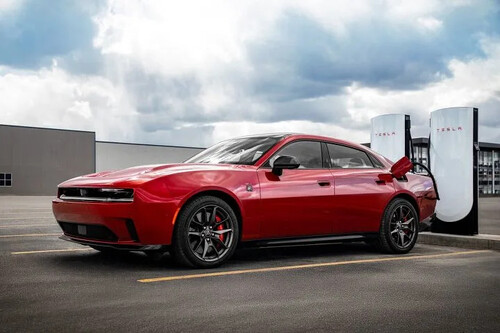
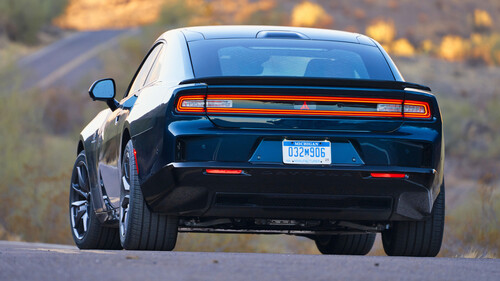
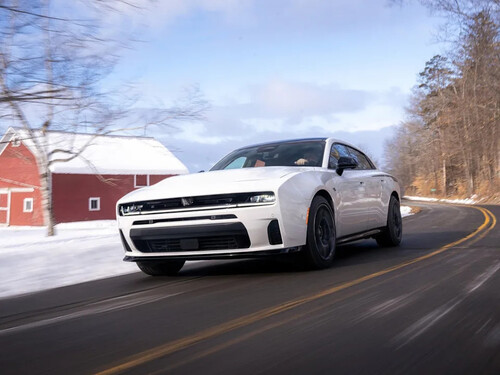
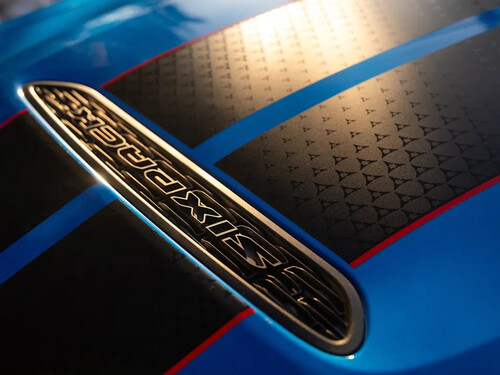
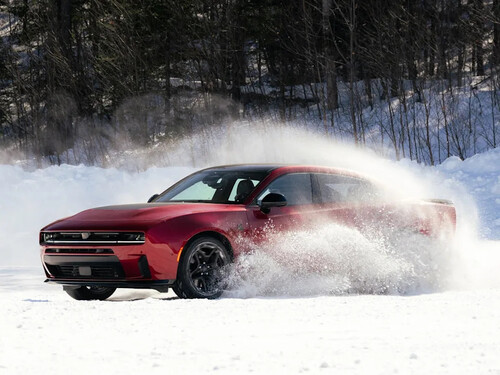
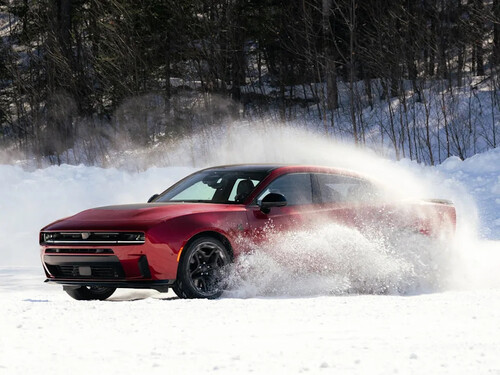
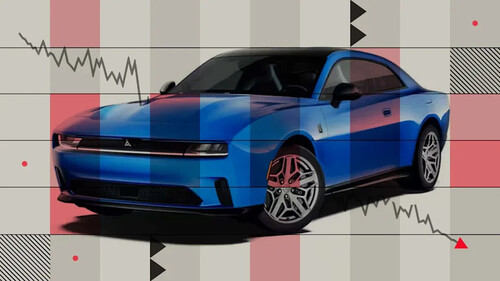
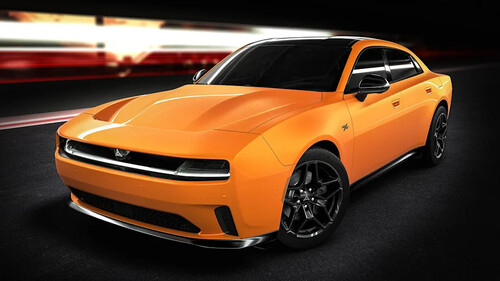
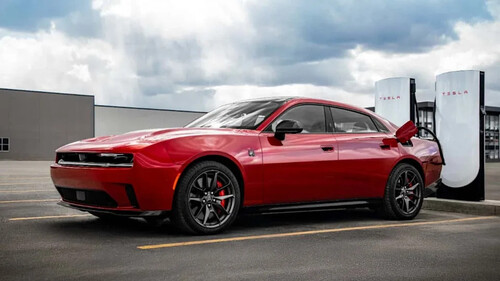
When the V8-powered Dodge Charger was discontinued in 2023, there was an expected uproar among muscle car enthusiasts. Though that wasn't the first time the famed muscle car had been on the guillotine. The first time was in 1978; then it was brought back in 1983, only to be discontinued again in 1987; then it was brought back in 1988; then shafted again in 2005, where it stayed a staple until 2023 (at least the V8-powered one; Stellantis made sure to mention an EV was coming). I started to think the Charger name was cursed.Kristen BrownThe silk curtain was drawn back from the first all-electric Dodge Charger just one year later, and naturally, it came with mixed reactions. Mostly bad ones, even though it came with all-wheel drive, up to 630 horsepower as the Scat Pack variant (469 as the R/T), and four- or two-door configurations. Dodge was careful to maintain the classic Charger looks; it's bigger than previous generations, and it came with some seriously impressive track-ready software. The gas-only Hurricane-powered version came shortly after, thanks to some heated demands from Mopar lovers. Now that I've driven both, I can say one is most certainly better than the other. But it's not the one you're probably thinking of.Related: Road Ethos Launches: The New Automotive Lifestyle Site You Should ReadFirst, let's break down the EV detailsThe all-electric Dodge Charger gets so much more hate than I think is deserved. If anything, it suffers from the same criticism the Mustang Mach-E did. While the Dodge Charger EV isn't an EV SUV that borrows the name of an iconic pony car, it does disconnect incredibly far from the moniker's legacy in terms of propulsion. The Charger saw a few V6s throughout the years, but the Charger was well-known for its ridiculously high-output HEMI V8s. So, taking out the guzzling, loud and proud V8 and replacing it with two electric motors felt sacrilegious to many.Kristen Brown/AutoblogWith that in mind, I do feel like, once you look past the heritage of the Charger name, the EV version has a hell of a lot to offer. I reviewed the Daytona Scat Pack model, which is the highest tier you can go. For $70,345, here's what you get over the gas-only model:Horsepower Aplenty: The standard EV charger, the R/T, makes 496 horsepower and 404 lb-ft of torque, while the Daytona Scat Pack makes 630 horsepower and 627 lb-ft of torque. If you use the PowerShot button, you get a temporary boost of 40 horsepower, bringing the total to 670. But only for a short period.Track-Ready Drive Modes: The all-electric Daytona Scat Pack comes with two noteworthy modes: Donut and Drift Mode. They do exactly what you think they do. Either mode moves the motors' torque where it needs to be in order to achieve either driving stunt. I didn't test these modes, but I've seen videos, and it looks amazing. The gas-only version doesn't have these modes, but you can essentially disable the front axle to make it RWD if you wanted to.Usable Driving Range: The Daytona Scat Pack I reviewed had a maximum range of 241 miles. Notably less if you fit it with the factory summer tires.Fast Charging: It's optimized for DC fast charging up to 183 kW, going from 20% to 80% in about 27 minutes. It comes with a CCS port, but you can get an NACS adapter from Dodge if needed.Frunk Space (For a Price): The Charger is already built with impressive cargo figures, but the EV comes with a frunk instead of an engine. It adds 1.5 cubic feet of space, but you need the Plus Group package to get it, which costs $4,995.Smoother Driving: The gas-only model has an automatic 8-speed transmission, which I found to be incredibly harsh when shifting, and it felt very clumsy. The EV's one-speed "transmission" was smooth and effortless, no matter how you drive it.It's Cheaper to Refuel: Only if you can charge from home, but it's still worth mentioning. Study after study shows that charging at home only costs about $0.04 to $0.06 per mile (or $35 to $61 per month), while gas cars cost between $0.10 to $0.15 per mile (or $120 to $180 per month). If you have to rely on public charging, that cost per mile for EVs jumps significantly, making it just as expensive or more than gas, depending on the EV, which charging company you're using, how often you're charging, and even when you're charging.What's so different about the gas-only model?The Dodge Charger, regardless of what it's powered by, shares the same looks, the same touchscreen, the same software, the same rear legroom dimensions, and the same interior amenities. They're even similarly priced. But there are a few notable differences between the SIXPACK and the Daytona Scat Pack EV.Kristen BrownFor $67,160 (just $3,185 less than the top-tier EV), this is what you can expect over the electrified version:Pony Variation: Like the EV version, there are two ways to slice the Hurricane twin-turbo inline 6: The SO, which stands for "Standard Output," offers 420 horsepower and 468 lb-ft of torque. The HO, or "High Output" option, boosts the horsepower to 550 horsepower and 531 lb-ft of torque.You Can Go Farther: Dodge's website claims that the gas-only maximum range on a full tank is close to 500 miles if you're doing mostly highway driving, as the average MPGs in that case are around 26. I'm not sure I believe that, as most of my driving was on the highway, and the range I saw was 322 miles. Which is still further than the EV.Natural Sound: The Daytona Scat Pack EV has a fake exhaust that you can hear looping if you listen close enough. It's a fun feature that adds personality, and you can adjust the loudness (or even turn it off completely) if you want to, but you can't beat the natural roar from a thirsty, roarin' gas-only engine.Better Track Behavior: I've seen a few reviewers drive both on the track, and while the EV has a faster, smoother transition from zero to sixty, the added weight of the battery certainly changes the dynamics. The gas-only version is lighter, so it's more maneuverable and easier to control.The Gas-Only Version is Cheaper: There are a lot of trims to choose from, because you can opt for either two- or four-door configurations. The two-door R/T version starts at $49,995 and tops out at $59,990 for the Scat Pack. That's a lot less than the EV, which starts at $59,995 and maxes out at $64,990. Though, as we've seen, the price can be over $70,000 depending on packages and add-ons.Related: 2026 Dodge Charger EV: Is it More Than Just a Gimmick?What do they have in common?I've said it a few times by now, but they share literally everything save for the propulsion method and price. Both are roomy, large, and surprisingly practical. The trunk of the EV version surprised me and my mother-in-law, when both of us were able to fit our Costco hauls in the trunk. Because the wheelbase is long and it has a rear hatch door, there's tons of space at your disposal. The rear seats are comfortable; it was easy to get my daughters' car seats into either model, and there was plenty of legroom for adults with rear-facing A/C vents, USB-C charging ports, and cupholders for everyone. Both my husband and I were shocked by how much practicality was packed into a muscle car's body.Kristen BrownAnd they're both so much fun. My daughters enjoyed both, though I'd say the gas-only version was their favorite because it came in the Redeye color instead of the Bludicrous color. They also liked how loud the gas-only version was compared to the EV. Both have very easy-to-use software and interior controls. They're essentially dummy-proof. I enjoyed both thoroughly.With that, I'd pick the EV—because it's more reliableListen—I was just as shocked to learn that I'd pick the EV over the gas-only version, but I have a few reasons. First being the fact that EVs are more reliable. Their systems are relatively simple compared to today's gas engines, and I have a personal beef with whoever decided to not put an engine oil dipstick in the new Charger. Here's why:The day after it was delivered to me, I decided to drive it to the gym. As it rumbled to a start, I got an alert on the dashboard that read, "ENGINE OIL LOW. ADD 1 QT SOON." I had to dismiss the message, and then a light was permanently illuminated on the dash. I decided not to drive it to the gym, for fear I'd do harm to the engine. I asked my husband, who's an ASE Certified Advanced Level Specialist and a Subaru Certified Master Technician, and asked him about it. His first words were, "It probably doesn't have a dipstick. I'd call the fleet company." So, I did. They sent someone out, who verified there wasn't a dipstick to check and had to go through the computer. The computer said it was indeed a quart low—at only 3,000 miles—and left a quart with me. While I was driving to the gym later, the car alerted me that it was "CRITICALLY LOW" and showed one bar below empty. It didn't update to its previous reading of 1 quart low until I parked it at the gym, which told me that it freaked out from being parked on an inclined driveway. You wouldn't have to worry about that with the EV.Kristen BrownAt the end of my week with it, it's still reading low. And because there's no dipstick, I have to rely on the computer (which has already proven to not be reliable, since it can't tell the difference between being parked on an incline or not) to check on the level.Kristen BrownAlso, the transmission in the gas-only version felt… Funky. At slow speeds, even in Eco mode, it would rev high and then shift into the lower gears, but it would do it very aggressively. If you wanted to, say, put the pedal to the metal before you get onto the freeway, the engine would make a ton of noise before the transmission seemed to engage. And when it did, it did very aggressively. It didn't feel right at all. And, to be fair, given its name and category, drivers before me likely drove it harder than Dodge would probably want people to, but… Still. If I bought it brand new and it drove like that, I'd be very concerned about the Charger's longevity as a gas-only version. I wouldn't have those fears with an EV.Related: I Drove The Gas Dodge Charger Sixpack And Electric Charger Daytona: Here's Which Muscle Car Makes More Sense