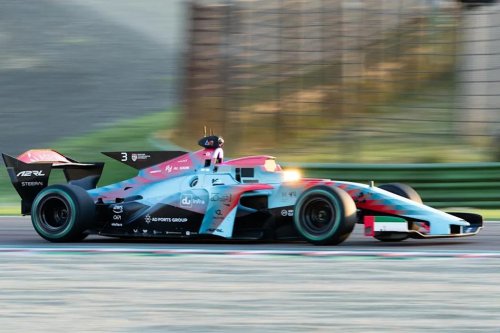
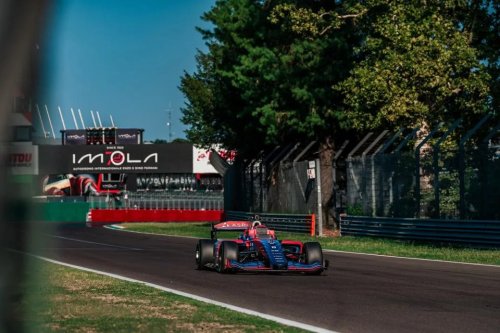
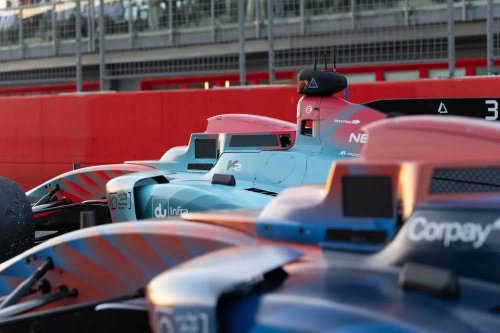
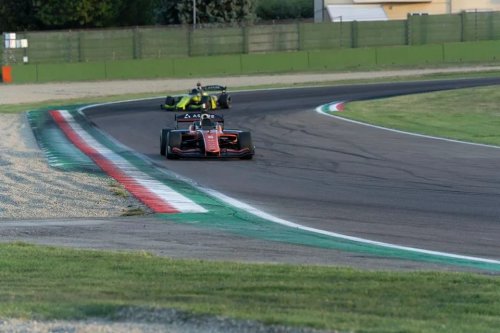
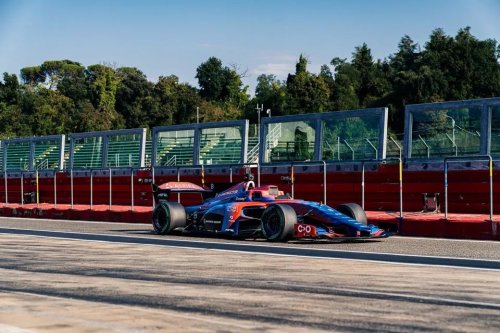


















Could A2RL Give European Automakers An Autonomous Driving Advantage?ForbesJames Morris, ContributorSat, September 12, 2026 at 8:30 AM UTCAdd us on GoogleOnce on the racetrack, the A2RL cars are entirely autonomous.Francesco OrlandoSelf-driving cars are starting to feel like a real proposition around the world. We're used to hearing stories about Waymo taxis in California and surprisingly good technology in China, but with Wayve beginning supervised operations in London and Croatia's Verne starting services in Zagreb, the revolution is entering Europe too. US and Chinese technologies still dominate, however. After its first European competition at Imola, though, could the A2RL self-driving racing series help change that? I talked to teams and the organizers to find out."Europe is following technology that is being firstly deployed in the US and China," says Professor Marko Bertogna, team principal of Unimore Racing, one of the top A2RL teams. "That's a big aspect that we would like to reverse." A2RL stands for Abu Dhabi Autonomous Racing League, and its home location is in the Emirate. When I last wrote about whether A2RL could rival Formula One for entertainment, the series was already delivering overtakes and drama. November's six-car final at Yas Marina saw the German TUM team win after Unimore's challenge ended in a collision.A2RL Moves Beyond Its Home CircuitBefore the Imola race, Stéphane Timpano, CEO of organizer ASPIRE, extolls how A2RL technology has developed. "The cars are super reliable now," he says. "The autonomous hardware stack we have in the car is still the same, but the level of quality of the software, which is what the teams bring to the party, has kept evolving and improving."AdvertisementAdvertisementUnfortunately, the race at the legendary Imola track showcased how there are still improvements to be made. Unimore's nemesis TUM returned to the pits with a technical issue on the formation lap, before the rolling start. Pole-sitter Unimore led and set the fastest lap at 1 minute 40 seconds, but a technical problem then dramatically slowed its car. PoliMOVE, following within a second and recording the event's top speed of 252.3km/h, could not avoid hitting Unimore's rear. Both teams' races then ended in the gravel. Abu Dhabi-based Kinetiz took the lead and won the 12-lap contest ahead of Germany's Constructor Racing. PoliMOVE, Unimore and TUM were classified third, fourth and fifth respectively.Imola was more of a racing challenge than the Abu Dhabi track of previous races, so the successful laps are still noteworthy. The Formula 4 track record is 1 minute 44.831 seconds, with Formula 3 at 1 minute 31.767 seconds and Formula 2 at 1 minute 27.056 seconds. With a human driver, a Super Formula car like those used by A2RL might manage 1 minute 20 seconds, so the A2RL cars are just 20 seconds off the pace. Imola adds narrower racing space, elevation changes and less forgiving margins than Yas Marina. Five teams were selected for the international event, staged alongside conventional motorsport during ACI Racing Weekend. Taking the technology somewhere unfamiliar tested whether progress survived a change of scenery.Imola is the first European circuit to host an A2RL race."Year one we didn't have a simulator," says Timpano. "So year one was real testing and real damage on the car. Now the damage is significantly reduced because the mistakes happen virtually." A digital version of Imola allowed teams to prepare before arriving. Timpano contrasts more than ten weeks of testing per team for the inaugural event with ten days allocated at Imola.For Unimore, simulation prioritizes physics over photorealistic scenery. "90% of the work was on the vehicle dynamics," says Bertogna. Keeping that model computationally manageable allows many thousands of runs to refine settings before risking hardware. "In this kind of vehicle, you change the track, you change condition. You should be able to quickly optimize your calibration parameter. The simulator helps you do most of the work before going on track. Anytime you go on track, you have a risk."AdvertisementAdvertisementFor Bertogna, resilience was already the priority before Saturday's setback. "It can be an error, a bug of a specific component," he says. "It can be the dynamics of the vehicle, which responds in a different way than you planned. We implemented a lot of mechanisms to anticipate unpredictable aspects."Replacing A Driver's Senses In A2RLThe hardware remains a serious racing machine. The standardized EAV-25 weighs around 690kg and is based on the Dallara Super Formula SF23, with a combustion engine rather than an electric powertrain. Its autonomy technology is relevant to either form of propulsion, after all. The seat and steering wheel make way for computing equipment, with actuators operating steering and brakes."The autonomous driver has a very comparable weight to the human driver," says Sascha Buettner, team lead at TUM Autonomous Motorsport. "So one can go out, the other can go in, and there is a fair competition between the two." A2RL technical director Nicola Palarchi explains how the autonomy hardware includes seven cameras, four radars and three lidars. Teams receive identical hardware, software drivers and firmware, making efficient code central to competition. The cars drive themselves; normal racing rules prohibit remote driving or live parameter changes from the pits.Instead of a driver, the A2RL cars have a computer, an extensive sensor package, and some software."We have 360-degree vision at all times," says Buettner. "A human driver needs to check the mirror." But seeing everything does not automatically produce driving intuition. Accelerometers, suspension measurements and an optical ground-speed sensor help quantify motion and slip. "We try to recreate the feel of a vehicle from these sensors. The strain gauges on the suspension, and the suspension travel, let us know how the tires move. The driver will just feel in a seat how the car is behaving."AdvertisementAdvertisementSpeed exposes limitations that more computing power alone cannot fix. Palarchi says the car can travel five meters at 250km/h during one lidar refresh. Combining readings from different sensors helps fill the gaps. The Imola race collision illustrated the stakes, although there's no indication sensor latency contributed to it. "Having multiple cars at once in close combat is the most difficult because of latency, processing time, frequency of refresh of the sensors.""The point where we are really limited is not on the computing power; it's actually on the sensor around the car," continues Palarchi. This year's changes also include network oversight, cybersecurity and better monitoring of computers and sensors. A rain kit has been developed beyond its prototype stage, with testing encountering heavy rain and hail. These are essential steps toward operating outside Abu Dhabi's comparatively predictable conditions.A2RL's AI Angel For Human DriversThe most intriguing commercial application resulting from A2RL might preserve the person behind the wheel. Timpano describes a virtual AI angel, crediting Dallara's Andrea Pontremoli with the idea: AI that actively helps drivers improve performance safely, rather than simply analyzing their mistakes afterward. "What I believe is the next real step is to bring AI into the racing car next to the drivers," says Timpano. "Today, everything that is claimed to be AI is mostly analysis of data but not helping the driver to do something better in a safer way."The distinction here is between autonomous systems that prevent an accident and those that augment a driver's abilities. A system that understands available grip, vehicle motion and the developing situation could potentially coach a driver or intervene when a maneuver becomes dangerous. Racing provides an unusually demanding environment for developing those capabilities. The A2RL cars may have malfunctioned in Imola, but not many humans could drive at the speed they did around this track safely either.A2RL now offers close racing between autonomous cars."Luxury sportscars probably don't want to be driven autonomously, but you can use this technology for driver engagement or virtual coaching," says Bertogna. "From a safety aspect, you can use it for autonomous braking, for last-minute avoidance, this kind of stuff at high speed, so this is a very relevant asset that comes exactly from what we deploy here." Bertogna says his group works with companies in Italy's Motor Valley, although nondisclosure agreements prevent him discussing specific projects. This remains a development opportunity, not an announced production feature, however. Translating track performance to unpredictable public roads still requires substantial validation.AdvertisementAdvertisementBefore TUM's formation-lap problem, Buettner emphasized robust fallback behavior. "A lot of our software is designed to be quite safe and fall back to reasonable performance when maximum performance is not possible anymore," he says. "We have a lot of safety systems in the code. In the simulator we want to be more on the limit, and we want to test what we don't want to see in the real world. When we go beyond the limit, we'll see it in the simulator, make sure the software can handle it." That philosophy offers a useful bridge between winning races and helping road drivers: maintaining control when circumstances stop matching expectations.Europe's Opportunity In Physical AI Through A2RLChina and the United States dominate much of the consumer autonomy conversation, with Tesla particularly prominent in personal cars. But driver assistance and driverless operation are two different things. Tesla's Full Self-Driving (Supervised) requires active supervision (the clue is in the name…), but as I explored in my article about Tensor's proposed personal robocar, selling consumers Level 4 autonomy is a more complicated proposition.Europe is not starting from zero, however. Mercedes-Benz secured German approval for conditionally automated driving at up to 95km/h. Bertogna's argument is about turning European expertise into greater commercial influence, with Abu Dhabi's assistance, rather than denying its existing achievements. "The Emirates have the desire to innovate," he says. "They have funding, and they have ambition. We lack funding and we are less innovative, but we have very strong industry, and we are ambitious as well."There's still some way to go, but A2RL shows potential for the future of high-speed autonomous driving.For Bertogna, A2RL provides a partnership between Emirati investment and European engineering. Kinetiz's victory shows the UAE brings competitive expertise too. Unimore's fastest lap and PoliMOVE's fastest top speed demonstrated European pace, but converting research into dependable products requires more than speed. "These challenges show you that the academic research ecosystem is valid," Bertogna argues. "These reasons stimulate you to reconsider the potential of the European technology."AdvertisementAdvertisementCompeting directly with enormous robotaxi budgets in China and the US is not his preferred route, however. Bertogna's company is pursuing narrower applications, including logistics, delivery and vehicle relocation, where the environment and task can be more tightly defined. "This can be developed with millions, not billions," he says. "So this is something feasible." The AI Angel idea fits that more focused strategy: sell valuable capability to an established manufacturer, rather than replicate an entire autonomous driving business.Taking A2RL's Next Step AbroadA2RL says its next race will return to Yas Marina, with Imola's lessons feeding into development in Abu Dhabi. Timpano's stated plan for 2027 remains an Abu Dhabi race and an international race, with venues under discussion, although there are no confirmed 2027 dates. "The idea will be to find another iconic place like Imola, and most likely do that coupled with other races," he says. "So we also bring that novelty to the public, and the public will discover something totally new."Alongside hardware development, Timpano sees another possible export in simulation: a virtual driving license for autonomous software. Regulators could test new systems and updates against local conditions before allowing deployment, although this is still very much in the ideas phase. "Every time you receive a new car as a country regulator, you need to certify it," he says. "And every time there is something that comes from outside and upgrades your car, you need to make sure that the new upgrade works."Bertogna wants industry to seize the opportunity. "Let's not wait for politicians to do it, let's exploit the challenges and possibilities," he says. "International collaboration like this is a goldmine if you are properly exploiting it because European industry is still amazing." The Imola race made A2RL's opportunity and its unfinished work equally clear. If A2RL's teams can turn their understanding of cars at the limit into dependable products, the series could help build a European–Emirati industrial advantage. An AI angel may first earn its wings on a racetrack, but its most valuable work would be preventing the kind of emergency that decided Saturday's race – on public roads.AdvertisementAdvertisementThis article was originally published on Forbes.com