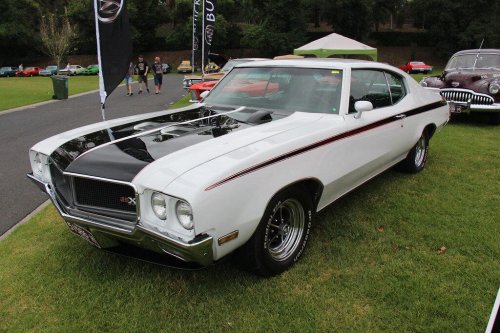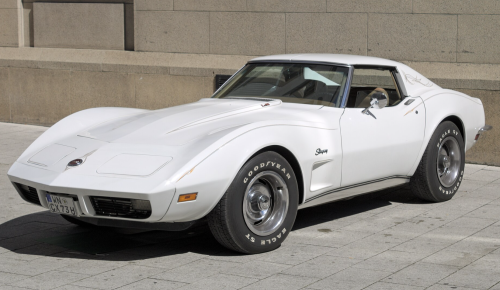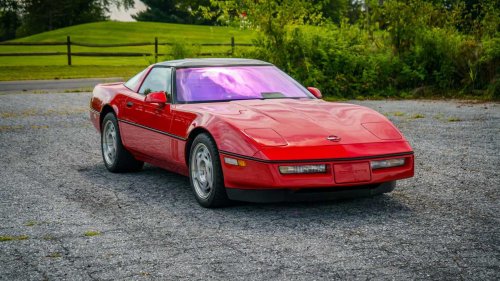
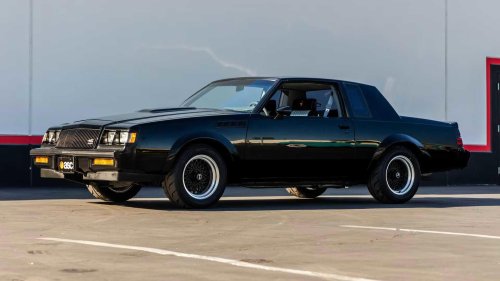
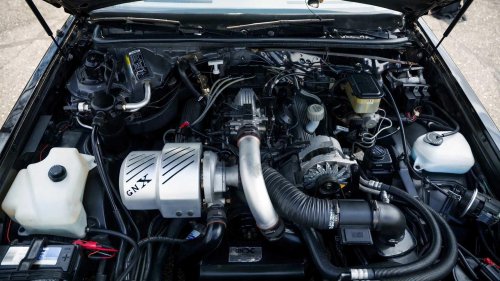
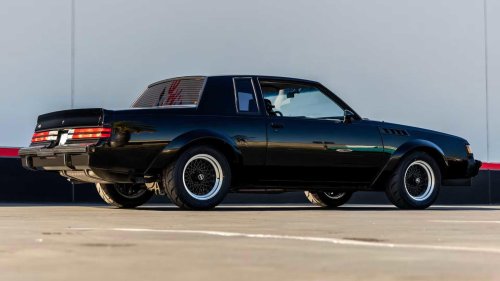
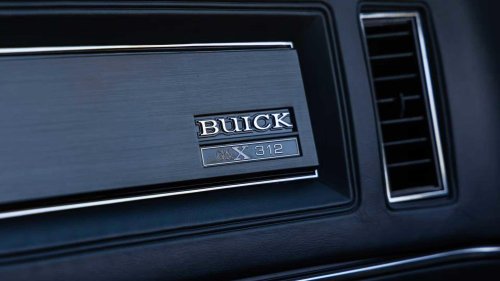
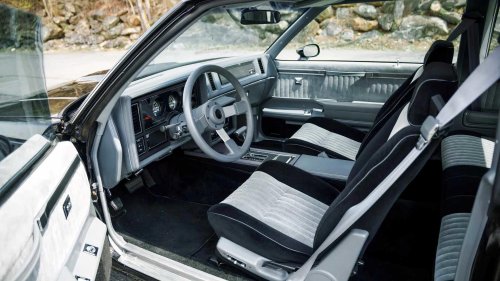


















American performance cars hit rock bottom in the early 1980s. Emissions regulations, eye-watering insurance premiums, and a decade of corporate timidity had reduced the muscle car from a cultural statement to a liability. The Corvette, which had once genuinely troubled European sports cars, spent most of the 1970s producing numbers that looked increasingly apologetic. When the C4 arrived for 1984, billed as a clean-sheet rebuild of America's sports car, it felt like progress. By 1987, it was making 240 hp and running the quarter-mile in the mid-14-second range. Credible. Encouraging, even.What nobody at GM wanted discussed was that a blacked-out coupe from Buick had the Corvette covered by over a second in the quarter-mile. Buick. The brand your grandfather parked outside the country club. The car wore no recognizable badges, came in one color and one color only, and was assembled in numbers so small that the majority of GM's own dealers never saw one. In 1987, the year it was born and the year it ceased to exist, it was the quickest production car in America. There were 547 of them. Buick, against all reasonable expectation, had done it again. The C4 Corvette's Problem in 1987 Via: Bring a TrailerThe 1987 C4 Corvette's L98 V8 produced 240 hp and 345 lb-ft of torque, available through a four-speed automatic or the newly introduced six-speed manual. Period testing of the 1987 C4 returned 0-60 times around 6.0 seconds and quarter-miles in the 14.4 to 14.5-second bracket, which in the context of 1987 American performance was a legitimate result. The Mustang GT came in behind it. The Camaro IROC-Z sat close. Against the broader market, the C4 made a reasonable claim to the title of America's quickest production car.The weakness was in how the L98 delivered its power. A naturally aspirated 5.7-liter making 240 hp is a conservative tune, and the engine built its torque through the mid-range rather than off the bottom. On a quarter-mile strip against something producing peak twist at 3,000 rpm, the Corvette was always going to be chasing. Its engineers had built it for a broad range of uses. What rolled up alongside it had been built for one. The 1987 Buick GNX: Darth Vader's Weapon of Mass Destruction Via Mecum AuctionsGNX stands for Grand National Experimental, and the final word is pulling its weight. The project came from Buick's Chief Engineer Dave Sharp, who approached ASC McLaren with a precise brief: take a fully-loaded 1987 Grand National and build the send-off that the rear-wheel-drive Regal program deserved. McLaren agreed. 547 Grand Nationals were prepared with the correct interior trim package and dispatched to McLaren for conversion, each returning as something American performance had not produced in over a decade.Car and Driver covered the launch with the headline "Lord Vader, your car is ready." The name required no explanation. Everything that identified the car as a Buick had been removed or blacked out. The hood and fender emblems were gone. The front fenders gained functional heat-extracting vents. Sixteen-inch black mesh wheels sat under composite flared arches. Nothing about it invited a second look. That was entirely the point. At $29,900, it cost $10,995 more than a base Grand National and put the buyer above the sticker price of a C4 Corvette. Most of them bought it anyway, because they knew something the Corvette buyer did not.In 2024, Kendrick Lamar named his fastest-selling album after it and drove one onto the Super Bowl stage in front of 120 million viewers. Lamar, born in 1987, owns one of the 547. The GNX had spent 37 years being a secret held by people who paid attention. After the halftime show, the secret was out. Why Buick Buried The Real Numbers via Bring A Trailer The 276 hp and 360 lb-ft ratings were a corporate decision, not an engineering one. The factory rated the GNX conservatively to avoid embarrassing Corvette, repeating the same internal politics that led Buick's engineers to understate the 1970 GSX Stage 1 by a comparable margin. The Corvette was GM's performance flagship. A Buick Regal running a quicker quarter-mile was an uncomfortable fact that the rating system could at least partially obscure.It did not obscure it for long. Third-party dyno testing confirmed actual output at 300 hp and 420 lb-ft of torque, with peak torque arriving at 3,000 rpm. A 276 hp car weighing 3,500 lb does not run 13.43 seconds in the quarter-mile. The physics are straightforward. The drag strip results were public. Anyone willing to read the timing slips already knew what Buick had actually built. The official rating existed for the press release. The quarter-mile time was what mattered on the night. Only 547 GNXs Were Ever Built Via Mecum AuctionsThe production run closed at 547 cars, all from the 1987 model year, all identical in specification. Originally projected at 200 units, demand pushed the final number higher before the decision to end the Grand National program ended any further discussion. Every example received a numbered production plaque on the dashboard and a second on the fan shroud under the hood. Stewart-Warner analog gauges replaced the standard Buick instruments throughout, including a dedicated boost gauge and an 8,000-rpm tachometer. Each car also came with a serialized jacket from race supplier Molly Designs. Many of those jackets no longer exist.Tribute cars built on standard Grand Nationals are both common and convincing. The numbered production plates are the primary verification tool, and the GNX Registry maintained by enthusiasts with access to GM's original factory records is the definitive source for confirming genuine examples. At these prices, buying a tribute car by mistake is not a small problem, and a VIN check against the Registry alongside an inspection from a turbo Buick specialist is not optional. It is the minimum due diligence before any transaction. GNX vs. the Corvette: 1987 Quarter-Mile Performance MecumThe Corvette result is clean and decisive. In official Car and Driver testing, the GNX ran 12.7 seconds at 113 mph. The C4 managed 14.5 seconds at 95 mph. The Buick was nearly two seconds quicker and still pulling harder at the finish line. The Mustang GT was not a relevant conversation. In 1987, the quickest thing wearing an American badge was a Buick with no chrome, no recognition, and a power rating the car itself clearly found insulting.The Ferrari F40 row is not there for effect. In the same period test, the GNX beat the F40 in the quarter-mile by 0.3 seconds, a car with 478 hp, a twin-turbocharged V8, and a price tag approaching $400,000 in today's money. The Buick had 3.8 liters, six cylinders, and a $29,900 window sticker. The F40 was the first production car to break 200 mph. The GNX beat it to the finish line. That result has been documented, debated, and confirmed for nearly four decades. Read it again if you need to. It still says what it says. What a 1987 Buick GNX Is Worth Today via Bring A TrailerThe GNX was always going to be a collector's car. Most buyers in 1987 recognized it immediately and stored their examples accordingly, which explains the unusually high proportion of very low-mileage survivors still available. Current market data puts a Good-condition example at around $125,000 and a Concours car above $250,000, with ultra-low-mileage examples trading in a market that has its own ceiling entirely. The auction record stands at $308,000 for a car with 568 miles, set in 2022. Before that, the high-water mark was $220,000 for production number 547, the last one built, which had covered just 68 miles when Mecum sold it at its 2017 Kissimmee auction.Mileage is more decisive for the GNX than for almost any other American collector car. The gap between a sub-1,000-mile original and a documented 20,000-mile driver can exceed $100,000, and the Kendrick Lamar Super Bowl effect has not faded since 2025. Values moved after the halftime show as a generation of new buyers discovered simultaneously what the car actually was and what it now costs.The GNX's arc mirrors the1970 GSX Stage 1almost exactly: Buick, the brand the performance world dismissed, building the quickest American production car of its decade, in tiny numbers, while everyone was watching something else. The market has now fully absorbed that story, and the price reflects it. Anyone who was going to acquire a GNX cheaply already has one. The rest of us are working with what the current market will offer, and that window continues to close.Sources: Hagerty, CorvSport, Street Muscle Magazine, NFL YouTube Channel, GNX Registry, Car and Driver, General Motors.