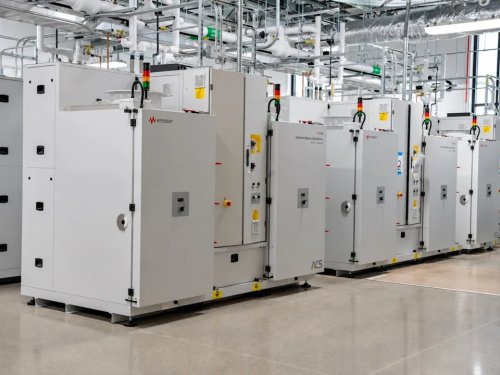



















“If it’s too good to be true, it probably is,” my old Irish grandmother liked to say. Researchers at the Chinese Academy of Sciences claim to have developed an all-iron flow battery electrolyte that sustains more than 6,000 charge/discharge cycles without capacity degradation. The material costs roughly 80 times less than lithium-based alternatives, the researchers claim. Here is the abstract of the study, which was published in the journal Advanced Energy Materials on April 1, 2026. The alkaline all-iron flow battery (AIFB) adopting Fe complexes in both half-cells is an essential pathway to large-scale energy storage with inherent merits of long discharge duration. However, inferior electrochemical reversibility and ligand crossover hinder the long cycling stability of the AIFB. Herein, we delicately design the Fe complex anolyte with large-space steric hindrance and a negatively charged protective layer, which significantly boosts the long-term stability of the AIFB. While the coordination of Fe3+ with polydentate multi-ligands abundant in hydroxyl and sulfonic acid groups renders Fe complex a high steric hindrance, the negatively charged interface of Fe complex also effectively prevents OH− attack and active species crossover by virtue of electrostatic repulsion, thereby synergistically achieving high electrochemical stability and low membrane permeation. Based on the design guidelines, the anolyte design process starts with 12 organic ligands as building blocks, followed by constructing 11 distinct Fe complexes with tailored structures. After multiple rounds of screening, the AIFB adopting the [Fe(HPF)BHS]4− anolyte exhibits a record-breaking ultra-long cycling stability over 6000 cycles at 80 mA cm−2. This work provides deep insights into efficient anolyte design and offers a universal Fe complex design strategy, which is beneficial to promoting the application of high-performance iron-based flow batteries. Ignored By The Press Well, that is certainly interesting. What does it mean? News of this breakthrough is nowhere to be found in the mainstream press, which seems odd, considering the enormous implications of a dramatic drop in the cost of grid-scale battery storage. In preparing to write this story, I found several articles about this iron flow battery research, all of them quite far removed from the news sources the general public frequents. Oddly, not one of them provided a link to the study. Recently, a loyal CleanTechnica reader regaled me with a review of my writing by Gemini, which emphatically claimed I was not a journalist. I’m actually OK with that, as I do not consider myself to be one. But I seldom, if ever, write a story like this that does not contain a link to the source. You are free to decide for yourself whether those other outlets can claim to be journalists or not. I have my own opinion on that matter. The Rest Of The Story According to News 18, flow batteries store energy in liquid electrolytes held in external tanks, pumping the fluid through an electrochemical cell when charge or discharge is needed. Unlike solid-state cells, capacity scales with tank volume rather than electrode mass, making the format attractive for grid-scale storage where physical footprint matters less than cost per kilowatt-hour. The Chinese Academy of Sciences team formulated an iron-based electrolyte that addresses a persistent problem in all-iron flow battery chemistry — side reactions that generate hydrogen gas at the negative electrode, which gradually depletes active material and degrades cycle life. The new electrolyte formulation reportedly suppresses that reaction, enabling the 6,000 cycle performance figure. Lithium carbonate, which is the basis for most lithium-ion batteries, is traded on commodity markets and has swung between roughly $7,000 and $80,000 per metric ton over the past five years. Iron sulfate, the primary precursor for iron flow electrolytes, is an industrial byproduct available at a fraction of that price. The Devilish Details “The 80 times cost differential cited by the researchers refers to raw material cost per unit of stored energy, not the installed system cost, which also includes membranes, pumps, and power electronics,” News 18 says. “That distinction matters. Iron flow systems have historically carried high balance-of-plant costs that erode the cost of materials advantage. “If the new electrolyte formulation reduces or eliminates the need for expensive ion-exchange membranes — a detail the available reporting does not fully clarify — the total installed cost advantage could be substantial. If standard membranes are still required, real-world cost savings will be narrower than the raw-material comparison implies.” In other words, this is interesting news that could possibly alter the economics of large scale energy storage substantially, but it has yet to be tested in any real world scenarios. The prospect makes those of us who are champions of clean, zero carbon electricity thrilled by the possibilities, but there’s many a slip twixt the cup and the lip, my dear old Irish grandmother would say. News 18 points out that vanadium redox flow batteries currently dominate the commercial flow battery market, with several 100 megawatt-hour installations operating across China, Europe, and the United States. Vanadium electrolyte is expensive and subject to supply constraints, which has sustained interest in iron-based alternatives for more than a decade. Previous iron flow designs struggled with the hydrogen evolution problem the Chinese Academy team now claims to have resolved. LFP Dominates Energy Storage Today Lithium iron phosphate battery packs have become the default choice for utility-scale storage in recent years due to falling cell prices. Those LFP batteries typically deliver 3,000 to 6,000 cycles at 80 percent depth of discharge. An iron flow battery with high cycle life and low capital cost could find a market in multi-day storage applications where the energy density of LFP batteries is less relevant. Breakthroughs in materials in the lab can take years or even decades to earn commercial success. The utility industry is famously risk averse. It needs reams of data and years of real world experience before it smiles favorably on new technologies. But money talks. If this research leads to reliable grid storage that is significantly cheaper, it will gain industry acceptance in time. The Chinese Academy of Sciences has not announced a commercial partner or pilot scale deployment timeline as of yet. The 6,000 cycle claim is base on laboratory experience. However, flow battery performance at the kilowatt or megawatt level often diverges from cell level results due to shunt currents, thermal management, and membrane fouling. We have seen this play out with Donut Lab in Finland recently. It made some grand claims about its supposed solid-state battery. Those were met with significant pushback from scientists and the company has suddenly gone quiet about its breakthrough claims. Independent verification of the electrolyte stability data will be the immediate next test of the validity of this new technology. “The path from stable electrolyte chemistry to commercially viable grid storage hardware is long, but the raw material economics of iron give this approach a structural cost floor that lithium-based systems cannot match,” News 18 says. Here in the posh writers lounge at CleanTechnica global headquarters, we asked our resident Zen master for his opinion. “We’ll see,” he said. Hat tip to Vijay Govindian, who found this story buried in his news feed and forwarded it to me, Thanks, Vijay!