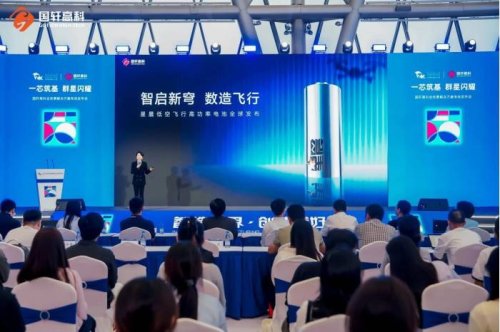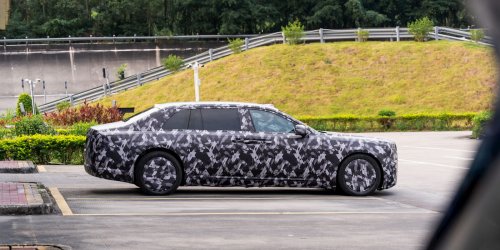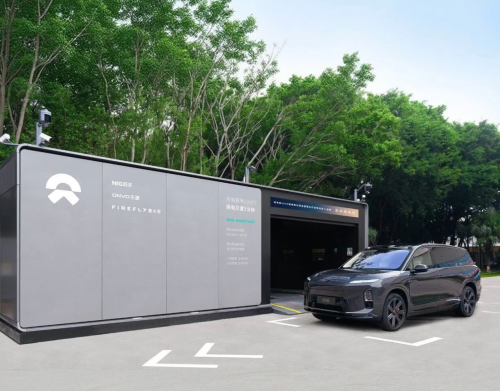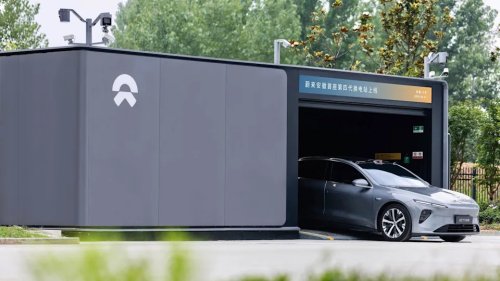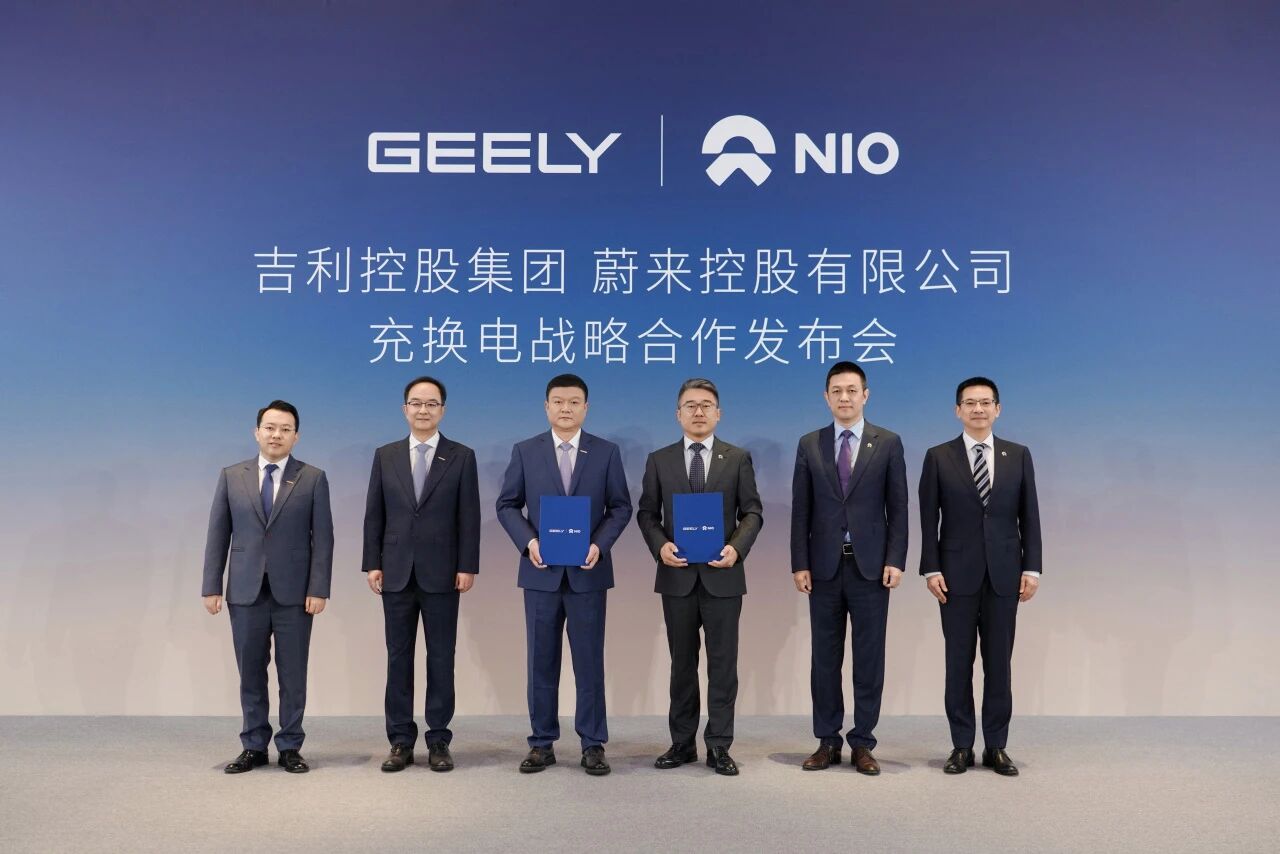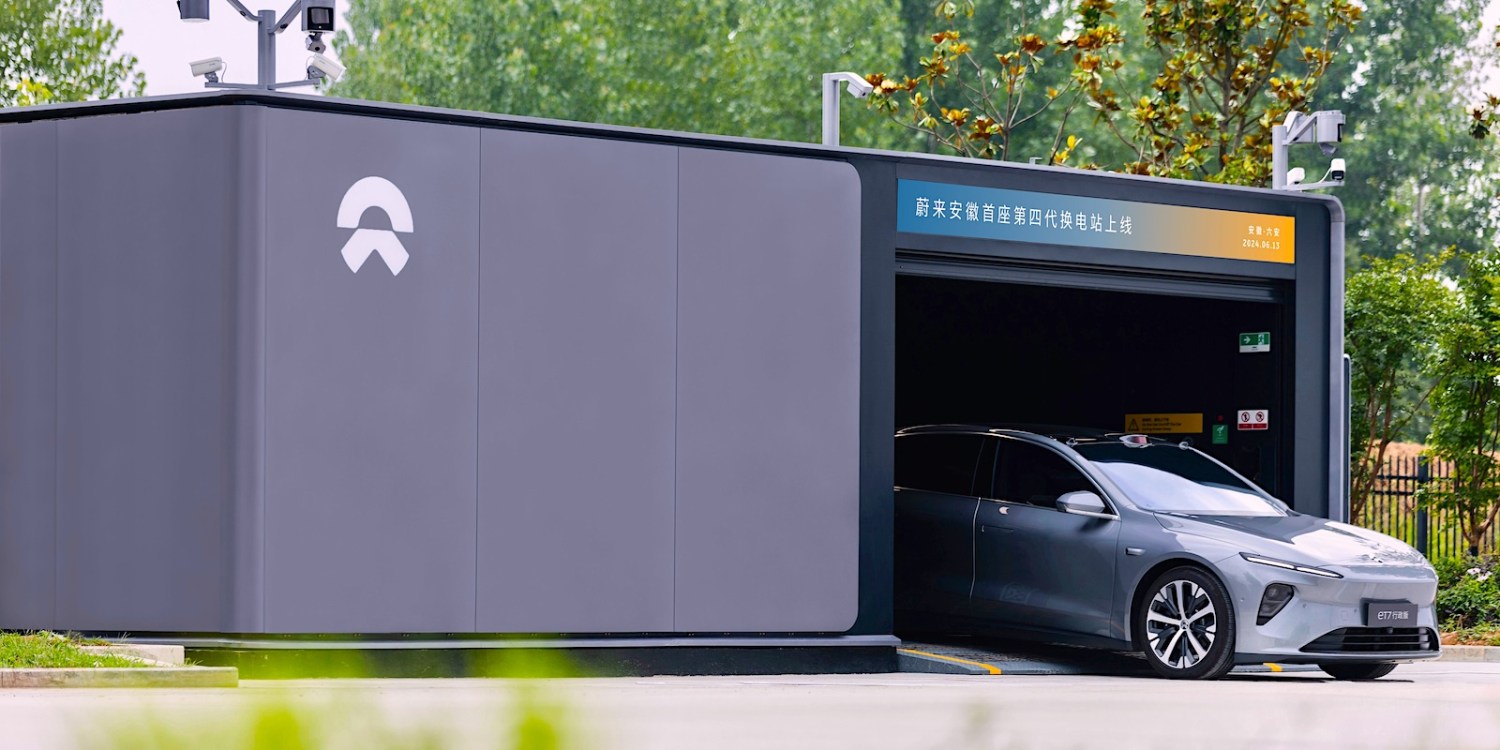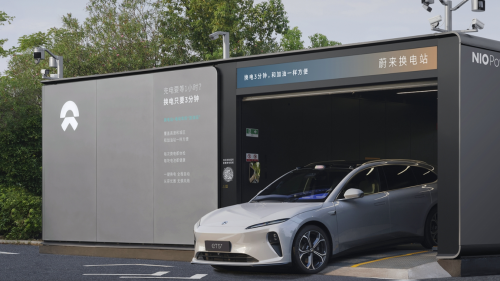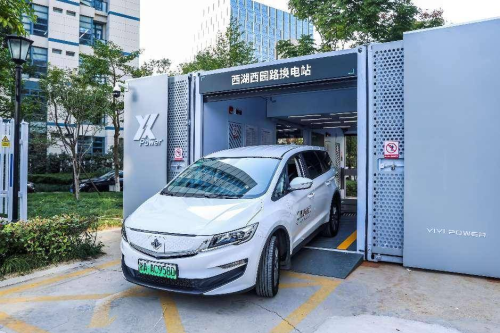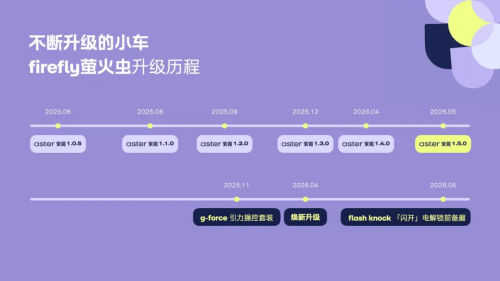

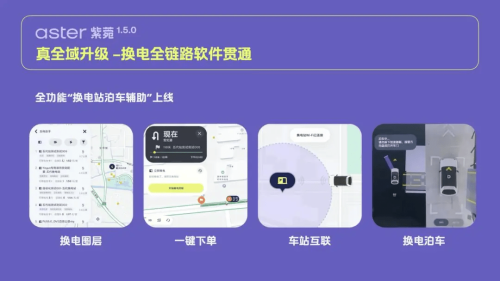
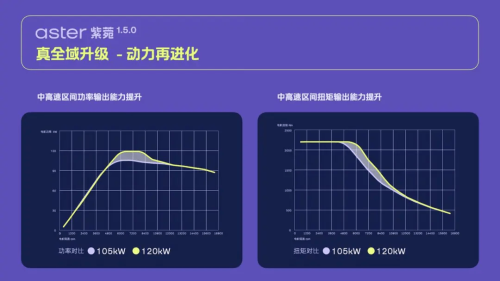
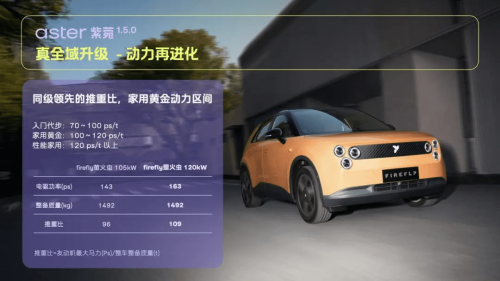
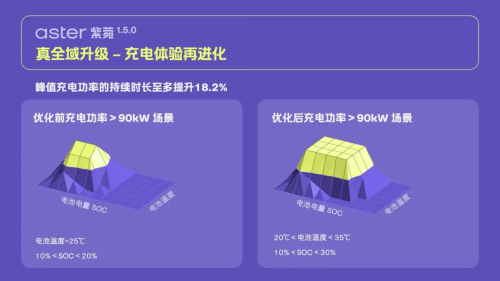





















On May 14, firefly officially launhced the Aster 1.5.0 intelligent system in China through over-the-air (OTA) rollout. Ahead of the public rollout to owners, firefly held a media briefing where CEO Jin Ge detailed the key upgrades included in the new version. The OTA package itself is relatively compact, with only three major updates, but each carries broader strategic implications. Upgrade history of firefly’s Aster system First, after upgrading to Aster 1.5.0, the 2025 firefly sees motor peak power rise from 105kW to 120kW, while the 0-100 km/h acceleration time improves from 8.2 seconds to 7.9 seconds. The upgrade is being offered free of charge to all owners, which the company describes as an “industry-first.” Second, charging efficiency has been optimized in the new version. For example, charging sessions can now sustain power output above 90kW for a longer duration, with official figures claiming an extension of up to 18.2%. Power upgrade of firefly’s Aster 1.5.0 Most significantly, the update formally introduces battery swap-related functions in preparation for the upcoming rollout of swap services, including swap station mapping, interconnection between stations, and optimized autonomous parking for swap operations. During the subsequent Q&A session, Jin Ge also disclosed additional details about NIO Inc.’s fifth-generation battery swap stations, suggesting that the long-awaited swap functionality for firefly owners is getting closer to reality after nearly a year of anticipation. Battery swap upgrade of firefly’s Aster 1.5.0 At the same time, the company also made an eye-catching statement regarding a future firefly convertible model, saying a project would be approved if monthly sales surpass 10,000 units. Pricing, however, could be RMB 30,000-40,000 ($4,100-$5,500) higher than the current model. Perhaps the more intriguing question is how firefly managed to improve performance purely through OTA updates, and what kind of real-world changes owners can expect after the upgrade. Here’s a closer look. Stronger Acceleration, Faster Charging Recent online discussions around “OTA power limiting” have sparked controversy across China’s EV sector. During the event, firefly CEO Jin Ge addressed the issue directly, explaining how the company was able to increase motor output via software updates. According to Jin, the jump from 105kW to 120kW was achieved by optimizing software algorithms, improving voltage utilization and increasing inverter current, all while maintaining sufficient hardware redundancy and software fault tolerance. No physical hardware changes were required. Put simply, the additional 15kW comes from tapping into unused hardware headroom that already existed within safety margins, rather than “locking and later unlocking” performance. Behind the numerical gains is also a revised power delivery curve. Specifically, the motor can now sustain its 120kW peak output between 4,800 rpm and 12,000 rpm, lifting the power-to-weight ratio to 109 ps/t, which the company claims reaches the “golden standard” for family-use vehicles. Motor power upgrade of firefly’s Aster 1.5.0 Jin Ge added that firefly was originally conceived as a compact urban mobility car rather than a “hot hatch.” The development priority was maximizing cabin space within a small footprint, making compact motor packaging the company’s “first choice.” Even with the architectural advantages unlocked through OTA, the upgraded firefly still trails performance-focused rivals such as the Leapmotor Lafa5, which currently offers outputs of up to 160kW. Power output of firefly’s Aster 1.5.0 The company also emphasized that the performance increase does not negatively affect energy consumption figures. On the charging side, in addition to extending high-power charging duration above 90kW, the acceptable battery temperature window for fast charging has been widened from the previous 25°C benchmark to a broader 20°C-35°C range. The new version also adds Bluetooth-enabled front trunk unlocking to improve day-to-day usability. Charging upgrade of firefly’s Aster 1.5.0 Viewed from this perspective, the logic behind the Aster 1.5.0 upgrade becomes fairly clear. As Jin Ge stressed, the performance boost represents an expansion of operational boundaries while remaining within the limits of safety and hardware redundancy. While OTA-based performance upgrades are not new in the industry — Tesla and Mercedes-Benz have already introduced similar capabilities — firefly owners are likely to view this update more favorably given that it is completely free and available to all users. More importantly, the performance OTA is effectively the “dessert” rather than the “main course” of this update. Compared with the power and charging improvements, the next section may deliver even bigger surprises for firefly owners. Battery Swap Finally Approaches Reality The more important development for firefly owners is that the long-awaited fifth-generation battery swap station network is finally nearing rollout. During the post-event Q&A session, Jin Ge revealed that 2026 marks the first year of fifth-generation swap stations. Pilot station operations will begin in June, followed by larger-scale deployment starting in July. firefly As for station numbers, referencing previous comments from William Li, NIO Inc. plans to add 1,000 battery swap stations in 2026. Jin Ge added that, excluding already-built fourth-generation stations, “there will definitely be four to five hundred fifth-generation stations,” and every fifth-generation station will support firefly battery packs. Besides the launch schedule and initial deployment scale of the fifth-generation stations, the Q&A session also touched on plans for larger-capacity battery packs. The company reiterated that “a larger battery is definitely coming,” though no concrete launch timeline has been announced. The reason lies in firefly’s limited structural packaging space. firefly To increase capacity while maintaining the same dimensional specifications, the battery chemistry would likely need to shift from lithium iron phosphate (LFP) to ternary lithium cells with higher energy density. The core challenge, however, is cost. As Jin Ge bluntly put it, “the cost is indeed very high.” Naturally, another key concern among users is actual battery swap capability. Since launch, battery swapping has remained inseparable from discussions around firefly. Although consumers can lower the purchase threshold through the BaaS model, the absence of swap stations and larger battery packs has prevented firefly from fully realizing the advantages of its “chargeable, swappable and upgradeable” energy ecosystem. Meanwhile, competitors have already moved ahead. Before firefly, models such as the CATL-backed AION UT Super, built on the Choco-Swap ecosystem, had already established an initial battery swap network. NIO’s power swap station Now, with the launch of Aster 1.5.0 and the commercialization timeline for fifth-generation swap stations becoming clearer, the final missing piece of firefly’s “native battery swap architecture” appears close to completion. As noted earlier, the Choco-Swap ecosystem is expanding rapidly, meaning battery swapping is no longer a unique selling point exclusive to firefly. The question now is how firefly can transform swapping into a genuine product advantage. The answer may ultimately depend on how quickly fifth-generation stations and larger battery packs can scale up. Ahead of the first anniversary of the firefly brand launch, the company has already surpassed 50,000 deliveries. According to Jin Ge’s teaser, the 60,000th delivery milestone is “coming soon” — a notable achievement that already outpaces many EV compact-car rivals, including Smart and MINI. Based on CPCA retail data, firefly sold 4,973 units in April this year, ranking eighth among China’s top 10 best-selling new energy compact cars. Whether the battery swap ecosystem can help stabilize monthly sales at 6,000 units or even higher remains a question that only time can answer.