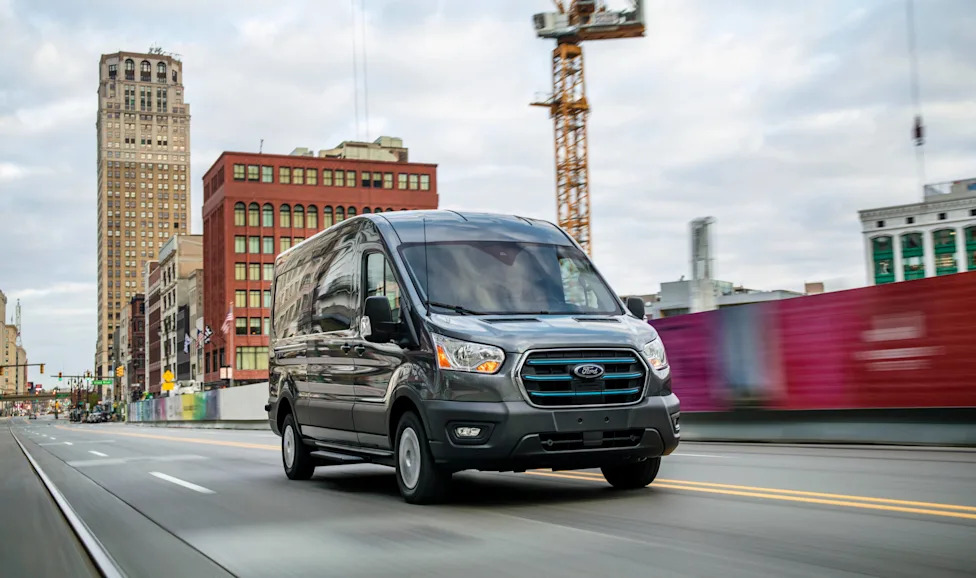



















2025 Ford E-TransitAutoblogAutoblog StaffFri, September 11, 2026 at 3:44 PM UTCAdd us on GoogleAutoblog and Yahoo may earn commission from links in this article.MSRP: ~$51,000Use the table of contents to jump to a sectionOverviewThe 2025 Ford E-Transit is a full-size electric commercial van, now in its fourth model year. It comes with a rear-mounted electric motor with 266 hp and 317 lb-ft of torque, driving the rear wheels and drawing electrons from an 89-kWh battery pack. Maximum range reaches 159 miles with the low-roof configurationAdvertisementAdvertisementThere are three roof heights and two body lengths to choose from, and configurations include Cargo Van, Chassis Cab, and Cutaway variants, providing the customer with extensive options and up to 487.3 cu-ft of cargo space or a payload of up to 3,997 pounds. The 2025 Ford E-Transit's price is now about the same as the gas Transit as well. The E-Transit is best for fleets aiming to reduce running costs, and with predictable daily routes not exceeding 100-150 miles.What's New for 2025?The 2025 E-Transit has access to four new factory-approved trade-specific upfit packages: Electrician Trade (reels to hang wire and bins/drawers to organise parts), HVAC Trade (refrigerant-container restraints, shelving, and bins), General Contractor (a combination of the first two), and Foldable Shelving (for delivery companies).Ford has also introduced Smart Acceleration Truncation, which automatically adjusts throttle response based on the van's load to prevent jackrabbit starts. Standard 180-degree-opening rear doors are now fitted to all low- and medium-roof vans, while 253-degree-opening doors are fitted to high-roof models (and optional on the others). Finally, a $2,000 rebate toward the installation of an EV charger is included with every E-Transit purchase.ExteriorThe E-Transit has the same silhouette as the gas model, but gets E-Transit badging and subtle blue grille accents, while a front-mounted charging port is another obvious difference. The compact low-roof configuration suits parking garages, the medium roof adds headroom, and the high roof allows people up to 6'9" to stand upright inside. Two body lengths are offered. Cutaway and Chassis Cab models come in the low-roof configuration for custom upfitting.FordView the 3 images of this gallery on the original articleInteriorEvery E-Transit comes with a 12-inch Sync 4 touchscreen with HD Radio, a 4G LTE modem supporting Ford Pro Telematics and Wi-Fi, and wireless Apple CarPlay and Android Auto. The two Dark Palazzo Gray front seats are trimmed in vinyl, but cloth is optional. Other options include Pro Power Onboard with 2.4 kW of exportable power for equipment and tools, as well as a camera-based digital rearview mirror for seeing through the cargo hold. Standard driver assists include automatic emergency braking, lane-departure warning, and lane-keep assist.FordView the 3 images of this gallery on the original articlePrice Range and Best Value ConfigurationThe Cargo Van's price starts at $51,000, but the $46,200 Chassis Cab is the lowest entry point. The federal commercial EV tax credit of $7,500 may apply.ConfigurationPriceBase: Chassis Cab$46,200Top: Cargo Van (Extended, High Roof)$56,530Key SpecsPowertrainMotorHPTorqueDriveRange (Low/Med/High)Single Electric266 hp317 lb-ftRWD159 / 148 / 143 miChargingMethodRateTimeAC Level 2 (80A)19.2 kW0-100% in ~6 hrsDC Fast Charge176 kW67 mi in 15 minBattery: 89 kWhAdvertisementAdvertisementMax cargo: 487.3 cu-ft (High Roof)Max payload: 3,997 lb (Cutaway)Seating: 2WarrantyCoverageTermBasic3 years / 36,000 milesPowertrain5 years / 60,000 milesBattery8 years / 100,000 milesComplimentary MaintenanceNot includedPros and ConsPros:Price parity with gas Transit eliminates EV cost barrier, and the $7,500 commercial EV tax credit and $2K charger rebate lowers the cost of ownership significantlyDC fast charging at 176 kW adds 67 miles of range in just 15 minutes, and overnight AC charging at 19.2 kW delivers a full battery in about 6 hours for next-day readinessPro Power Onboard provides 2.4 kW of exportable electricity, replacing the need for a separate generator on job sites and reducing equipment costsCons:Maximum range of 159 miles (low roof) drops to 143 miles on the high-roof model, further decreasing with heavy loads, making the E-Transit impractical for long-haul routesThe 89 kWh battery is smaller than the Mercedes eSprinter's available 113 kWh pack, and range trails both the eSprinter and Ram ProMaster EV in their largest battery configurationsRear-wheel drive only limits traction in winter conditions compared to the gas Transit's available AWD systemVerdictThe 2025 E-Transit arguably makes the strongest case of any electric full-size commercial van on sale in the U.S. right now. At about the same price as a gas Transit, the math is straightforward: up to 48% lower scheduled maintenance, federal tax credit, and way lower running costs add up to deliver rapid payback on the investment. Of course, with a maximum range of 159 miles, it's meant for city environments, not long journeys, but it amply covers the average daily U.S. commercial van's 74-mile distance. It's not a long-haul solution, but within the ambit of its abilities, it's a no-brainer.Competitors:Mercedes-Benz eSprinterRam ProMaster EVChevrolet BrightDropAdvertisementAdvertisementThis story was originally published by Autoblog on Sep 11, 2026, where it first appeared in the Cars section. Add Autoblog as a Preferred Source by clicking here.