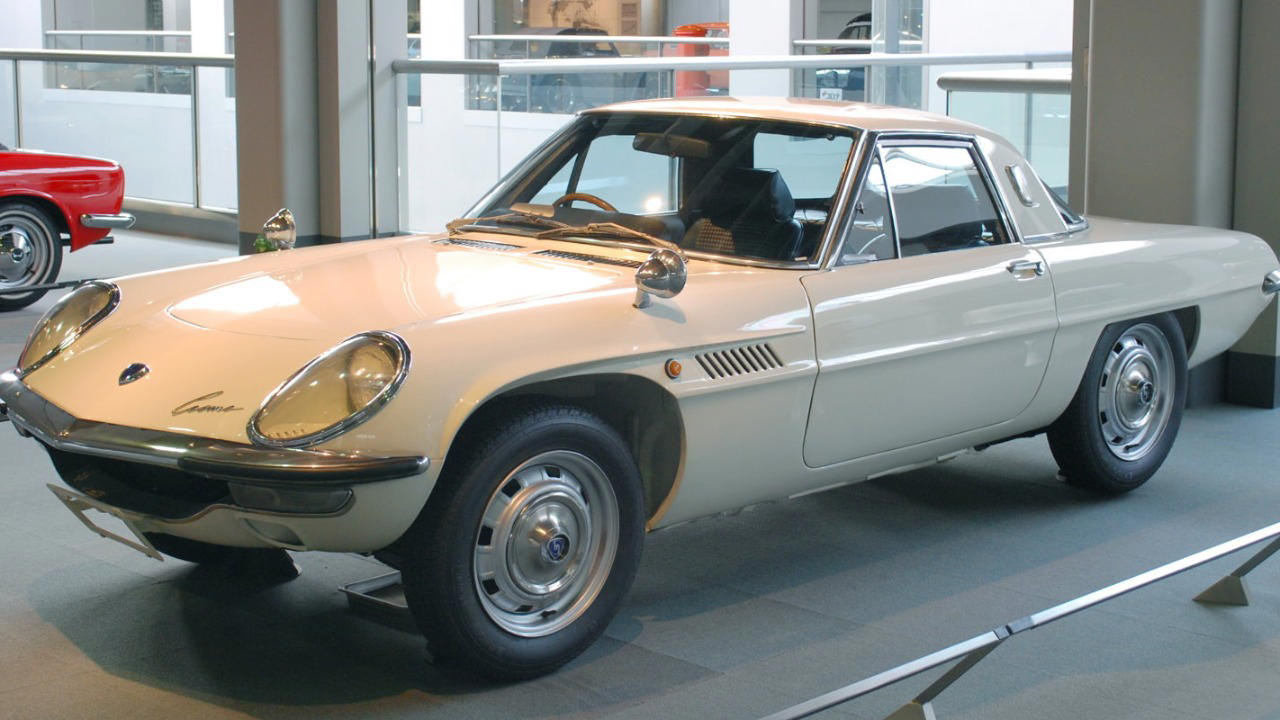
You’ve never heard of the 1968 Mazda Cosmo Sport but it introduced something revolutionaryThe 1968 Mazda Cosmo Sport rarely appears on bedroom posters or auction headlines, yet it quietly launched one of the boldest experiments in performance engineering. Beneath its delicate coupe body sat an engine with no pistons, a compact rotary that would define Mazda for decades and reset expectations for what a Japanese sports car could be. That mix of space-age styling and radical hardware made the Cosmo Sport a turning point, even if most drivers have never heard its name. Far from a mere design exercise, the Cosmo Sport proved its concept on road and track, from exclusive showrooms in Japan to an 84 hour endurance race at the Nürburgring. Its story explains how Mazda built a reputation for risk taking and why a low-volume coupe still shapes the brand’s identity long after production ended. The forgotten coupe that changed Mazda Viewed today, the 1968 Mazda Cosmo Sport looks almost fragile, with a low nose, slim pillars, and a cabin that seems to hover over its short wheelbase. In a detailed walkaround, Jan describes how a later 1970 Mazda Cosmo remains “so often overlooked in automotive history,” despite its distinctive proportions and meticulous detailing, a sentiment that applies just as clearly to the earlier 1968 car that set the template for the series Mazda Cosmo. The Cosmo name itself became a small family of models. According to the entry on Series L10A/L10B, the first Mazda to wear the Cosmo badge was also sold as the 110S for export markets, and it established the basic layout that later Cosmo generations would follow. Low-slung bodywork, a front engine and rear drive chassis, and a cabin trimmed to feel more grand tourer than stripped-out racer all signaled a car aimed at sophisticated buyers rather than mass-market commuters. In period, the Cosmo Sport was positioned as a halo model for Mazda. It sat above more conventional sedans and coupes, priced closer to a house in Japan than to a typical compact car. One enthusiast description of the 1967 Mazda Cosmo Sport calls it Japan’s First Supercar This, emphasizing how exotic the sleek white coupe looked in its home market and how different it felt from workaday runabouts that shared the same streets Japan’s First Supercar. That exclusivity, combined with limited production and right-hand-drive bias, helps explain why so few drivers outside Japan ever saw a Cosmo in person. The car’s real significance, however, came from what sat under its long, sculpted hood. The rotary revolution inside Where rivals relied on familiar inline-fours or sixes, Mazda treated the Cosmo Sport as a test bed for an entirely different idea of combustion. Instead of pistons moving up and down, the car used a compact rotary powerplant with triangular rotors spinning inside an epitrochoid housing. A detailed retrospective describes how the 1968 Mazda Cosmo Sport Launched the Automaker Rotary Revolution, turning a risky engineering project into a production reality that would influence every sporty Mazda that followed Rotary Revolution. Enthusiast coverage of the 1967 Mazda Cosmo Sport often frames this moment as The Rotary Revolution Begins Before the RX, pointing out that long before marketing slogans like Zoom and mainstream icons like the RX-7, Mazda had already committed to a radical engine architecture in its first sports car Rotary Revolution Begins. The Cosmo Sport made that commitment visible, and audible, with a high-revving, smooth power delivery that felt nothing like the pushrod fours of the era. Video retrospectives on the 1967 Mazda Cosmo Sport 110S describe it as The World First Rotary Powered Sports Car, highlighting how the coupe introduced rotary power to a segment that had been dominated by conventional engines First Rotary. Another clip on the same model notes that the Cosmos Sport was truly groundbreaking as the world’s very first production car equipped with a two rotor rotary engine, a configuration that would become synonymous with Mazda performance for decades Cosmos Sport. In technical terms, the two-rotor layout gave the Cosmo Sport a compact, lightweight engine with a high redline and a distinctive, almost turbine-like character. Enthusiast explanations of Mazda’s first sports car emphasize that it had an engine with no pistons and that this unusual layout contributed to both its price and its mystique, with some sources noting that it cost as much as a house and once raced for 84 hours straight in competition. For Mazda, the Cosmo Sport was not just a single model but a proof of concept. The company used the coupe to validate rotary durability, refine sealing and lubrication, and build in-house expertise that would later feed into cars such as the RX-2, RX-3, and RX-7. A social media post on a 1971 Mazda Cosmo Sport calls the Cosmo line a Groundbreaking Japanese Sports Car and highlights how the 1968 Mazda Cosmo Series I embodied this early phase of rotary development Groundbreaking Japanese Sports. From showroom to the 84 hour Nürburgring marathon Radical engineering means little without proof, and Mazda chose one of the hardest tests available. The Cosmo Sport’s defining motorsport moment came at the Marathon de la Route, a punishing event at the Nürburgring that ran for 84 hours. A detailed history of the race explains how the Marathon de la Route, often recognized as the 84 Hours of Nürburgring, demanded constant running on the long, unforgiving circuit with minimal rest for drivers or machinery Marathon de la. For a new engine concept, that race was a brutal exam. Rotary skeptics had long questioned apex seal durability and fuel consumption. Running flat out for 84 hours on one of the world’s toughest tracks was a direct answer. Enthusiast summaries of Mazda’s first sports car remind readers that the car’s engine, with no pistons, endured those 84 hours straight, an achievement that helped shift the rotary from curiosity to credible alternative in the eyes of engineers and fans. The Cosmo Sport’s performance at the Marathon de la Route also shaped Mazda’s emerging identity in motorsport. The company was not yet the Le Mans winner it would later become, but the decision to send a rotary-powered coupe to such a severe event signaled a willingness to take risks on the international stage. Supporting coverage that traces the Marathon de la Route story through European racing history situates Mazda’s effort alongside other experimental projects of the era, with references to resources such as The History and broader motorsport archives like formulah.com that document how manufacturers chased endurance glory. For Mazda, the payoff was twofold. First, the Cosmo Sport proved that its two-rotor engine could survive conditions far harsher than any customer would face. Second, the race linked the elegant road car to a narrative of toughness and innovation. That combination of delicate styling and mechanical grit remains one of the Cosmo’s most appealing contradictions. Design details and the evolution of the Cosmo Beyond its engine, the Cosmo Sport’s design tells a story of ambition and refinement. Enthusiast analysis of the 1968 Mazda Cosmo Sports notes that after about a year of production, Mazda introduced a series of changes to the Cosmo in the summer of 1968. But the summer of 1968 was also the occasion, after a year of production, to introduce a few changes to the Cosmo. Some were visible, others more subtle, but together they show how Mazda kept adjusting the car as it learned from early owners and racing feedback. The Cosmo’s proportions were informed by its rotary heart. With no tall cylinder bank to package, designers could keep the hood low and the front overhang short, which contributed to the car’s distinctive stance. The cabin sat slightly rearward, with a long dash-to-axle ratio that echoed European exotics of the period. Inside, the Cosmo Sport mixed space-age motifs with traditional craftsmanship, pairing round gauges and brightwork with carefully stitched upholstery. Later Cosmo variants, including the Series L10A and L10B, as described in the German overview of the Mazda Cosmo, refined these themes with incremental mechanical and cosmetic updates. International versions, chronicled in Spanish and Persian language references to Mazda Cosmo and Cosmo history, show how the model name carried forward into later, more luxurious coupes that kept the rotary link alive even as tastes shifted. Enthusiasts today often encounter the Cosmo through digital platforms rather than on the street. The Mazda Cosmo is Japan Forgotten Sportscar video, accessible through tools such as developers.google.com/youtube, helps a new generation understand the car’s proportions and presence in motion. Community posts that celebrate the Mazda Cosmo Sport as a Groundbreaking Japanese Sports Car and highlight specific examples like the 1968 Mazda Cosmo Series I keep the story alive even as the cars themselves remain rare in the wild. The Cosmo’s limited production and high original price have also made it a favorite topic among collectors and auction watchers. Coverage that frames the 1967 Mazda Cosmo Sport as Japan’s First Supercar This underscores how its combination of advanced engineering and exclusivity has translated into strong interest on the classic market, even if actual transactions remain relatively few compared with more common sports cars. Why the Cosmo still matters For Mazda, the legacy of the Cosmo Sport is not just nostalgia. The car set a template for how the company would approach performance projects: by combining daring engineering with expressive design and by proving new ideas in the harshest possible arenas. The Rotary Revolution that began with the Cosmo Sport fed directly into generations of RX-badged cars, and even as Mazda explores new technologies, the rotary concept continues to appear in discussions of range extenders and future sports models. Enthusiast communities that focus on the Mazda Cosmo Sport and the broader Cosmo lineage help keep that legacy in focus. A dedicated group that describes the 1971 Mazda Cosmo Sport as a Groundbreaking Japanese Sports Car and highlights the 1968 Mazda Cosmo Series I shows how owners and fans treat these cars as more than static museum pieces Mazda Cosmo Series. They are rolling proof of a time when a relatively small automaker from Hiroshima decided to challenge conventional engine wisdom and succeeded. Even the act of preserving information about the Cosmo reflects its underdog status. Donations that support Mazda Cosmo Wikipedia entries and related pages help ensure that details about Series L10A/L10B specifications, production numbers, and racing exploits remain accessible. Parallel references in Arabic, such as the page discovered through Mazda Cosmo Wikipedia, illustrate how interest in the car spans languages and regions even if physical examples are scarce. For many enthusiasts, the Cosmo’s appeal lies in that mix of obscurity and importance. A video that asks viewers whether they knew Mazda’s first sports car had an engine with no pistons and once raced for 84 hours straight captures the surprise that often accompanies a first encounter with the story Mazda. The fact that such a significant technical milestone remains relatively unknown outside specialist circles only adds to the car’s mystique. More from Fast Lane Only Unboxing the WWII Jeep in a Crate 15 rare Chevys collectors are quietly buying 10 underrated V8s still worth hunting down Police notice this before you even roll window down The post You’ve never heard of the 1968 Mazda Cosmo Sport but it introduced something revolutionary appeared first on FAST LANE ONLY.