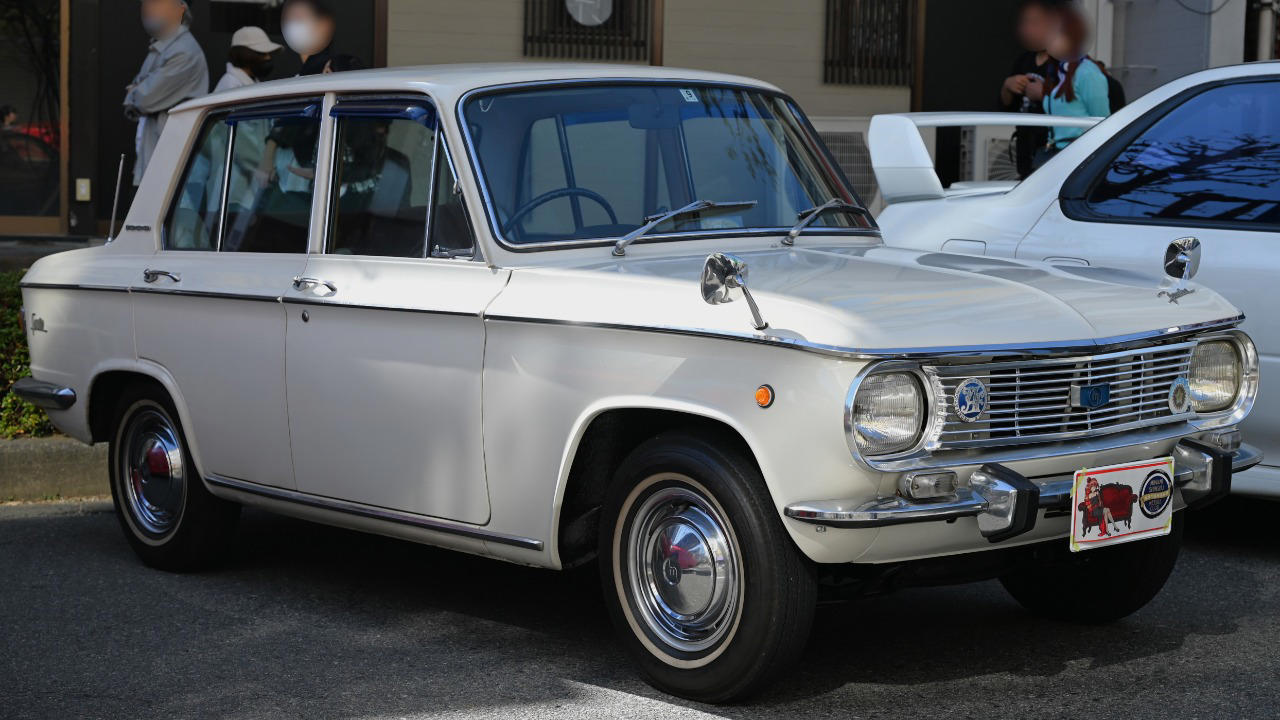
The 1967 Mazda Familia rarely appears in coffee-table histories or auction headlines, yet it quietly carried Mazda from a regional maker of tiny trucks into a serious global car brand. What looked like a modest compact in dealer showrooms helped create the volume, engineering confidence, and export footprint that later supported Mazda’s rotary sports cars and the long-running 323 line. To understand how Mazda built something larger than any single model, it helps to start with this unassuming family car. From flat-deck van to first true family car Mazda did not begin with glamorous sports machines. Earlier in the 1960s, the company was still better known for small commercial vehicles than for passenger cars. The turning point came when Mazda introduced the Familia as what the company itself has described as its first true family car, a shift captured in official messaging that recalls how the model arrived with a clean, flat-deck body and simple practicality for everyday use. That repositioning signaled a deliberate move away from purely utilitarian products toward cars that could anchor family life. The earliest versions were humble. Reporting on the model’s evolution describes how the Mazda Familia began as a compact van with roughly 40 horsepower, aimed at buyers who needed basic transport more than performance. As the Mazda Familia adapted to different markets, Mazda added variants that stretched far beyond that first 40‑HP van, including sedans and even a pickup truck for European customers, which shows how quickly the company recognized the platform’s flexibility and commercial potential. Inside Mazda, the Familia was treated as more than a single product. It was a test of whether the company could design, build, and sell a globally relevant small car at scale. That ambition would shape every major change that arrived in the mid 1960s. The 1965 coupé and the move upmarket The first sign that Mazda wanted the Familia to be more than a bare-bones runabout came with a sportier body style. A new Familia 1000 coupé appeared in November 1965, fitted with a 985 cubic centimetre SOHC “PC” engine that gave the compact car a more sophisticated edge. The use of a single overhead camshaft in such a small family car hinted at Mazda’s willingness to invest in engineering rather than relying on the cheapest possible mechanicals. This coupé did not exist in isolation. It arrived just as Mazda was adding the larger Mazda Luce to the range, which pushed the company into a higher segment and gave it a more complete passenger car lineup. With the Familia covering the small family car slot and the Luce reaching upmarket customers, Mazda could begin to speak to a broader audience at home and in export markets. The 1965 coupé effectively turned the Familia into a family of its own, with multiple body styles and engine options that could appeal to different buyers. That strategy also laid the groundwork for future branding. The use of the Familia name across several formats helped cement it as a core product line rather than a one-off experiment. Later, when the car became better known in many markets as the 323, that continuity would matter. The 1967 Familia: a new generation with bigger ambitions The real inflection point arrived with the second generation. The new Familia appeared in 1967 with a 987 cubic centimetre engine and a more modern body, a package that was sold as the Mazda 1000 in some export markets. That 987 cc figure appears repeatedly in historical references because it marked a clear technical step up from the earliest van-based models while still keeping the car in an affordable tax and insurance bracket. Period material and enthusiast histories describe how this 1967 car kept a simple pushrod layout for its 987 cc engine, a choice that balanced cost, reliability, and ease of maintenance. A video history of the Mazda Familia’s second generation notes that the new model arrived in November 1967 with that same push rod 987 cc engine, highlighting how Mazda preferred to evolve proven mechanicals rather than chase complexity for its own sake. The presenter, Jan, frames this as a deliberate decision to keep the car accessible while improving refinement and styling. The 1967 Familia was not just a sedan. The platform spawned wagons and other derivatives that allowed Mazda to address family buyers, small business owners, and export customers with varied needs. One reference describes how The Mazda Familia is a small family car or compact car that Mazda manufactured between 1964 and 2003, and the 1967 generation sat near the beginning of that long production arc. The fact that the nameplate would stay in production for nearly four decades shows how central it became to Mazda’s identity. Even at this stage, Mazda was already thinking beyond Japan. The decision to sell the 1967 car as the Mazda 1000 in some markets reflects a simple marketing reality: displacement-based names were easier for overseas buyers to understand, especially in regions where Mazda was still a new arrival. The underlying product, however, remained the Familia, with the same basic engine and chassis that Japanese customers were buying. Volume, exports, and the quiet work of a “great little car” While the 1967 Familia did not attract the attention that sports cars enjoy, it was the kind of product that keeps a company alive. It offered a combination of compact size, modest running costs, and enough space for a small family, which made it a logical choice for buyers moving up from motorcycles or basic trucks. Mazda’s own storytelling about the model emphasizes how Few customers at the time knew its history, but many felt its legacy as a simple, functional family car that slotted neatly into everyday life. As the Mazda Familia shapeshifted to fit export markets, Mazda introduced the Mazda 1300 line with a 1.3‑l engine, as well as a pickup truck for European buyers. That expansion shows how the basic architecture of the 1967 car was robust enough to accept larger engines and more demanding duty cycles. The same underlying package could serve as a family sedan in Japan, a light commercial vehicle in Europe, or an entry-level car in other regions. Each variant added incremental volume, which in turn helped Mazda spread development and tooling costs. Later accounts of the model’s export story recall how Mazda began shipping a fourth generation of its compact family car in the late 1970s, promoting it as Mazda’s great little car. A period enthusiast video about that era points out that Mazda began exports of the fourth generation familiar compact in 1977, and that owners came to describe it affectionately as a great little car that punched above its weight. That reputation rested on a foundation built by earlier generations, including the 1967 model that first proved Mazda could deliver a credible small car to a wide audience. Over time, the Familia name became synonymous with Mazda’s core compact offering. A later corporate retrospective on the line notes that the eighth generation took total Familia production past the 10 million unit mark, a milestone that would have been impossible without the steady sales of earlier generations. Every 1967 sedan that rolled out of the factory helped move Mazda toward that figure, even if no one at the time imagined such a long production run. The Familia and the rotary revolution The 1967 calendar year carries another meaning inside Mazda history. It is also the year Mazda put its experimental rotary engine into series production. The company launched the Cosmo Sport as its first rotary sports car, a sleek coupe that showcased a powerplant radically different from the conventional pistons inside the Familia. Mazda’s own heritage material describes the Cosmo Sport as a project that demanded intense development work and careful engineering to make the rotary viable for road use. The decision to pursue the rotary was not a casual gamble. Knowing how imperative the success of the rotary engine would be for the company, chief engineer Kenichi Yamamoto assembled a dedicated team to refine the design, solve reliability problems, and convince management that the technology could support a full range of cars. Historical analysis of Mazda’s rotary program explains how Yamamoto’s group worked through issues like rotor tip wear and sealing, problems that could have ruined the engine’s reputation if they appeared in customer cars. In that context, the steady presence of the Familia line mattered enormously. While the Cosmo Sport attracted attention as a technical showcase, it was a low-volume halo product. The Familia, by contrast, generated the sales numbers that kept Mazda’s factories busy and its balance sheet stable. Without a dependable compact car range, Mazda would have struggled to fund the research and development required for the rotary program. Later rotary models, such as the RX series, benefited directly from this arrangement. They sat on showroom floors alongside practical cars like the Familia, which brought in customers who might never consider a specialized sports coupe. That showroom traffic, in turn, created cross-selling opportunities. Buyers who came in for a family car could see, touch, and sometimes test-drive a rotary model, while enthusiasts drawn by the rotary halo were reminded that Mazda also built sensible transportation. Contemporary accounts of the rotary’s performance highlight how dramatic the contrast could be. One retrospective on Mazda’s rotary gamble recalls how a late 1960s rotary car could reach speeds north of 120 m per hour and felt agile and eager in corners. Figures like that were far beyond what a 987 cc Familia could achieve, yet both cars shared Mazda badges and dealer networks. The existence of a reliable compact like the Familia made it easier for Mazda to justify the risk of such high-performance experiments. How a family car shaped Mazda’s global identity Over the following decades, the Familia name grew into one of Mazda’s most important assets. A modern retrospective on Mazda’s most influential models describes the Mazda Familia, also known as the 323 in many markets, as a global sensation and Mazda’s most successful model. According to that account, The Mazda Familia carried the 323 badge and remained in production for 40 years, helping Mazda establish a reputation for compact cars that resonate with drivers across generations. That long run gave Mazda something every carmaker needs: a dependable, recognizable product that can anchor marketing, dealer planning, and long-term investment. The 1967 version sits close to the beginning of that story. It was early enough in the run to shape customer expectations, yet modern enough to compete with contemporary rivals. Buyers who chose a 1967 Familia or Mazda 1000 were effectively casting a vote of confidence in Mazda’s ability to deliver durable, efficient transport. The model’s global reach also helped Mazda refine its understanding of export markets. As the company adapted the Familia into the Mazda 1300 and other variants, it learned which features mattered most to overseas buyers, from engine size and gearing to interior trim and corrosion protection. That feedback loop influenced not only later Familia generations but also other models in the lineup. Enthusiast and reference sites that chronicle the car’s history reinforce this point. One detailed overview of the Mazda Familia line notes that The Mazda Familia served as Mazda’s small family or compact car offering from 1964 all the way to 2003, a span that covered multiple economic cycles, fuel crises, and shifts in consumer taste. The 1967 generation had to navigate the early stages of that journey, proving that Mazda could keep the car relevant through styling updates, mechanical improvements, and smart positioning. Regional variations added complexity. In some markets, the car was badged primarily by engine size, such as Mazda 1000 or Mazda 1300, while in others the Familia or 323 name took center stage. A multilingual set of references, including Japanese, German, Greek, Spanish, and Persian language pages about the Mazda Familia and Mazda 323, reflects how widely the car spread and how deeply it embedded itself in local automotive cultures. The fact that enthusiasts maintain these records decades later suggests a quiet but persistent affection for the car. Engineering philosophy: simple, adaptable, and quietly ambitious Looking back at the 1967 Familia, one theme stands out: Mazda’s preference for simple, adaptable engineering that could be refined over time. The use of a pushrod 987 cc engine in the second generation, even as the company experimented with advanced technologies like the SOHC 985 cc unit in the earlier coupé and the radical rotary in the Cosmo Sport, shows a clear separation between high-volume workhorses and technical flagships. Corporate history around the Cosmo Sport highlights how much effort went into perfecting the rotary, yet Mazda did not rush that technology into its bread-and-butter family cars. Instead, it allowed the Familia to mature on its own path, gradually adding features and variants as the market demanded. Official material on the Cosmo Sport describes how Mazda treated that car as a showcase for craftsmanship and innovation, which implies that the company understood the need to protect its mainstream products from unproven ideas until they were ready. Enthusiast analysis of Mazda’s rotary development adds another layer. Detailed accounts explain how engineers under Kenichi Yamamoto took lessons from early rotary prototypes and applied them not only to sports cars but also to broader engine programs. That cross-pollination eventually helped Mazda improve combustion efficiency, emissions control, and manufacturing techniques across its lineup, including the compact cars that descended from the 1967 Familia. The flexibility of the Familia platform also speaks to Mazda’s engineering philosophy. The ability to stretch the basic architecture into a Mazda 1300 with a 1.3‑l engine, or to convert it into a pickup for Europe, suggests that the underlying chassis and suspension were designed with headroom. Mazda did not build a single-purpose car that would be obsolete within a few years. It built a base that could support multiple roles, a strategy that would later reappear in the company’s use of shared platforms for different body styles and markets. A legacy hiding in plain sight Today, when enthusiasts and marketers celebrate Mazda’s history, they often focus on the rotary sports cars, the lightweight MX‑5 roadster, or modern crossovers. Yet the company itself continues to reference the Familia when telling its own story. Corporate social media posts and short films revisit the moment in 1963 when Mazda introduced the Familia as its first true family car, emphasizing how Its clean, flat-deck design and everyday usability shaped customer expectations. Another video piece simply titles the car The Mazda Familia and intercuts archival footage with modern commentary, reinforcing the sense that this unassuming compact still matters to Mazda’s brand identity. More from Fast Lane Only Unboxing the WWII Jeep in a Crate 15 rare Chevys collectors are quietly buying 10 underrated V8s still worth hunting down Police notice this before you even roll window down The post You’ve never heard of the 1967 Mazda Familia but it helped build something bigger appeared first on FAST LANE ONLY.



















 +10 others