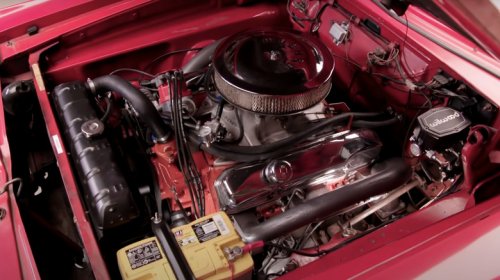
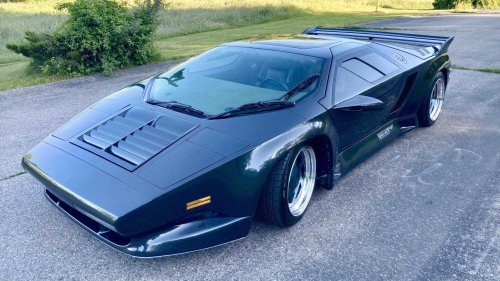
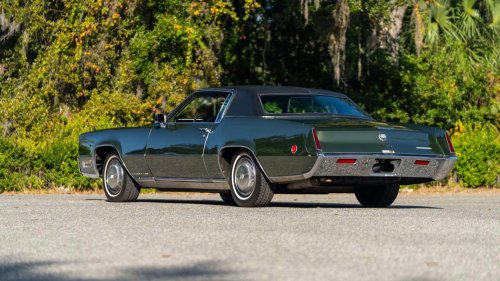
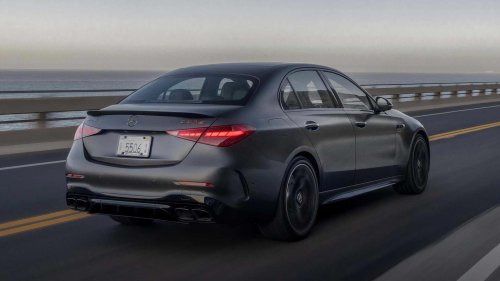
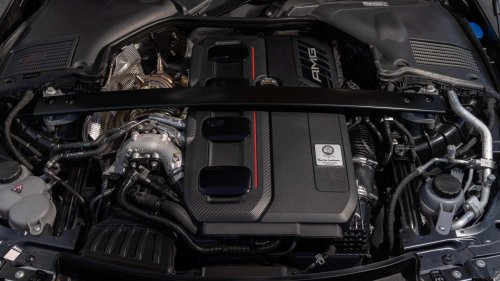
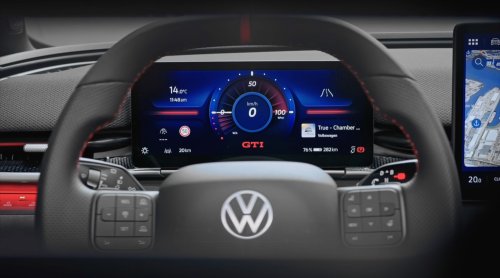
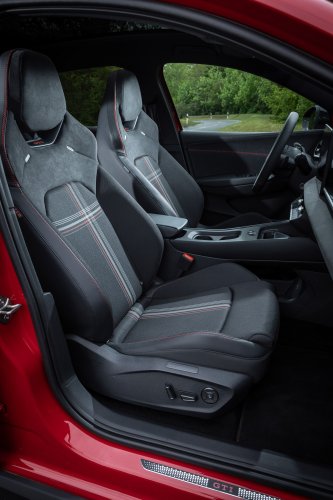
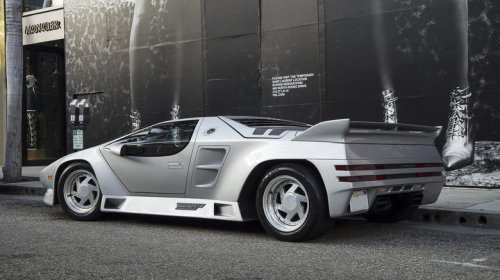
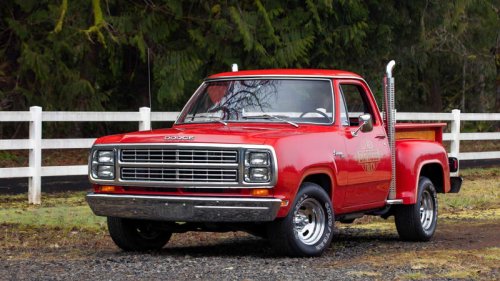
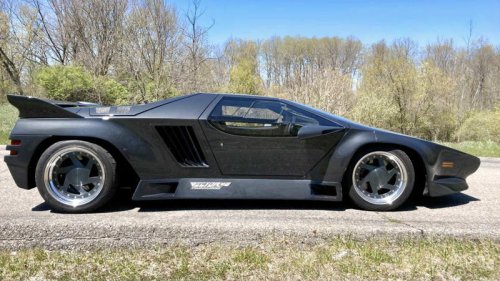
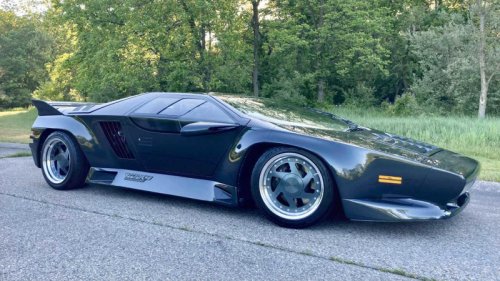
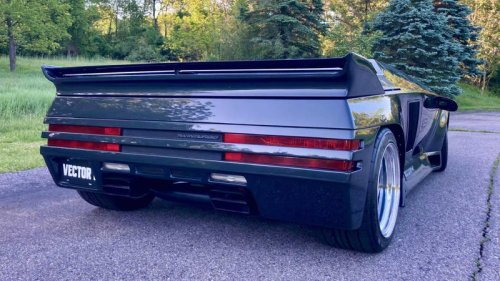
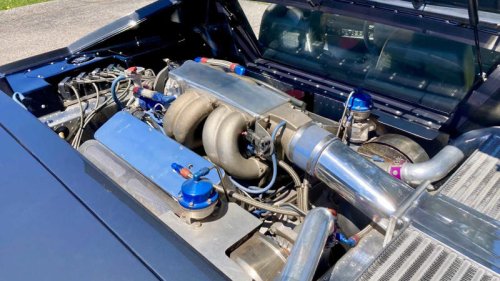
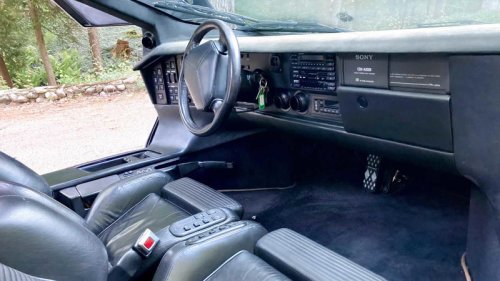
Not often do you hear your buddy come into a bar and say something like: "I just bought a new Honda Type-R, it's got 310 pound-feet, cool huh?.." Or perhaps: "You know what's cool about the new MK8 Golf GTI? It has 15 pound-feet more torque than the previous model." That's because we all love to talk about how much power a car has, closely followed by how quickly it will sprint to 60 mph or cover a quarter mile, but torque never gets much of a mention.But torque is often just as important as horsepower, especially when we are talking about acceleration. Torque is a rotating force produced by an engine’s crankshaft, designed to measure the work an engine can perform. In other words, if you have a heavy muscle car, you will need a decent slug of torque to overcome inertia and accelerate the mass from a standstill. But when it comes to the question of what was the first car to top 600 pound-feet of torque, it wasn't a hefty muscle car, it was something more unexpected... The Muscle Cars Of The 60s Were All Torque And All Action Mecum Before we get on to the first car to receive more than 600 pound-feet of torque, let's look at the torque monsters that went before it. As with a lot of eye-opening moments in the history of cars, the mind naturally drifts back to the good old days of the '60s muscle car. While there was a power war waging, with cars like the 425-horsepower 1969 Dodge Charger 500 and 430-horsepower 1969 Chevrolet Camaro ZL1, there were other models that were more interested in doing the twist. The 1970 Buick GS 455 is a torque beast. This Buick is widely credited as being the first production car to break through 500 pound-feet of torque, having precisely 510 pound-feet from its big block V8. Useful if you like drag racing, and towing a lighthouse home afterward. The '70s Saw Torque Take A Holiday Mecum Of course, we all know what happened next. A series of emissions regs and an oil crisis, not to mention soaring insurance, meant that the bottom fell out of the monster muscle car market pretty quickly. Whereas there seemed like no limit to the mind-boggling outputs of the freewheeling late '60s and early '70s cars, suddenly manufacturers were scrambling to rein them in. The result was the so-called Malaise Era, where zombie muscle cars with familiar names had the indignity of flimsy four-pots under the hood.Horsepower and torque took a holiday for a while. There were a few meaty V8-powered machines in the late '70s, such as the quirky 1978 Dodge Li'l Red Express Truck (AKA the fastest vehicle in America at the time), but with 225 horsepower and 295 pound-feet from a 5.9-liter V8, it was nothing compared to the Golden Era muscle cars. But American power and torque was about to come back — in a big way. The Vector W8 Brought Torque Back To The Headlines via Bring A TrailerSource: VectorThe Vector W8 is a supercar that could have, should have, changed the world, but didn't quite manage it. The car was as scintillating on paper as it was to witness in the carbon fiber and Kevlar. While the hard-edged wedgy bodywork looked like a cross between a Lamborghini Countach and an F-117 stealth fighter, the powertrain promises rocketship-like propulsion. Fitted in the middle was a 6.0-liter Rodeck all-alloy V8, based on the General Motors small block, but with the added advantage of twin Garrett turbochargers and direct port fuel injection.If the driver turned the fighter jet-looking dial in the cabin to eight pounds of boost, horsepower was rated at 650 and torque at 650 pound-feet. There was the option of turning the dial up to 12 pounds of boost, which introduced 1,200 horsepower and an unknown level of higher torque, which would have probably sent you into orbit. Or the nearest ditch, whatever came first. The sprint to 60 mph was confirmed at 3.8 seconds, but the claimed top speed of 242 mph was never verified. The W8 Was A Supercar Out Of This World via Bring A Trailer The rear-drive W8 is still an extraordinary-looking supercar. Yes, it is perhaps over styled in a lot of ways, but the proportions and details such as the cabin and rear lights still stand out in a unique and exciting way. The use of aerospace-grade materials such as aluminum honeycomb, carbon fiber, and Kevlar, showed that this wasn't some glorified kit car either, with later reviews saying it was actually pretty well screwed together. The transversely mounted V8 is linked to a three-speed Vector AutoMated automatic transmission purchased from Oldsmobile. Mad Torque Wasn't Enough To Save The W8 Bring a Trailer When the Vector W8 was launched in 1990, it still looked very futuristic for an old car. The car could be traced back to the W2 of 1972, which didn't look that different, although there was no engine. Seven years later the visionary supercar was fitted with a 5.7-litre twin-turbo Chevrolet V8, and the motoring press couldn't hide its excitement, but then there was another ten years before W8 production started. The W8 looked every inch the supercar, but various factors went against it. Firstly, the early '90s weren't a good time to sell supercars, with stock brockers sorely missing their huge bonuses, but then there was the price itself. The W8 Would Have Been Expensive Even In 2026 Money via Bring A Trailer The W8 cost $450,000, which was three times more than a Ferrari Testarossa — and that's a lot for a car with a General Motors V8, no matter how good it looks. Then there was an attempt to test it, where it broke down several times, at one point the three-speed GM transmission struggling to send torque to the rear wheels. When tennis star André Agassi brought a high-profile lawsuit against Vector for poor build quality, the W8 was pretty much wrapped up.Jerry Wiegert, the man behind the W8, no doubt had the vision to make a competitive supercar, as well as the panache to get it noticed, but in the end it wasn't enough for the W8. Just 19 cars were built before Vector was acquired by MegaTech of Indonesia. That company built the lesser-known Vector M12 (America's only V12 manual supercar) before dissolving. Just 18 M12s were built in the late '90s. Buying A W8 Today via Bring A Trailer Let's stop for a second and appreciate that the Vector W8, at $450,000 in 1990, was the equivalent to $1,125,120 in today's money. That's legit hypercar money. But unlike many 80s and 90s rare exotics, the W8 hasn't skyrocketed in price. The price for a Vector W8 is $734,000 in good condition, says Hagerty, which makes it only slightly more expensive than a 1988 Lamborghini Countach LP5000 Quattrovalvole ($605,000). If you can't stretch to a quarter of a million bucks for a W8, help is at hand. The later M12, which had a 5.7-liter V12, Lamborghini Diablo chassis, and a rear wing apparently pinched from a Ferrari F50, sells for "just" $161,000.Sources: Hagerty.com



















![130-ton electric works 4,000 feet beneath the surface of the Earth [video]](https://cdn.topcarnews.net/thumb/id/aHR0cHM6Ly9pMC53cC5jb20vZWxlY3Ry-ZWsuY28vd3AtY29udGVudC91cGxvYWRz-L3NpdGVzLzMvMjAyNi8wOC9lbGVjdHJp-Yy1taW5pbmctdHJ1Y2sucG5nP3c9MTUw-MCZhbXA7cXVhbGl0eT04MiZhbXA7c3Ry-aXA9YWxsJmFtcDtzc2w9MQ/ec304c8d1d214c59a29e6580ad117d13.png?t=20260920&post_id=57890)