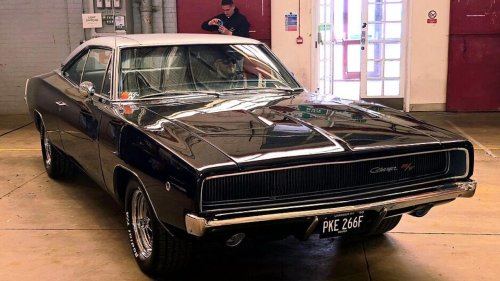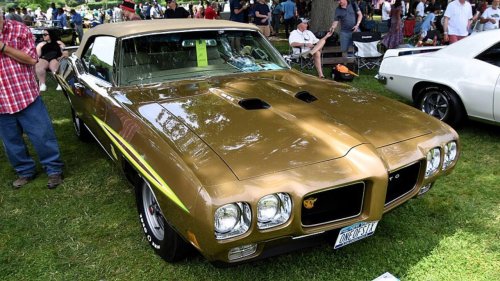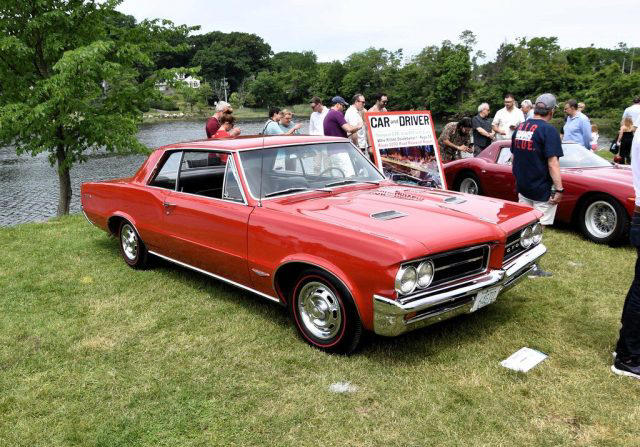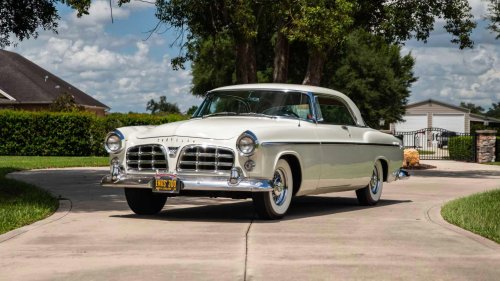
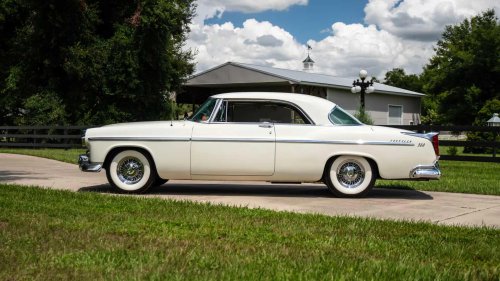
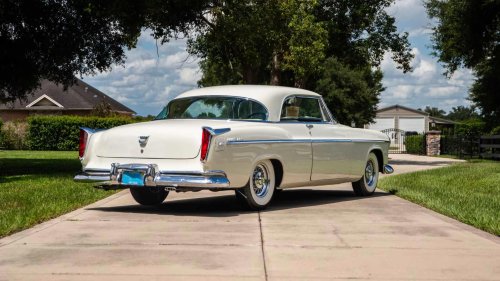
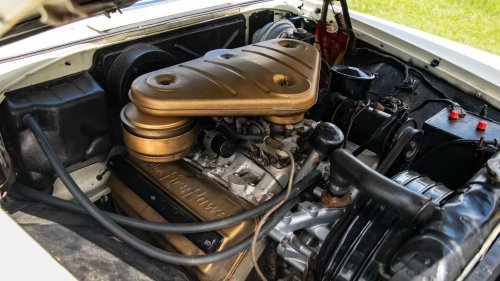
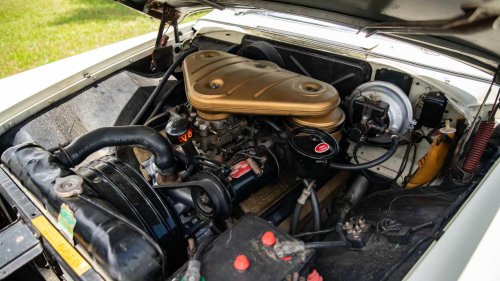
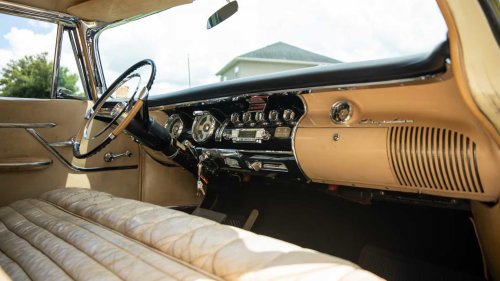
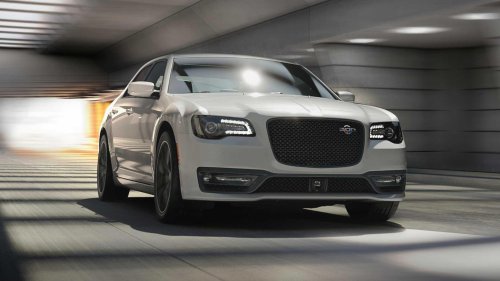
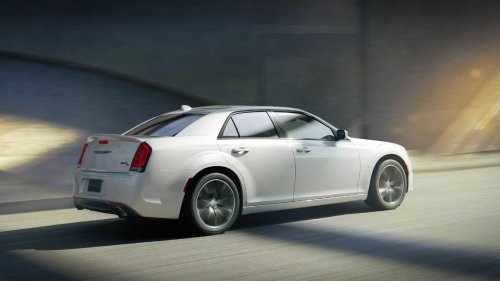



















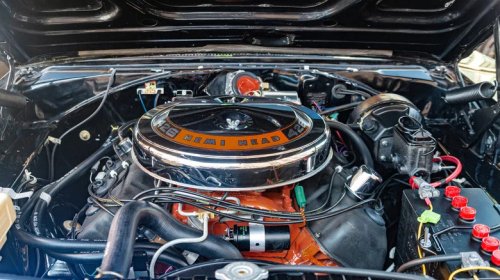
If you're itching for an argument, go ahead and try to definitively prove what was the first, true muscle car in a room full of gearheads. You're going to get different answers shouted at you from all directions, with some claiming the 1949 Oldsmobile 88, with its high-compression Rocket V8, as being the first. Others are going to yell out the 1964 Pontiac GTO, as it was the first purpose-built muscle car. After all, its recipe was to have a big engine shoehorned into a mid-size car.However, there's a third contender for the title of first muscle car, but it doesn't get as much attention as the aforementioned two. It's called the Chrysler C-300, and it was the first model to belong to the marque's famous 300 Letter Series. Its claims to muscle car fame include its engine and a few other aspects. However, the fact of the matter is that some people strongly believe the C-300 was America's first true muscle car, and we're going to figure out how and why this is the case. Automakers were toying with how to build and market these models even before the segment had a proper name. Chrysler's First Foray Into American Muscle Mecum Quick Facts About The Chrysler C-300 Introduced in 1955 Featured Chrysler's FirePower Hemi V8 Roughly 1,725 were produced in total Only offered with an automatic transmission Acted as an integral model for Chrysler's involvement in NASCAR Long before the C-300's NASCAR prowess, Chrysler had been involved in the production of race cars and their associated components. Beginning in the mid-1920s, the automaker began competing in the 24 Hours of Le Mans, with entries taking place in 1925, 1928, and 1929, utilizing the Chrysler Six model. Unfortunately, Chrysler didn't secure a single win at Le Mans back then, and still hasn't to this day. Despite the disappointing losses, Chrysler ended up learning quite a bit from its time in France, enough to begin tinkering with the idea of performance-oriented road cars.Justin Westbrook/CarBuzz/Valnet Following the close of World War II, Chrysler decided to shift its focus to producing higher-performing luxury cars in an attempt to set itself apart from other major luxury brands, such as Cadillac and Lincoln, both of which were busy pioneering the world of luxury vehicle opulence. In 1951, Chrysler introduced its first performance V8 engine, branded as the "FirePower V8." At the time, Oldsmobile had introduced its first high-compression V8 just two years earlier, lighting a fire underneath the seats of other brands to catch up.However, despite being two years late compared to the Oldsmobile engine, Chrysler's FirePower V8 had another ace up its sleeve: its hemispherical combustion chamber. That, right there, marked the birth of the Hemi namesake, a term that would be carried through much of Chrysler's history going forward. At the time, however, the Hemi was still an obscure engine with little popularity surrounding it. This would all change with the introduction of the C-300 in 1955, four years after the Hemi's introduction. Chrysler C-300: A New Kind Of Luxury 1955_chrysler_c-300_sideWhen it comes to the domestic American market, the Chrysler C-300 can be considered one of the first post-War cars from a flagship luxury brand to combine both sportiness and luxury, and be advertised as such. Upon its introduction in 1955, it was considered America's most powerful car, thanks to its FirePower V8. The C-300's looks were impressive, with some taking to calling it the car's "100 Million-Dollar Look." The man at the helm of its design was Virgil Exner, who spent most of his career with both Chrysler and Studebaker, although several other brands had also employed him.1955_chrysler_c-300_rearWhen the C-300 finally entered the open market, it had to contend with considerable foreign competition right away. For starters, the Bentley Continental was introduced in 1952 for the US market, along with the Mercedes-Benz 300 SL, which came about two years later. To make things even more difficult, the BMW 503 was launched at the same time as the C-300. However, because the Chrysler also acted as a sort of homologation vehicle along with being a flagship model, it was meant to be produced in limited numbers regardless. This meant that its foreign competition wasn't as daunting as it would be if the C-300 was a normal production model. This Is What Put The NASCAR Spirit Into The C-300 MecumThe FirePower Hemi V8 living underneath the C-300's hood was an impressive piece of engineering for its time. The thing is, though, it had more up its sleeve than just a hemispherical combustion chamber. Because the C-300 performed so well on the street, very few modifications were made to it when it entered into actual NASCAR races, meaning the thing was well-known as a stock car for the street. After all, back then, stock car racing was simply that: cars in mostly stock form, racing.Mecum Sitting atop the C-300's FirePower V8 is a pair of four-barrel carburetors, necessitating that huge, golden intake seen in the picture above. It also boasted a hotter, NASCAR-spec camshaft. Solid valve lifters were present, along with boasting an overhead valve valvetrain. Its hemispherical combustion chamber was regarded as more efficient, allowing for a larger volume of air and fuel to enter the combustion chamber, along with its inherent ability to house larger valves. A high-flow exhaust system was also featured, and a two-speed automatic transmission called the PowerFlite was the sole gearbox on offer.Mecum The rest of the C-300 was also set up for the racetrack. The bones of its suspension setup were based on the Chrysler New Yorker, although both its front and rear suspension were tightened up for better cornering ability. Stopping was taken care of by a set of drum brakes, which, unlike much of the car, were not upgraded at all. Despite its powerful engine and dreams of racing, the drum brakes were considered inadequate.We'll flesh out the 1955 Chrysler C-300's detailed specs in the table below:*Specs courtesy of RM Sotheby's & NotoriousLuxury.com The Final Hot 300 ChryslerNearly 70 years after the first 300-Series Chrysler was introduced, the final iteration was launched. In 2023, the Detroit Giant decided enough was enough, and slated the Chrysler 300 for discontinuation. This caused quite a large uproar, as loads of folks loved the thing. After all, the 300 continued to adhere to its original sentiment of providing a decent amount of luxury with a sporting flair. However, Stellantis was keen to turn Chrysler into a flagship EV brand, and the decidedly-gasoline-powered 300 had no place in that plan.Stellantis However, instead of simply sending the 300 on its way without fanfare, Chrysler managed to create a proper send-off variation of the famous model. It didn't carry an exciting name like "Final Edition." Instead, Chrysler coined it the 300C, a namesake used prior. The most impressive aspect of the final 300C model was its powerplant, a 6.4-liter Hemi V8 that produced 485 horsepower and 475 pound-feet of torque. Only 2,000 examples were produced for the US market, with an additional 200 destined for Canada.Chrysler Say what you want about Chrysler, but the 300 Series was a long-standing and celebrated model within the MOPAR community and beyond. It was one of the first cars to bring NASCAR-bred performance to the streets on a factory level, and that counts for quite a lot.