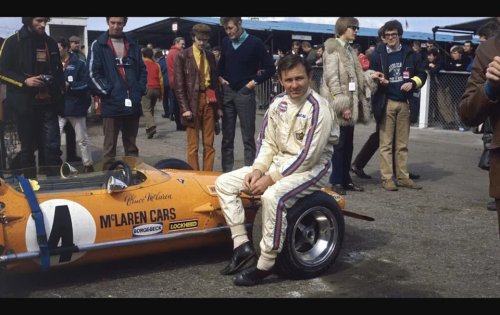
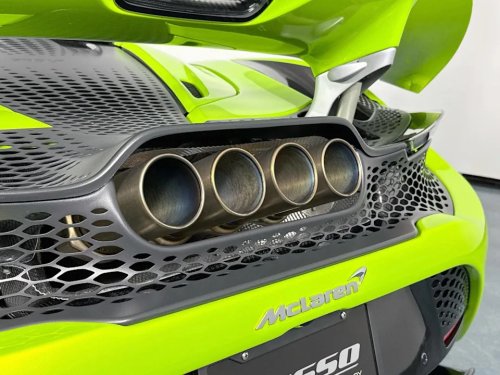
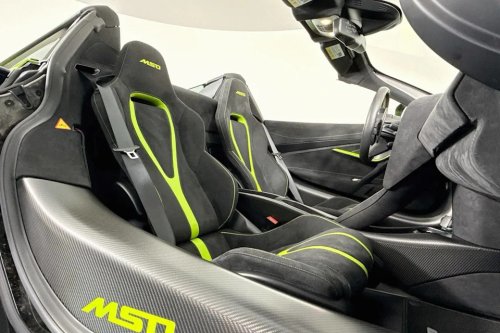
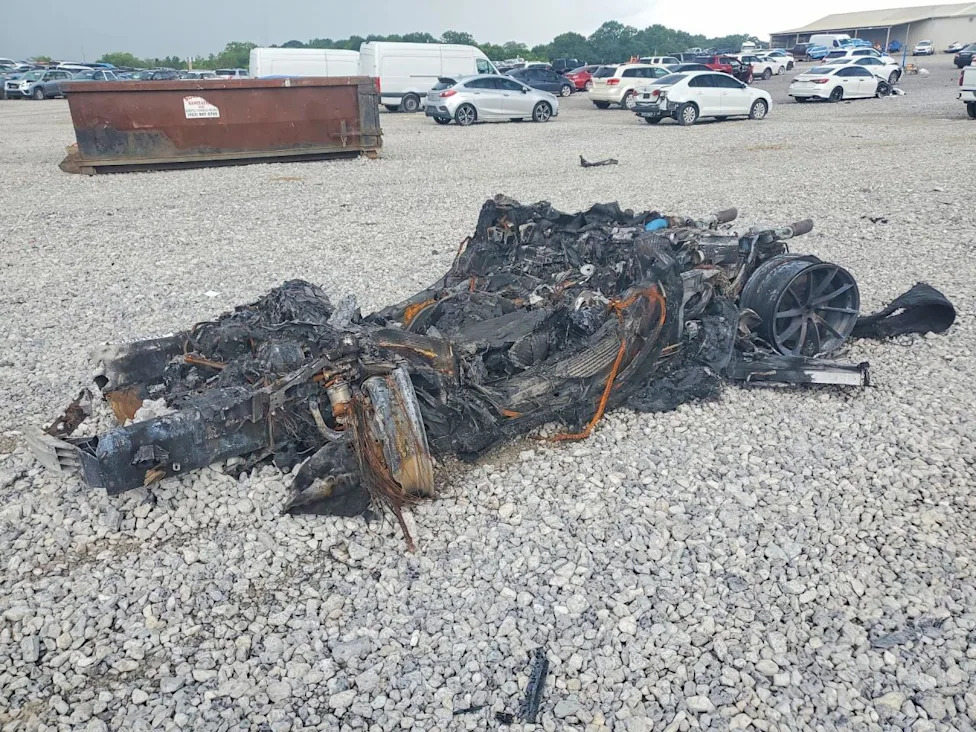
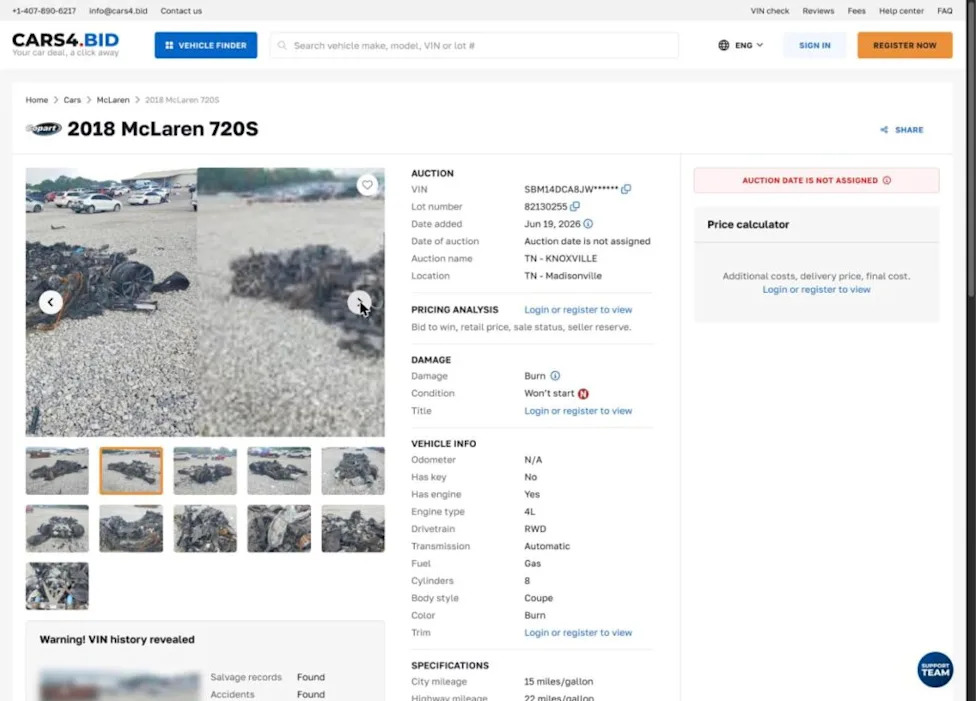
This Pile of Melted Metal Used to be a McLaren 720S and Someone is Still Trying to Make Money of ItScroll through enough Copart inventory and the damage stops registering. Bent frames, flooded interiors, hail-stippled hoods — it all blurs together after a while. Then a lot out of Madisonville, Tennessee, breaks the pattern. Copart lot 82130255 is cataloged plainly as a 2018 McLaren 720S Base. Click through the photos and there is no McLaren left to look at. There's a low, blackened mass of fused carbon fiber and aluminum sitting on a gravel yard, two wheels twisted out at odd angles, a set of exhaust headers still tracing the rough shape of a V8, and not much else. That is the entire car.Copart lot 82130255: a 2018 McLaren 720S listed with burn damage, no key, and no readable odometer. Screenshot via cars4.bid.The listing doesn't oversell it. Copart classifies the damage type as burn, lists the condition as "won't start" — arguably the driest understatement in the company's vocabulary — and notes the car has no key, no readable odometer, and a partial VIN starting with SBM14DCA8JW. The listing still checks yes next to has engine, though whatever survives of McLaren's 4.0-liter twin-turbo V8 is fused into the wreckage closely enough that finding it requires some faith. No auction date has been set yet; it's simply sitting in the pipeline for Copart's Knoxville sale.Why Fire Kills A Carbon Fiber Supercar For GoodEvery 720S is built around McLaren's Monocage II, a one-piece carbon fiber passenger cell that provides most of the car's crash structure and a big chunk of its weight advantage over steel-chassis rivals. Carbon fiber gets its strength from long fibers held in precise alignment by a cured resin matrix, and that resin has a heat tolerance nowhere near what steel or aluminum can shrug off. Push it past that threshold and the resin chars and delaminates, killing the structure's ability to transfer load between fiber layers, often in sections that still look solid to the naked eye. There's no equivalent of pulling a frame straight or sistering in new metal here. Once a monocage has been through a fire like this one, the safe assumption is that the entire tub is scrap, regardless of what a visual inspection suggests.Two wheels, exhaust headers, and the engine block are the only recognizable pieces left of the 720S. Screenshot via cars4.bid.Where A Wreck Like This Actually GoesThat reality narrows the buyer pool considerably. Nobody bidding on lot 82130255 is planning to drive it again. The realistic destinations are a metal recycler paying for the aluminum content, a parts buyer after anything electrical that survived for another 720S owner's repair, or an exporter who wants the VIN and paperwork attached to a legally recovered title. That last path is the one insurers and regulators worry about most, because title branding only works as a safeguard if every inspector down the line actually does the inspection.AdvertisementAdvertisementThat safeguard is thinner than owners might assume. Earlier this year, a Michigan detective who was the only officer in his town authorized to certify salvage title inspections pleaded to faking a stack of them and served 90 days in jail for it. His cases involved ordinary trucks and sedans, not carbon-tub exotics, but the vulnerability is identical at any price point: a rubber stamp only means something if the person holding it is actually looking at the car.Two Extremes Of The Same BadgeMcLaren's market has produced a useful illustration of both ends of this spectrum recently. A pop-art liveried McLaren F1 GTR once campaigned by Pink Floyd's Nick Mason sold for a marque-record $34.6 million, built on a chassis that survived four decades intact with documented history behind it. Around the same time, a McLaren parked outside a Birmingham wedding was firebombed by a getaway driver in a Volkswagen Golf, a reminder that these cars are exactly as vulnerable to five minutes of arson as anything else with a fuel system. Lot 82130255 sits at the unglamorous end of that same range: same badge, zero provenance, and a structure fire has already made the decision on.Some manufacturers now offer factory programs that will rebuild a customer's car from the ground up and reset the clock to zero, but McLaren isn't among them, and even if it were, a burned Monocage II wouldn't qualify anyway — the tub itself is the one part no factory rebuild can trust again. For anyone tempted by a salvage-title 720S showing up cheap on an auction site, the real cost isn't the winning bid. It's discovering, after the fact, that there was never a car there to rebuild in the first place.



















 +5 others