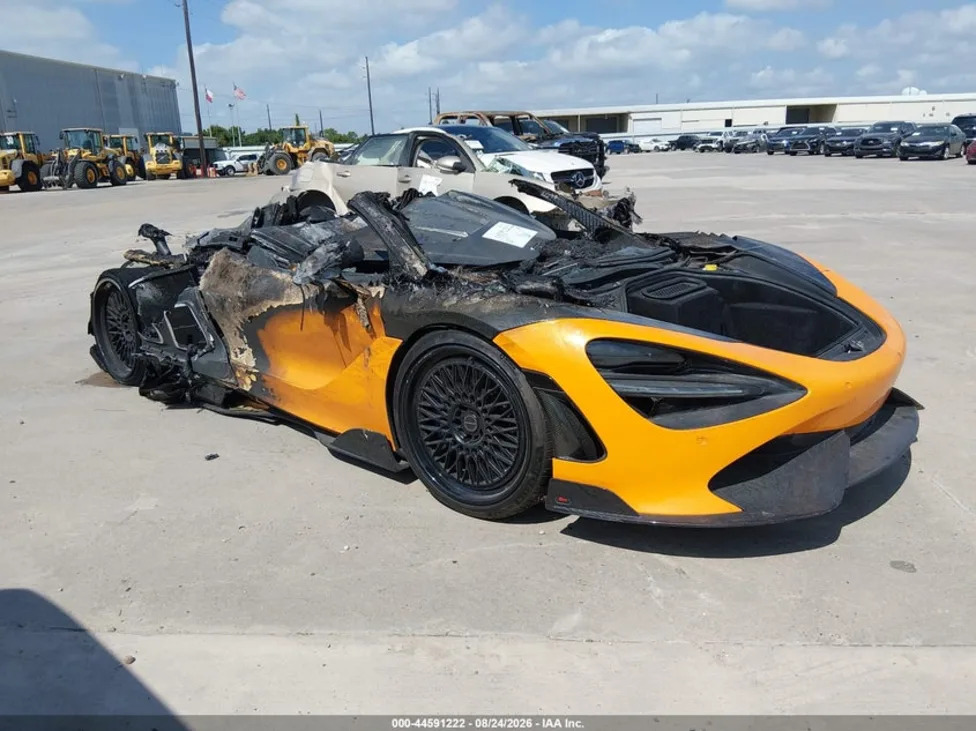
This McLaren 720S Burned Down to Its Skeleton — And You Can Still Bid on the RemainsSomewhere in Houston sits a 2020 McLaren 720S Spider that looks like it rolled out of a showroom and straight into a bonfire. The doors and front clip still wear their factory orange paint. Everything behind the A-pillars — engine bay, rear clamshell, most of the cabin — is gone, reduced to blackened aluminum and fused wiring. It's now listed for auction through Insurance Auto Auctions out of the company's Houston-North branch, carrying a Texas title branded NONREPAIRABLE, the harshest paperwork status a car can receive in that state.The listing pegs the car's actual cash value at $211,445, which is what the insurer that wrote the claim decided the Spider was worth before the fire touched it. What's odd is the odometer: IAA lists it at 1 mile, flagged "not actual," with a note that the figure was "applied with last known ODO per AutoCheck." In plain terms, whatever the last reliable mileage reading was before the fire, nobody could pull it directly off the car afterward, so the paperwork defaults to a placeholder instead of a real number.A "Total Burn" loss code reads differently than the collision damage most salvage listings show, and the photos make the pattern obvious. The fire consumed the engine bay, rear structure, and cabin, but largely spared the nose and doors. That tracks with how mid-engine cars typically catch fire: the ignition source almost always starts behind the passenger cell, where the engine, turbochargers, exhaust, and fuel lines are packed into a tight space with limited airflow once a car is parked and shut off. Once insulation or wiring back there ignites, the fire has a straight run forward through the engine bay long before it reaches the cabin, which is why a front clip can survive nearly untouched while the rest of the car doesn't.AdvertisementAdvertisementThis isn't the only McLaren fire making headlines this year, though the causes couldn't be more different. A separate incident involved an actual arson attack with homemade incendiaries thrown at a parked McLaren outside a UK wedding venue. Nothing in the Houston listing suggests foul play here — IAA doesn't identify a cause beyond "Fire" as the loss type and "Total Burn" as the damage code — but McLaren's own recall history is worth knowing regardless. In April 2020, the automaker filed NHTSA recall 20V231000 covering 2016-2020 720S models, plus the 2019 Senna, 2020 GT, and 2017-2019 570GT, after finding that a foam pad installed under the fuel tank for noise and vibration damping could trap moisture against the tank and corrode it. McLaren's own filing states that a resulting fuel leak "in the presence of an ignition source increases the risk of a fire." Dealers pulled the foam, inspected the tank, and replaced it where corroded, free of charge, starting in June 2020. There's no public confirmation this specific car's fire traces back to that defect, but the recall is a reminder that even a car built to McLaren's standards carries the packaging compromises that come with wrapping a twin-turbo V8 tightly behind the cabin. A second recall in mid-2021 covering the same generation addressed a brake banjo bolt that could ship without the drilled passage needed to feed fluid to a caliper — unrelated to fire, but one more sign that early 720S production saw more open campaigns than buyers might expect at this price point.The title brand is the detail worth understanding if you've never shopped a salvage lane. Most states stop at "salvage," a designation that still lets a vehicle be rebuilt, re-inspected, and legally returned to the road. Texas has a harsher category sitting below it: nonrepairable. Once a Texas title carries that brand, state law says the vehicle can never again be issued a standard title or be registered for road use — it can only be sold for scrap or parts. A recent case involving a Michigan detective who faked salvage-title inspections is a good reminder of how much power sits behind that kind of paperwork, and why states guard the inspection process so closely. For this 720S, a nonrepairable brand means the carbon-fiber tub, the surviving front-clip panels, the dashboard, the wheels, and any driveline pieces that test clean are the only things left with real resale value. Everything else is scrap metal with a McLaren badge stamped on it.That's exactly the market this listing is built for. Total-burn exotics rarely attract restoration buyers the way a moderately wrecked car might; parting one out for its tub, uprights, infotainment module, and body panels is usually the only economically sane path, and specialist exotic-salvage buyers exist specifically to bid on cars like this one. It's a strange bookend for a brand that can also see a McLaren F1 GTR sell for $34.6 million at auction in the same month a stablemate heads to a scrap bin in Houston. Whoever wins the bid on this 720S Spider isn't buying a project car. They're buying a parts bin that happens to wear a very famous badge on what's left of its nose.



















 +61 others