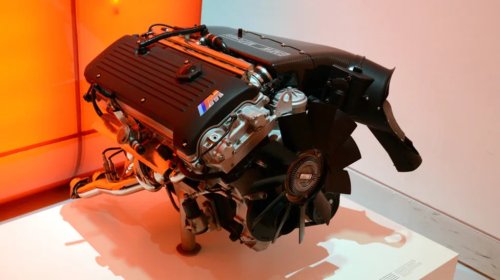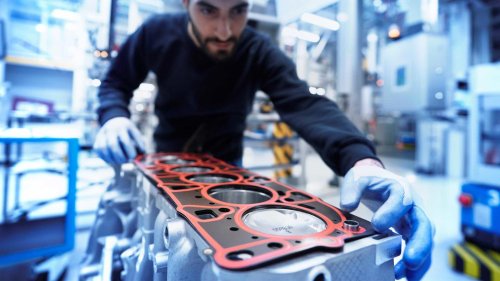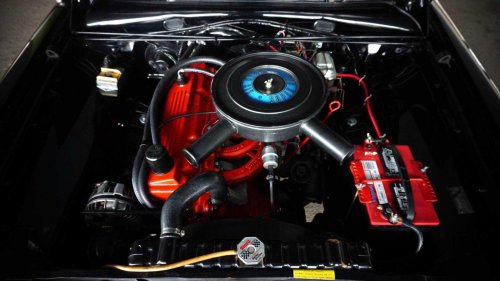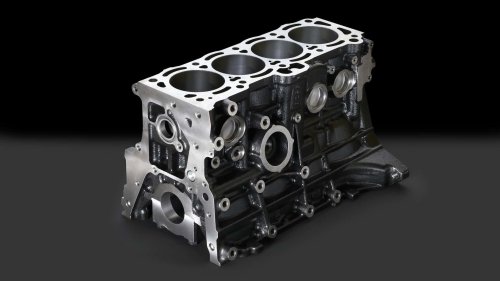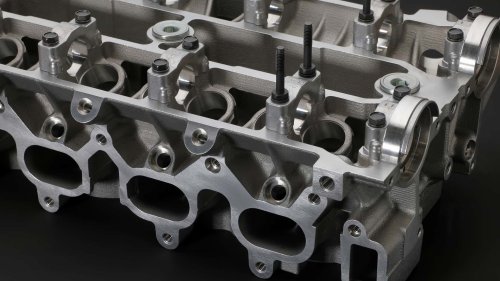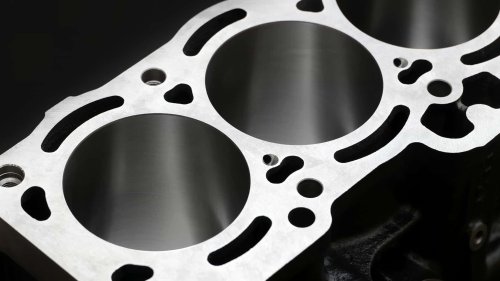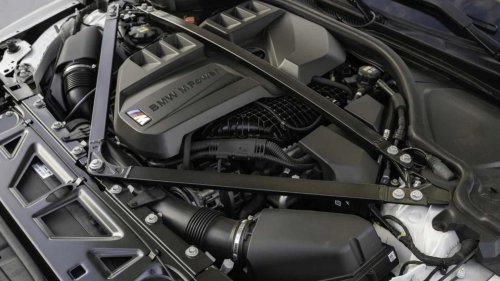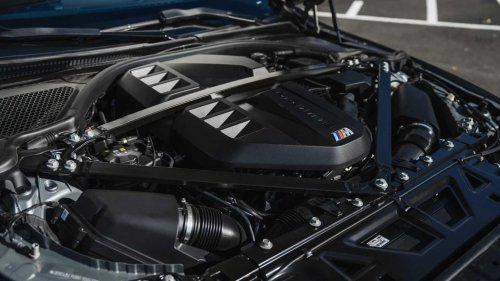
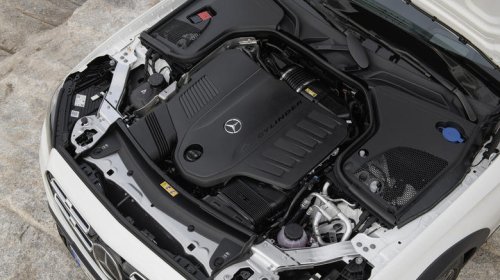



















Cheaper to produce than a V6Although making better cars is definitely a driving force for many automakers, making more money is very important too. Despite all their disadvantages, inline-6 engines open up profit margins.These engines have one cylinder head and one exhaust manifold, compared to two in V6 motors. Moreover, there are fewer camshafts in an inline-6 engine and a shorter timing belt. In addition, the engine block has a simpler construction, which streamlines manufacturing. Due to the fewer internal parts, it is also easier to lubricate inline-6 than V6 engines. And because they are inherently balanced, straight-six powertrains don't require balancing shafts, cutting down costs and complexity.Finally, inline-6 engines are simpler to make, which means manufacturing them at scale is simpler. It requires fewer tools and takes less time. While automakers have found ways to optimize V6 manufacturing, inline-6 engines still have the upper hand in that department.ScalabilityWhen V8 engines were ubiquitous in higher-end luxury cars, automakers could scale them down to V6 engines by chopping off two cylinders. Sure, it is slightly more complex than that, but many V6 and V8 engines of the past shared the same pistons, connecting rods, piston rings, and bearings. This scalable approach allowed them to cut manufacturing and development costs significantly while providing customers with more offerings.However, V6 engines are on the chopping block today due to engine downsizing, in favor of turbocharged four-cylinder units wildly different in design from V8s. However, there is an engine that is similar in construction to an inline-4 — the inline-6. These engines can share most internal parts and feature a similar block and head design. Not to mention, manufacturers could even use the same production line for their inline-4 and inline-6 engines.In fact, inline-6 engines are even more scalable than V6s and V8s, because in V configurations, changing the angle between the cylinder banks is often necessary. Notably, the best angle for a V6 engine is 60 degrees, while for a V8 it is 90 degrees, which hurts scalability. In inline-4 and inline-6 engines, all cylinders are arranged in a line, so part sharing is much easier.BMW and Mercedes-Benz both use this modular approach in their 2.0-liter inline-4 and 3.0-liter inline-6 engines. Each of those units shares the same 500cc cylinder capacity, along with similar pistons and connecting rods. So, in a sense, the inline-4/inline-6 combo is replacing the V6/V8 combo in modern luxury cars.Smoother operation than a V8American cross-plane V8 aficionados will tell you that the reason they love these engines so much is because they are smooth and refined. That is true if you compare them to V6s or small four-cylinder engines because the pistons from the two banks (in a 90-degree configuration) cancel each other's movements. Even so, in 90-degree V8, there is still oscillation, and a counterweight is required at each cylinder to minimize vibrations. Those counterweights make the whole engine less responsive.If smoothness is the reason why you like V8s, then you will love inline-6 engines because they are even smoother. Straight-six engines are longitudinally balanced and don't require balancing shafts because there is always a pair of cylinders doing the same movement and another pair doing the opposite movement. Moreover, the pistons in inline-6 engines cancel each other's vertical and transverse forces. With all of those forces compensating each other, you have a completely balanced engine with almost no vibration.The inline-6 engine isn't the only configuration with perfect balance. Boxer engines, regardless of the cylinder count, are also inherently balanced, and the same is true for V12 engines. Still, in today's world, where V8 powertrains are a dying breed, straight-six engines are the next best thing for luxury cars. They are smaller and more accessible, yet still buttery smooth.Inline-6 engines are generally easier to work onOpen the bonnet of a car with a V6 or V8 engine, and the complexity might make your head spin. V-configuration engines are usually more tightly packed under the hood, with not much space left for you to work on. Even a simple spark plug change could be a nightmare on most V6 and V8 engines.Inline-6 engines are the complete opposite —the spark plugs and ignition coils sit on the same side, near the top of the engine. Heavy repairs are also much easier on an inline-6 engine. For instance, the exhaust and intake manifolds are clearly separated and easy to reach. Opening the cylinder head cover is also straightforward because the engine sits vertically, and the valvetrain components are easier to reach. Not to mention, V6 and V8 engines have two-cylinder heads and need to be removed for most repairs, so double the job.Other components, like the timing chain, water pump, A/C pump, thermostats, and oil filters, are all easier to reach on inline-6 engines. Additionally, less disassembly is required to reach each of those parts, which can significantly speed up the process. Overall, straight-six engines cut maintenance and repair times, allowing dealers to serve more customers faster.Modern inline-6 engines are much more compactAutomakers are increasingly using electricity in modern cars — not only for better fuel economy but also for packaging concerns. For instance, an integrated starter generator/alternator (ISG), powered by a 48-volt electric system, allows engineers to completely electrify auxiliary engine parts, like the water and A/C pumps.Therefore, ISGs eliminate the accessory belt, cutting a few inches from the overall length. It might not be much, but it was enough for Mercedes-Benz to replace its aging M276 V6 engine with the M256 straight-six. ISGs have other advantages as well. Namely, they are torquey enough to fill up the gap before the turbocharger spools up, significantly reducing turbo lag. In the M256, the ISG produces 20 hp and 162 lb-ft of torque!Furthermore, manufacturers are decreasing the size of the latest inline-6 engines by reducing the bore of the cylinder and substituting it with a longer stroke. For example, Mercedes' 3.0-liter M256 motor has an 83-mm bore and 92.4-mm stroke engine, which cuts the distance between the bore centers by 16 mm (0.63 inches). Of course, that is still not enough for an inline-6 to be as small as a V6, but it is much better than before.