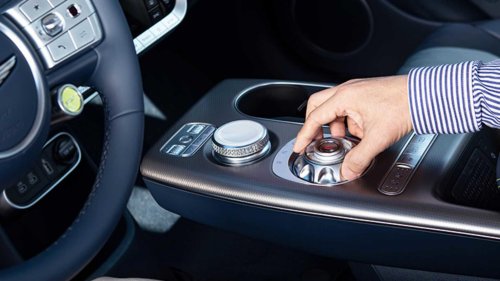
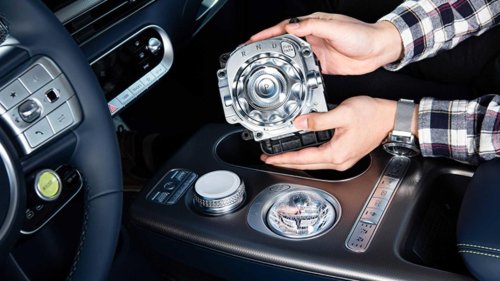
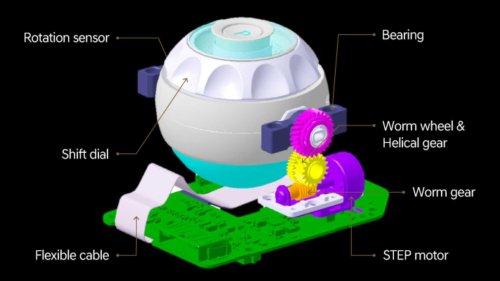





















To some, the silent glide of an electric vehicle is part of its appeal, while to others, it reminds them why they love to hate the entire concept. But for vehicle designers, that silence creates a strange design problem if a driver doesn't automatically know that the vehicle is awake and ready to go.And because there's no obvious mechanical clue, like starter motor churn or vibration through the seat, Genesis came up with a novel answer to the problem. Within its GV60, the brand's first dedicated EV, the gear selector mechanism doesn't look like a gear selector at all. It starts out as an illuminated glass sphere sitting in the floating center console before morphing into something else. It's quite an ingenious device, and it’s cool to take a closer look at. The GV60 Turned A Missing Engine Cue Into An Interior Event GenesisThe GV60 burst onto the US scene when manufacturers were falling over themselves to differentiate. It was a time when there was no shortage of luxury EVs in the marketplace, but their interiors were starting to look quite similar, with large screens, ambient lighting setups, and minimalist controls.Genesis was leaning on Hyundai Motor Group's E-GMP electric platform, but it still needed to do something to jazz up the GV60's interior. And it certainly needed this car to look like more than just a rebadged cousin of the Hyundai Ioniq 5 or Kia EV6.The Crystal Sphere would be the USP answer for Genesis, and the design team went to town with its presentation. When entering the car and activating the power, the sphere sits quietly in the console as a softly lit object, complete with a glass finish and an internal, laser-engraved G-matrix pattern. But when the driver depresses the start button, the sphere rotates through 180 degrees and now reveals a metal shift-by-wire controller.Genesis says the Crystal Sphere matches the brand's "beauty of white space" interior philosophy. Its Chief Creative Officer, Luc Donckerwolke, adds that the sphere was necessary because the GV60 is so quiet that it needed a special device to prompt the driver.And the company didn't want to replicate the approach of some other EV companies, where the vehicle's state of readiness is just a small icon on the instrument cluster. In a gas car, the sound and vibration present more than enough evidence for the driver to select a gear and get on their way, but in some EVs, the absence of anything obvious can often lead to a "what do I do now?" moment for fresh drivers. Genesis Built It For Safety, Status, And Theater Genesis The Crystal Sphere certainly looks dramatic, but it nevertheless performs its job well. After all, if the GV60 is not yet ready to move, the visible object is the crystal-like sphere. But when the EV is ready, the sphere rotates to reveal the shift dial, and that entire performance is much harder to miss than a small dashboard symbol alone.The sphere also has other tricks up its sleeve and won't rotate into the driving position if the battery is under charge, so the driver clearly knows that they shouldn't take off. And as rudimentary as that may sound, there have been some instances of drivers trying to leave a public charging station while the car is still connected to its charger, so the Genesis approach negates that possibility.Once the selector does come into view, the illuminated sphere changes color within the wider ambient lighting system. It will glow red when the driver selects reverse, which represents another clear warning sign to help avoid any unwanted dramas. And all of this means that the GV60 shifter is not just decoration alone, as its presentation helps make this solid electric vehicle feel more physically legible. The Engineering Is Hidden In The Rotation Genesis Underneath the surface of the Crystal Sphere is an ingenious piece of engineering. Once the driver has pressed the start button and the vehicle is ready to drive, the assembly will move out of the way to expose the metal-finished shift-by-wire dial. This then becomes an electronic transmission selector, so the driver can choose the required drive function. And while that may seem relatively simple in principle, the approach required some clever thinking on the part of the design team.The Crystal Sphere is made up of two integrated parts: the crystal section and the shift dial section. The sphere must retain its smooth rounded appearance when it's not in use, but the driver has to be able to grip the exposed selector at the appropriate time in order to operate it. This meant that engineers had to carefully manage surface shapes, patterns, depth, clearances, and tactile feel, so the entire contraption would work seamlessly.The gear selector also provides feedback with its knurled surface, making it easier to grip. It supplies haptic confirmation when the driver engages a gear and a subtle vibration when the driver wants to change direction, like shifting from drive into reverse. Remember that this is not a mechanical linkage at all but, as with most modern EV selectors, the dial sends an electronic request to the vehicle's control system. So, Genesis had to ensure that the Crystal Sphere would make an electronic action feel deliberate and reassuring.The system also detects the rotational position of the sphere through a shaft sensor before using motor control to align everything precisely. There's a fixing device to stop unwanted movement beyond the intended position, and a worm gear with worm wheel arrangement to limit reverse rotation. All of these details are very important if the disappearing Crystal Sphere is to arrive at its end point accurately and stop securely, day in and day out. Testing Makes Perfect Genesis Meanwhile, Genesis had to make this theater put up with real-world abuse, and if the Crystal Sphere were to become one of the GV60's big selling points, it absolutely had to survive the rough and tumble of ordinary use. So, designers and engineers treated durability as a major development priority and spent a lot of time evaluating the mechanism for motor outputs, material selection, wiring specifications, rotational durability, and cycle testing.Engineers also tried to pre-empt the kind of misuse that may happen in a busy cabin, such as somebody pressing down hard on the sphere while it was moving. The assembly can withstand unexpected loads as well, in case somebody inadvertently places a heavy object on top of it while loading.Liquids were another concern for designers because the Crystal Sphere lives in an area where coffee, soda, and snacks may also appear. Hyundai tested the system with substances like cola, ketchup, yoghurt, and even honey, allowing any foreign material to pass naturally through to the cabin floor without immediately messing up the mechanism.And if the system does detect an obstruction, it can increase motor output. It can try to rotate even if something appears to be stuck, but it will stop in the worst-case scenario to protect the rotating mechanism. But finally, and as a complete fallback, the driver can rotate the sphere manually in the event of an emergency. The Sphere Helps Explain What Genesis Wanted The GV60 To Be Genesis For Genesis, the GV60 would be the first vehicle to sit on Hyundai's dedicated E-GMP platform, and the company wanted it to be something special. After all, this vehicle was introducing the brand's electric future, and Genesis did not want the GV60 to feel like some kind of conventional crossover with a battery pack below.In 2023, the GV60 arrived with a 77.4 kWh battery, fast charging capability, and high-output dual-motor performance. Today, the current GV60 Performance AWD produces 429 hp and 516 lb-ft of torque, and 483 hp if you activate Boost mode.While those numbers make the GV60 credible as a premium EV, Genesis clearly wanted something distinctive, and this is where the Crystal Sphere came into the picture. The company's competitors took a different approach to their EV offerings, with Tesla clearly favoring minimalism, Mercedes pushing screen real estate, and BMW being all about its bold design language.But for Genesis, the Crystal Sphere would create a special, physical connection between the driver and their machine.The GV60 innovation would also say a lot about the company and its positioning. Genesis had not set out to build the cheapest electric crossover by any means, and the Crystal Sphere was certainly a complicated and more expensive way to tackle one of the simplest jobs. But by taking a familiar control mechanism and rethinking its entire EV purpose, Genesis certainly created its own memorable moment of drama.Sources: Genesis, Hyundai.