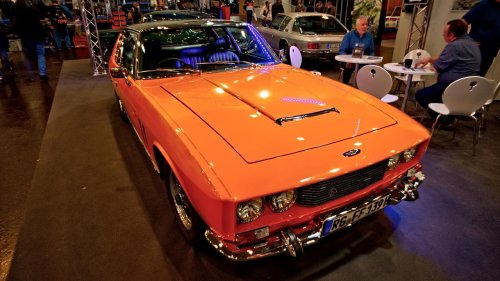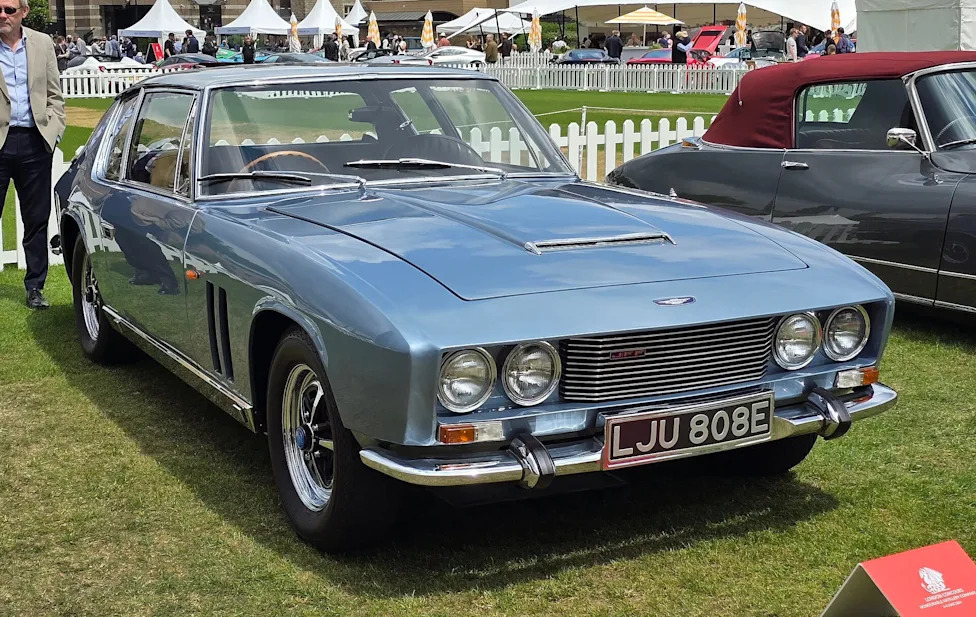
















The 1966 Jensen FF Had All-Wheel Drive and Anti-Lock Brakes Decades Before Anyone CaredAsk a car person which production car brought all-wheel drive to the performance world, and you will hear one answer: the Audi Quattro, 1980. Ask who put anti-lock brakes on a road car, and you will hear Mercedes-Benz, late 1970s. Both answers are fine, as far as they go. They also skip a Chrysler-powered British grand tourer that offered both technologies together in 1966, built by a small company in West Bromwich that never had the money to make it a success.The Jensen FF is one of the great what-ifs of postwar motoring. Only 320 were built between 1966 and 1971, and most of the world never saw one. It deserves far more credit than it gets.Two ideas from the aircraft worldThe FF started life as an Interceptor, Jensen's handsome, Italian-styled grand tourer powered by Chrysler's 383-cubic-inch (6.3-liter) V8 and a TorqueFlite automatic. Jensen then did something nobody else in the luxury-coupe class was attempting: it added the Ferguson Formula, a permanent four-wheel-drive system developed by Ferguson Research, the company founded by Irish engineer Harry Ferguson, better known for his tractors.The layout used a center differential, and by most accounts it sent roughly 37 percent of torque forward and the rest to the rear. A limited-slip differential at each end helped keep the car hooked up. Because the front driveline had to go somewhere, the FF's wheelbase grew by about five inches over a standard Interceptor.The second idea was the Dunlop Maxaret anti-lock braking system. Maxaret was born in aviation in the early 1950s, where it helped aircraft stop without skidding their tires into shreds. It was purely mechanical, with no computer and no electronics. A flywheel-based sensor detected a wheel starting to lock and momentarily released brake pressure through the vacuum servo, and the pedal would pulse back at the driver's foot. Dunlop claimed stopping distances up to roughly 30 percent shorter than a conventional system, and no flat-spotted tires.How it compared with everything else on the roadIn the mid-1960s, the fast, expensive cars of Europe were almost all rear-wheel drive and unassisted by anything resembling traction aids. The Aston Martin DB6, one of the FF's natural rivals, sent its power to the rear wheels and left the rest to the driver. If it snowed, you waited, or you fitted chains.The FF did not wait. In period testing, Autocar famously sent one up snow-covered ski slopes on ordinary road tires, in places where chain-equipped conventional cars could not follow. The magazine reportedly called it the safest car in the world. That was a bit of hyperbole, because Maxaret pulsed far more slowly than a modern ABS and could be set off by a sharp bump, but it captured how startling the car felt next to its peers. It was also quick: roughly 8 seconds to 60 mph and a top speed near 130 mph, with more than 270 pounds of extra hardware on board.Why almost nobody noticedThe FF was expensive, priced well above an already costly Interceptor (figures cited run from about 30 to 60 percent more). It was complicated, and hand-built Jensen reliability was never a selling point. Early cars had gearbox and front-hub troubles that took several revisions to sort out. The Ferguson hardware also took up so much space that the car could not be built in left-hand drive, which locked it out of the American market that might have kept Jensen afloat. By most counts, the FF found almost no buyers in the United States.Jensen ended FF production in 1971 as the company's finances crumbled, and the model faded from the story of the automobile.Did the ideas win anyway?Absolutely, though history gave the credit to others. Subaru offered all-wheel drive in a passenger car in the early 1970s, AMC's Eagle brought it to American showrooms in 1979, and the Audi Quattro, which arrived 14 years after the FF, turned it into a performance weapon on rally stages and a showroom halo for a brand. If you like the story of the Ingolstadt original, Motorious has covered a neglected 1982 Quattro Turbo pulled from a Scottish barn and a 1985 Quattro that needs rescuing. Neither could have existed without proof that the concept worked.Anti-lock brakes took a longer, messier road. It is only fair to note that the FF is not the first car with any kind of anti-skid system on the road, nor the first with an electronic one. Ford offered rear-only Sure-Track on some models in late 1969, and Chrysler's 1971 Imperial Sure-Brake is widely credited as the first four-wheel electronic system on a production car. Mercedes-Benz made it mainstream in 1978. But the Jensen paired a four-wheel anti-lock system with permanent all-wheel drive before any of them. That combination, the thing we now take for granted on everything from crossovers to supercars, did not become common for decades.Traction has been a theme for car makers since the beginning. Motorious has looked at GM's liquid tire chain, another clever answer to the same problem, and at Buick's 1986 Riviera touchscreen, proof that Detroit also had its share of cars that arrived too early.Why it still mattersThe FF is not a perfect car, and nobody who owns one will tell you it is. It is a heavy, thirsty, occasionally temperamental British GT with a big American heart and technology that its maker could not afford to develop further. But it shows what happens when an engineering idea shows up before the market is ready for it. Everything people now love about a modern all-weather performance car, the confidence in the wet, the ability to brake hard in a corner without panic, was on sale in West Bromwich in 1966.Somewhere over 100 are believed to survive. Enthusiasts who want a sense of the mainstream Jensen can browse our coverage of a rare Interceptor convertible, a 1976 Interceptor drop-top, or the modern Interceptor GTX revival. The FF is the one to find if you want the original version of a story that, in the end, belongs to every car with a driveshaft at each end.⚡️ Read the full article on Motorious