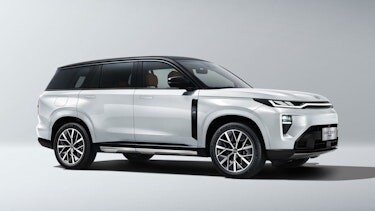
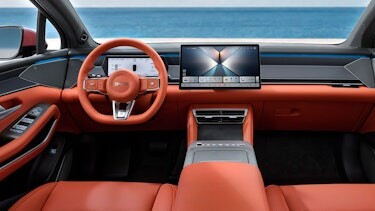
Gasgoo Munich- On June 8, just hours before Saidou Technology's official debut, Seres shares slid another 2.8%. It marked the fourth consecutive session in the red, dragging the stock down more than 10% in total.Back on June 2, when the Saidou Technology name first surfaced, Seres stock had jumped 2.4%. But as sentiment cooled and ByteDance publicly denied building cars on June 6—compounded by a brief slump in the broader A-share market—the shares slipped back into a downward trend. That four-day losing streak has erased more than 10% of the company's value.Whether tomorrow's launch will lift Seres' stock—or indeed become the company's second growth engine—remains an open question.Saidou's Future Has Backing From Many CornersFollowing changes in equity structure, Saidou Technology's future is no longer solely in Seres' hands.Saidou Technology was originally known as Landian Tech. In late May, Landian Tech completed a capital expansion. After the infusion, the Chongqing state-owned platform Shaci Zhiyuan became the largest shareholder with a 3.43 billion yuan investment, securing a 34.5% stake. Seres' wholly-owned subsidiary, Saihu, saw its stake drop to 32.96%, ceding control.Meanwhile, the employee stock ownership platform Yuexing Jiasheng, along with supply chain players including CATL's Wending Investment, Bojun Technology, and Xingyu Co., all took stakes.The result: a shareholder structure that blends state capital, automakers, supply chain leaders, and an employee platform, backed by more than 6 billion yuan in development funding.Image source: Tianyancha screenshotOn the surface, Seres has lost control of Landian Tech. Operationally, however, this looks more like a strategic adjustment.Landian Tech was established in 2023, targeting the mainstream family market between 100,000 and 150,000 yuan. Its lineup includes the Landian Tech E5, E3, and E5 PLUS. While AITO has surged rapidly in the premium market above 300,000 yuan over the past few years, Landian Tech has failed to garner similar attention. Public data shows Landian Tech brand sales totaled just over 20,000 units in 2024, lacking the scale effect needed to escape long-term losses.For Seres, continuing to nurture Landian Tech on its own would mean a steady drain of capital and resources. Bringing in state and industrial investors, however, alleviates that pressure while securing the brand additional development resources.More importantly, Saidou Technology carries a deeper strategic imperative for Seres. Since 2022, the success of AITO has driven both Seres' performance and market valuation higher. Yet, the market's perception of Seres remains inextricably linked to Huawei.Image source: Landian TechFrom smart cockpits to autonomous driving systems and brand marketing, Huawei's presence within the AITO ecosystem is overwhelming. While AITO's success has benefited Seres, it has also left the company overly reliant on a single brand and a single partner.The strategic logic behind launching the Saidou brand is sound. Seres currently relies heavily on AITO for sales and revenue, and no major automaker can pin its long-term growth on a single marque. In fact, multi-brand portfolios are standard industry practice, whether at SAIC, Changan, or Geely. For Seres, cultivating a second brand of its own is a mandatory assignment.However, building cars and selling them are two different skills. At the retail level, Landian Tech's brand influence, channel strength, and consumer awareness still lag significantly behind rivals like BYD and Geely in the same price bracket. Landian Tech's failure to gain traction in recent years suggests that relying solely on Seres' resources makes a rapid breakout in the fiercely competitive mainstream market unlikely.As such, bringing in state and supply chain capital is less a simple equity adjustment than a fresh start.Tomorrow, Saidou ArrivesAs the launch event approaches, outside interest in Saidou Technology is intensifying. The company has previously stated that the new brand will explore the possibilities of "AI-defined vehicles."That phrasing is a key reason the market has looked toward ByteDance. Last October, Seres' subsidiary, Seres Phoenix Technology, signed a "Framework Agreement on Embodied AI Business Cooperation" with ByteDance's Volcano Engine. The agreement covers collaboration on multimodal cloud-edge synergy, intelligent robot decision-making, and human-machine enhancement technologies.As Saidou Technology emerged, speculation briefly ran high that it could be a new brand jointly built by Seres and ByteDance.ByteDance, however, has explicitly denied rumors of car manufacturing, stating that its Doubao large model and Volcano Engine primarily provide technical services—such as large models and smart cockpits—to automakers. Based on available information, Volcano Engine appears firmly in the role of a technical partner.This model is nothing new to the auto industry. In recent years, Alibaba entered the sector via Banma Network, while Tencent has partnered with automakers through mapping, ecosystem services, and cockpit capabilities. Internet companies excel at software, algorithms, and traffic operations, but vehicle R&D, supply chain management, and manufacturing remain the home turf of traditional automakers.Image source: Seres GroupIn terms of resources, Saidou Technology is not without advantages.Its parent company, Seres, provides a solid backbone of technical support, with extensive experience in R&D, manufacturing, and channels. For a new brand targeting the mainstream market, that experience reduces the cost of trial and error.Moreover, Saidou Technology's new shareholder lineup is formidable. The addition of Chongqing state capital, CATL, and various supply chain firms provides financial backing, supply chain access, and industrial resources.Chongqing itself is also one of China's key automotive hubs, boasting a mature industrial chain and supporting capabilities.Yet, alongside the opportunities, the challenges are equally clear. The 100,000 yuan new energy vehicle market is now one of the most fiercely contested segments. Products like the BYD Seagull, Wuling Bingo, and Geely Xingyuan have already carved out significant market share, making it far harder for Saidou Technology to gain consumer recognition than it would have been a few years ago.At the same time, the battle for intelligence is trickling down. Smart cockpits and advanced driver-assistance features, once found only in high-end models, are gradually becoming standard in the mainstream market.Against this backdrop, relying solely on the concept of "AI-defined vehicles" is not enough to build a genuine competitive moat. Partnerships between internet firms and automakers are common, but market performance is ultimately decided by product strength, brand power, and the capacity for sustained investment.For Saidou Technology, the real test begins after product delivery. Realistically, the company has a long road ahead before it can become a "second AITO." For now, at least, the core variables determining Seres' performance, profits, and capital market standing remain AITO and the Huawei ecosystem.