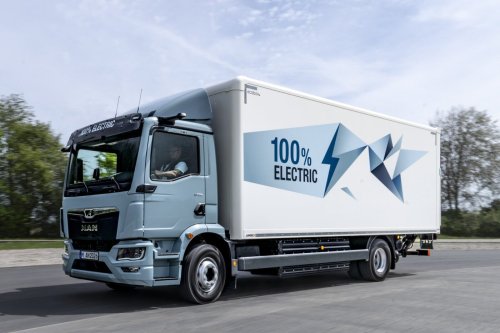
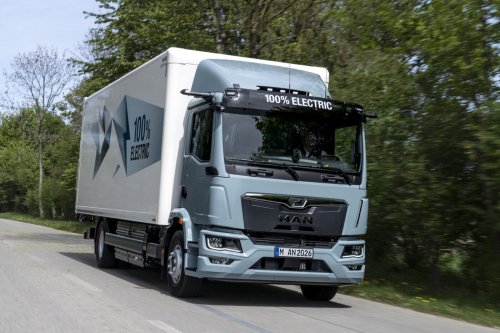
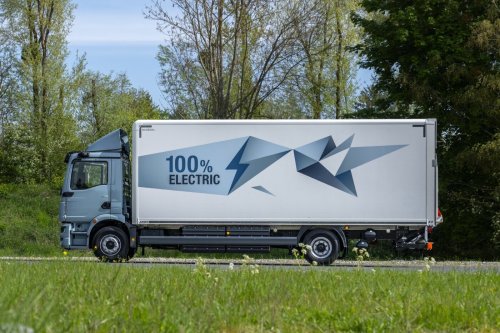
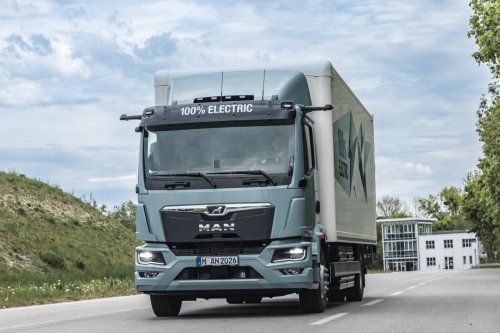
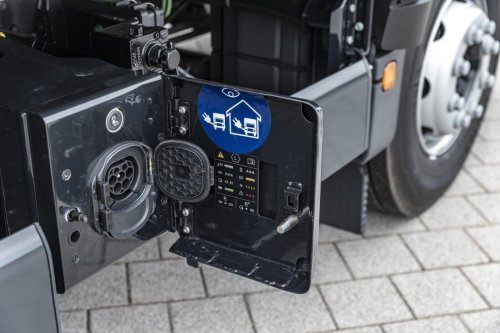
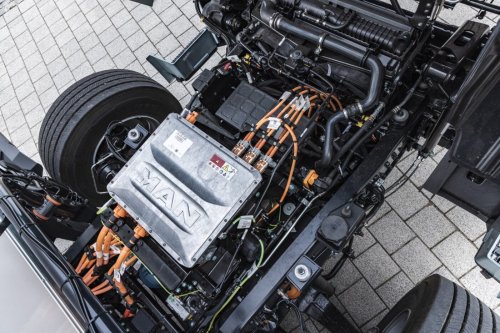
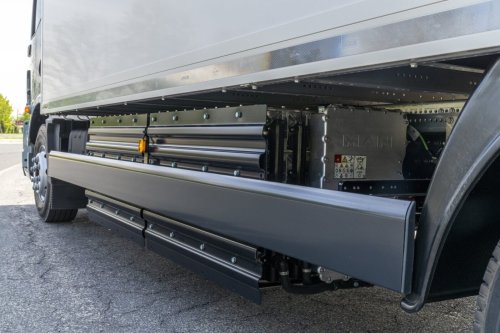



















Image: MANWith the eTGM, MAN is filling the final gap in its all-electric portfolio. With the eTGM, MAN closes the final gap in its all-electric portfolio. According to the Munich-based manufacturer, its electric truck range now covers vehicles from 12 to 50 tonnes. For the new mid-sized model, MAN relies on its extensive shared-component strategy, using batteries and the electric drivetrain already deployed in other trucks in the brand’s lineup. The manufacturer says this approach enables it to leverage the synergies of its ‘modular, cross-series technology concept.’MAN explained this strategy as follows: “Like all MAN e-trucks, the eTGM is based on the standardised modular BEV platform of the heavy-duty series. The central drive unit, battery systems, high-voltage architecture, and thermal management are derived from the eTGX and eTGS development and have been adapted for the medium-duty segment.”The vehicle made its debut at the commercial vehicle trade fair Transpotec Logitec in Milan, with production set to begin next year at MAN’s plant in Kraków.So where does the eTGM fit in? At 16 tonnes, the model is slightly heavier than the 12-tonne eTGL in MAN’s lineup but significantly lighter than the full-sized electric trucks, the eTGX and eTGS. MAN positions the new electric series for urban and regional distribution, municipal applications, and the construction sector. It offers a chassis payload of up to 10.6 tonnes and, when combined with a trailer, a gross combination weight of up to 33 tonnes.Up to 480 kilometres of rangeThe centrepiece of the eTGM is an NMC battery with two to four packs, each providing 80 kWh net capacity. In its maximum configuration, this amounts to a total net capacity of 320 kWh, which is expected to deliver up to 480 kilometres of range. As is typical for electric trucks, customers can choose how to balance payload and range. Achieving the maximum payload is only possible with the smallest battery configuration (and thus reduced range). If range is the priority, this comes at the expense of payload due to the heavier, fully equipped battery.The battery packs in the eTGM are the same as those used in the larger truck series (where up to six packs are available), MAN’s future coach, and the smaller eTGL. These packs are assembled at MAN’s Nuremberg plant and are based on NMC chemistry cells. The eTGM supports DC charging at up to 375 kW, with a charging session from 10 to 80 per cent state of charge (SoC) taking 43 minutes on paper (with four battery packs). AC charging will be introduced later, with MAN planning to add this functionality by the end of 2027. Image: MAN Image: MAN Image: MAN Image: MAN Image: MAN Image: MAN Image: MANFor the drivetrain, the manufacturer relies on a central electric drive unit (eCD210) with 210 kW output and a maximum torque of 800 Nm, combined with MAN’s two-speed transmission, TipMatic 2. As Richard Petermann, Head of the Overall Project, explained during the preview of the new series, this is the smaller drivetrain used in the heavy-duty trucks, adapted for the eTGM. Here, too, MAN employs shared components. While this electric motor delivers 245 kW in the larger trucks, it is downgraded to 210 kW for the eTGM.“The motor is larger than is typical for this class,” Petermann noted. “This improves efficiency. The larger the motor, the better the recuperation.” The energy recovery during braking can be adjusted in three stages. The eTGM supports both one-pedal driving and the electric-typical coasting function. “The high recuperation performance ensures excellent energy efficiency, particularly in stop-and-go traffic,” the representatives on site emphasised.16.01 tonnes for regulatory creditsMAN specifies the permissible gross vehicle weight of the new model as 16.01 tonnes (with an optional 16.5 tonnes also available). The reason for this precise figure is that electric trucks only qualify for EU regulatory credits once they exceed 16 tonnes.The Munich-based company stated: “As a fully electric truck in the over-16-tonne segment, customers in many European markets benefit from significant toll advantages. At the same time, the use of the MAN eTGM enables a significant reduction in fleet emissions and supports transport companies in meeting regulatory requirements such as the EU CO₂ fleet targets for heavy-duty vehicles.” The 16.01-tonne figure is thus officially documented.The aforementioned chassis payload of up to 10.6 tonnes refers to the optional eTGM version with a permissible gross vehicle weight of 16.5 tonnes and the smallest battery configuration (two packs). For the 16.01-tonne eTGM, the payload is 10.1 tonnes, which, according to MAN, ‘provides significant reserves for various bodywork applications.’ Typical applications for the MAN eTGM include food and supermarket logistics, municipal services, construction and waste management, and regional distribution. Both a mechanical power take-off (mPTO) with 22 kW and an electric power take-off (ePTO) are available.By the way: in 2020, MAN already produced a small series of a distribution truck under the eTGM name. However, this was based on a different technical platform, with a modest battery capacity of 185 kWh and a stated range of 190 kilometres.Production of the now unveiled series eTGM will begin next year in Kraków, according to Friedrich Baumann, MAN’s Executive Board Member for Sales & Customer Solutions. The electric truck will be manufactured on a flexible line alongside its diesel counterparts. The smaller eTGL has already been produced in Kraków since mid-July 2026 using the same principle. The similarities between the two medium-duty series are striking: the eTGL, for example, also features the adapted 210 kW motor but can only accommodate a maximum of two battery packs, which is the minimum configuration for the slightly larger eTGM.Baumann: “BEVs have the most efficient drivetrain”Friedrich Baumann is convinced that his company is bringing the ideal electric solution for urban and regional distribution to the road with the MAN eTGM. “It is the logical completion of our eTruck portfolio and makes MAN a true full-range provider of battery-electric commercial vehicles.”During the preview, Baumann also emphasised that electric drivetrains are the most efficient among all propulsion types, with an efficiency of over 70 per cent. “Other technologies do not achieve this level. We are convinced that the battery-electric drivetrain will establish itself as the propulsion system in the transport industry.”When the eTGM enters production next year, it will face limited competition. The electric 16-tonners currently available on the market include the Volvo FL Electric and Renault Trucks E-Tech D, which have been marketed for several years but offer relatively modest ranges. The DAF XB Electric is a more recent addition. In the 14-tonne class, Renault Trucks and Volvo Trucks have also announced new models, which will be the first trucks in the parent group to feature LFP batteries.