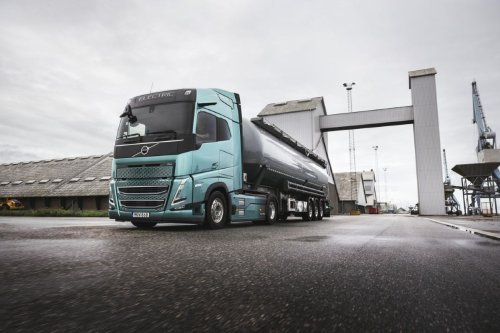
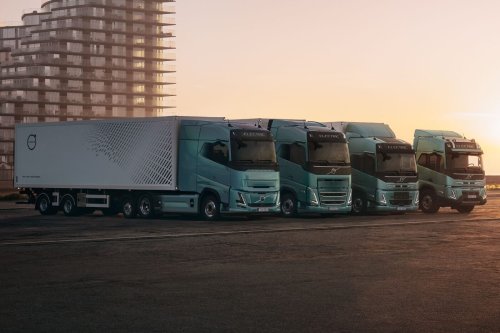
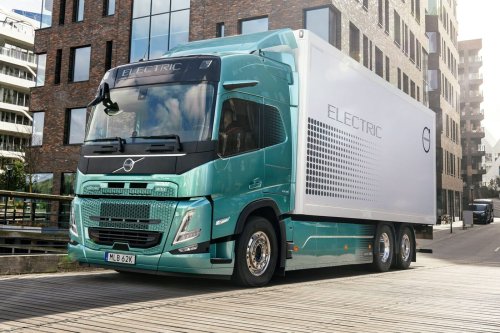
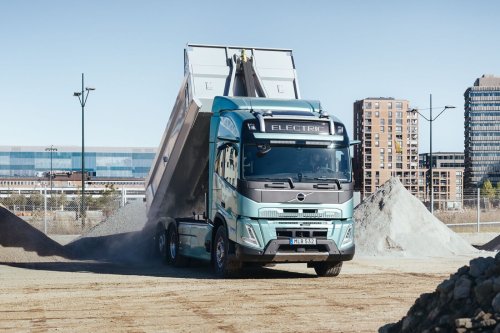
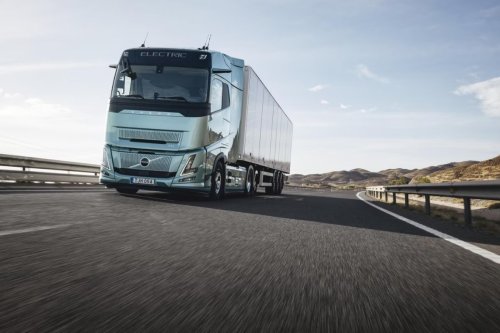
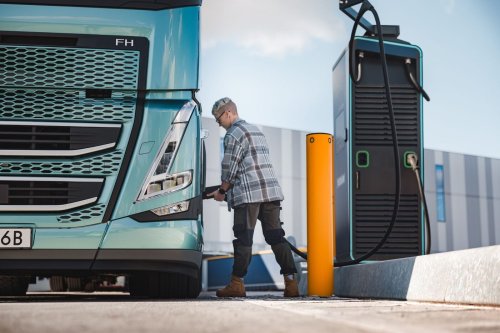



















Image: Volvo TrucksFor years, Volvo Trucks has dominated the emerging market for heavy-duty electric HGVs. As recently as 2024, the company said it had delivered nearly half of all battery-electric heavy trucks in Europe, according to reports—largely because many competitors were not yet market-ready.However, the competitive landscape has shifted. Over the past two years, most manufacturers have launched at least one heavy-duty electric HGV model. Some now rely on alternative battery technologies—primarily LFP instead of nickel-based chemistries—and offer significantly extended ranges.At the same time, the upcoming Megawatt Charging System (MCS) is set to support high-power charging, enabling electric HGVs to operate more efficiently on long-haul routes.But let’s examine the evolution step by step: by 2025, the market had already shifted, which—given the still relatively small production volumes—can happen quickly. Mercedes-Benz Trucks took the lead in Europe (EU30) for medium and heavy battery-electric trucks, capturing 35 per cent of the market. This success was largely driven by a single model: the eActros 600, Mercedes’ long-haul electric HGV.Volvo Trucks is now countering with the FH Aero Electric. As reported this week, this model is expected to achieve up to 700 kilometres of range without a charging stop. If confirmed, this capability will place the Swedes ahead of the entire competition.FH, FM and FMX Electric: Volvo Trucks get more rangeVolvo Trucks is also updating its existing lineup. The manufacturer has unveiled the next generation of its heavy-duty electric models—the Volvo FH Electric, Volvo FM Electric and Volvo FMX Electric—targeting regional transport with ‘major improvements in flexibility, productivity, driving comfort.’The key upgrade is the extended range, increasing from 300 to 470 kilometres—an uplift of 57 per cent. This significantly expands the operational radius of the electric trucks around depots, making them more viable for a wider range of applications.For context, the three electric HGVs are Volvo Trucks’ heavy-duty models, available to order since 2022 and in series production since then. The Volvo FH Electric targets regional and interregional transport, while the Volvo FM Electric focuses on heavy regional applications and the Volvo FMX Electric is designed for construction site logistics.All three models use a drivetrain that combines three electric motors with Volvo’s I-Shift transmission. The system delivers a peak output of 490 kW and a continuous output of 315 kW. Six battery packs provide a total energy capacity of 540 kWh, enabling a range of around 300 kilometres. Image: Volvo Trucks Image: Volvo Trucks Image: Volvo Trucks Image: Volvo Trucks Image: Volvo Trucks Image: Volvo TrucksSo how does Volvo Trucks achieve the significant range increase in the new generation? The company equips the three models with an entirely new drivetrain, combining a two-motor system with a specially developed 8-speed transmission. Maximum output rises to 540 kW—an increase of 50 kW—while Volvo has yet to disclose the continuous power rating.While the new drivetrain likely contributes to greater efficiency, the main factor behind the extended range of up to 470 kilometres lies in the batteries. However, Volvo Trucks has not provided further details on the battery technology in its latest announcement.A look at the corporate sister brand, Renault Trucks, provides some insight. The French manufacturer unveiled its new generation of electric HGVs in November in a world premiere. Under the shared umbrella of the Volvo Group, Renault Trucks typically shares its technical platform with Volvo Trucks. The previous E-Tech T is the equivalent of the Volvo FH Electric. Under the new name E-Tech T 540, it will increase its range from 300 to 450 kilometres. While this falls short of the 470 kilometres promised by the Swedes, the difference is explainable—more on that shortly.New battery cell generation, updated configurationFirstly, the new generation of heavy-duty electric HGVs from the Volvo Group continues to use 90 kWh battery packs, with configurations ranging from four to six packs per vehicle.The key change lies in a new battery cell generation—still based on NCA chemistry—along with a revised cell arrangement and further optimisations. electrive confirmed this during the presentation of the new Renault Trucks generation at Solutrans a few months ago.Samsung SDI supplies the cells, while German battery system specialist Akasol assembles the packs for Renault Trucks.The fact that Volvo Trucks extracts more performance from its battery packs aligns with a broader trend: the manufacturer is also enabling higher usable battery capacity in its upcoming long-haul HGV than its French counterparts.For example, the future Volvo FH Aero Electric is expected to deliver around 100 kilometres more range than the largely comparable Renault E-Tech T 780—up to 700 kilometres instead of 600 kilometres.This approach likely also explains the smaller but notable range advantage in the heavy-duty electric HGVs for regional and interregional transport, where Volvo achieves up to 470 kilometres compared to around 450 kilometres.It is unusual that corporate sister brand Renault Trucks took the lead in presenting the new generation of electric HGVs. The Swedish counterpart, Volvo Trucks, which is typically prioritised for model launches, followed around six months later.Now, however, Volvo aims to take the lead in range, even compared to its sister models from Renault Trucks. When asked by electrive, a company spokesperson attributed the increase to ‘a combination of software optimisation, increased usable battery capacity and further improved aerodynamics.’Around one hour charging with 350 kW CCSOn charging, Volvo Trucks states that its heavy-duty electric HGV trio can charge from 20 to 80 per cent in around 65 minutes, with DC charging power of up to 350 kW. The company does not mention an MCS port, and—similar to Renault Trucks—it is unlikely to be part of the current plan.Volvo has not clarified whether the 43 kW AC charging option will remain. However, a look at the sister models suggests that AC charging will likely continue to be available.The improvements become clear compared to the previous generation: earlier models were limited to 250 kW DC and required close to 90 minutes to reach 80 per cent charge.Let’s take a closer look at the drivetrain. Previously, the Volvo FH Electric, Volvo FM Electric and Volvo FMX Electric used the established Volvo Group concept of three electric motors combined with an I-Shift transmission, delivering 315 kW of continuous output and 490 kW of peak power.Now, Volvo Trucks equips all new models with an I-Shift transmission specifically optimised for electric drivetrains. The system pairs this with two electric motors, increasing maximum output to 540 kW. The manufacturer promises ‘smoother and more controlled performance.’ The new 8-speed powershift transmission also delivers smoother gear changes, while reducing noise levels and vibrations.In terms of practical benefits, the company emphasises that vehicle bodies (such as concrete mixers, hooklifts, or waste collection systems) can be operated without additional drive motors or attachments. “This is due to an integrated gearbox power take-off (PTO) with increased functionality enabling usage during driving,” the company explains. The core applications for this trio are primarily in road construction, regional distribution, urban logistics, utility services, and waste management.Available for order from summer 2026Volvo Trucks states that the gross combination weight of the Volvo FH, Volvo FM, and Volvo FMX Electric can reach up to 65 tonnes (where permitted), with a payload of up to 23.8 tonnes for a 4×2 tractor unit. It is important to note that the manufacturer will offer various battery configurations to optimise the balance between range and payload. Those aiming for the full range of up to 470 kilometres cannot expect the maximum payload of 23.8 tonnes. Both figures represent the maximum values for specific HGV variants. Speaking of variants: the vehicles can also be equipped with double drive axles and a longer gear ratio in the future. The upcoming electric HGV generation will be available for order from summer 2026.“We’re really sharpening our offering here. We are broadening it and making electric solutions possible for an even wider range of transport assignments, and also adding a cutting‑edge electric truck with a range of up to 700 km,” said Roger Alm, President of Volvo Trucks. “This means we can fully match the business needs of our customers. It has never been easier to replace diesel trucks with electric ones. We stand firm in our belief that electric vehicles will deliver a large part of the world’s truck transport in the future. With the amazing performance of all our new trucks, it’s easy to see why.”volvotrucks.com