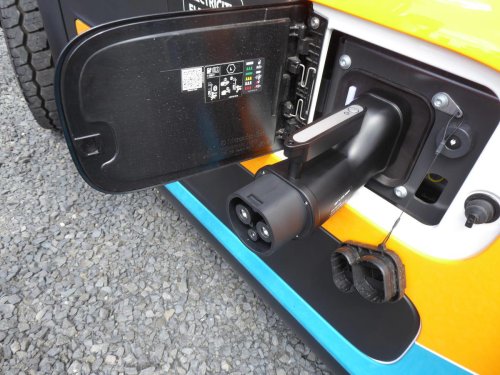
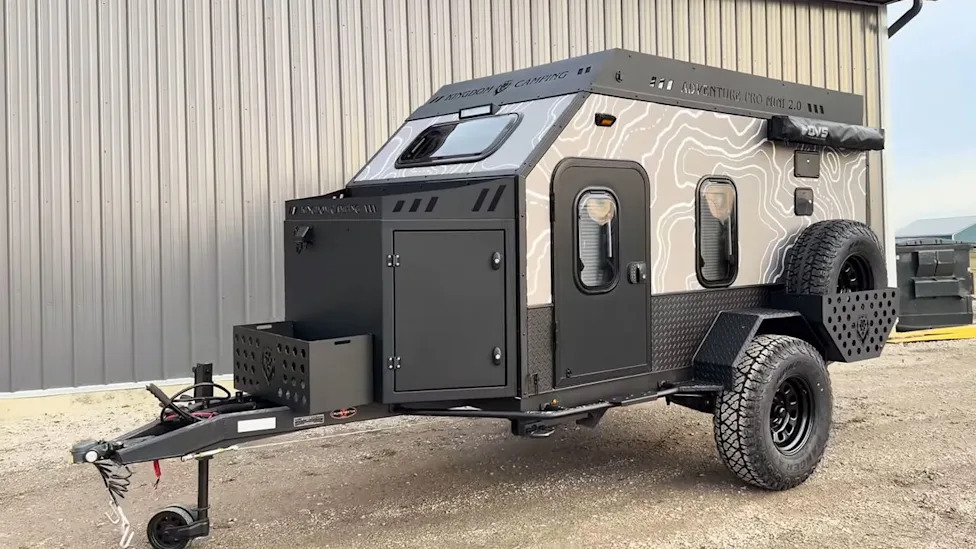
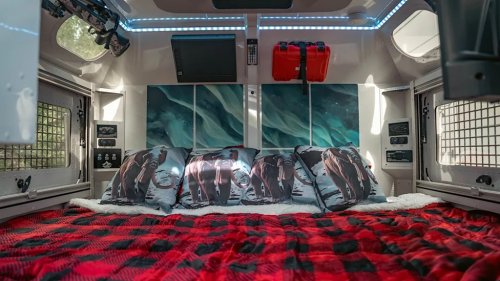
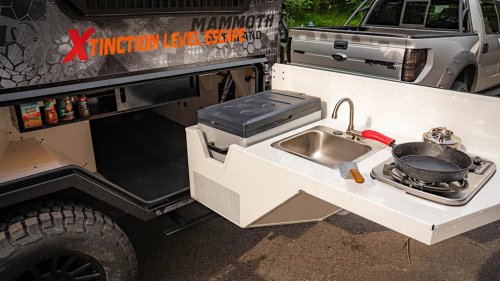
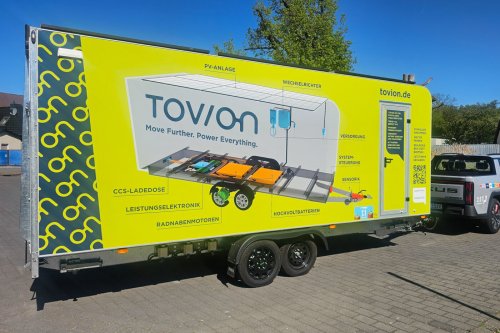
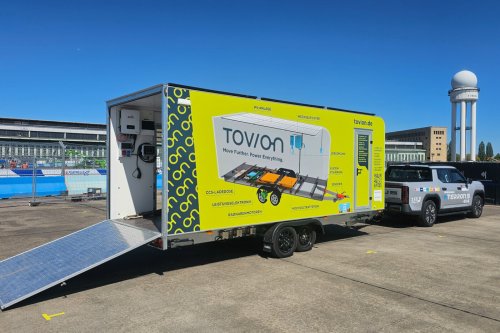
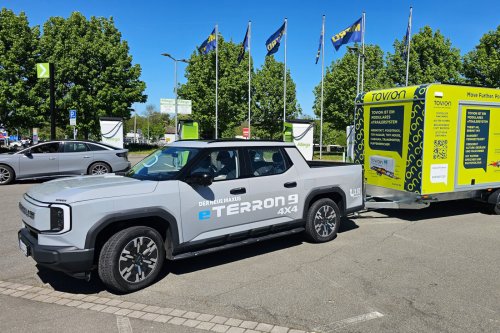
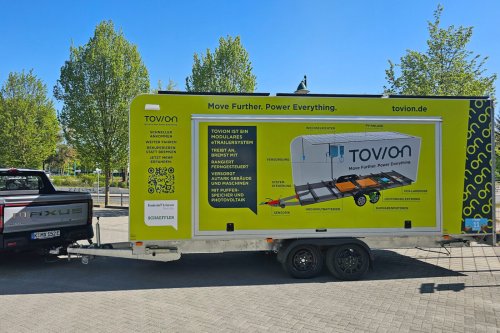
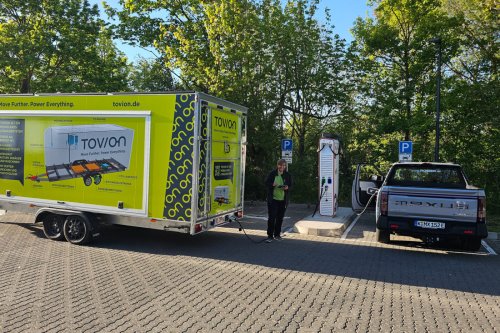
Image: TovionThe concept mirrors systems used in heavy-duty transport. Thanks to its dedicated electric drive system, the trailer can fully compensate for the additional load on the towing vehicle – “even with heavy trailers that have high wind resistance during continuous operation and as a boost during acceleration”, as Tovion explains. In other words, the energy consumption of the (electric) towing vehicle does not increase, or only marginally, meaning that range is maintained even when towing.The Tovion system is self-regulating and requires no additional modifications or communication with the towing vehicle. Sensors integrated into the drawbar detect the tensile or braking forces exerted by the towing vehicle on the trailer. Using this data, the control unit precisely manages the electric drive. Like an electric car, the eTrailer can also use its motors as generators, recharging the battery through recuperation.Power comes from Schaeffler wheel hub motors developed specifically for trailer use, delivering up to 120 kW and 1,800 Nm. This not only compensates for towing load but also enables the trailer to manoeuvre independently via remote control – similar to the mover systems commonly used on caravans.The battery installed in the trailer’s underbody can be recharged via a CCS charging socket at the rear – though Tovion does not specify the battery’s capacity. Additionally, the photovoltaic (PV) system mounted on the trailer’s roof, combined with the integrated inverter, contributes to the energy supply. As the system is designed for bidirectional operation, the stored energy in the trailer can be used via a 230-volt socket or a three-phase 400-volt connection. A V2X solution via the CCS interface is also available as an option. Image: Tovion Image: Tovion Image: Tovion Image: TovionWith the trailer battery serving as a mobile energy storage system, Tovion aims to address multiple trailer-to-load use cases. In leisure and camping applications, the autonomous power supply is particularly appealing. Thanks to the 400-volt system, tools, machinery, and even welding equipment can be powered off-grid on construction sites. Market stalls and food trucks can also operate without a mains connection, thanks to the trailer’s energy storage. For a camping trailer that remains parked unused for much of the year, the battery can also serve as a ‘trailer-to-home’ mobile buffer storage for buildings.At present, this is not a production-ready product but a prototype with road approval, designed for real-world testing and demonstration. Tovion put this to the test during the E-Cannonball event – using a Maxus eTerron9 as the towing vehicle, as it meets the required towing capacity of 3.5 tonnes. The rally itself covered 260 kilometres through the landscapes south of Berlin. Including the journey to and from the event, the Tovion team travelled over 1,500 kilometres. “This year’s rally took place in optimal weather conditions – a benefit for the Tovion system, as the integrated photovoltaic system significantly extended the range,” the statement reads. “The integrated wallbox and V2L function also allowed the team to supply power to other participants overnight.”Tovion is being developed as part of the “eConTrailer” project, which is funded by the BMWK. The future type approval of the drive system in the O2 class as an “E-trailer” under Regulation (EU) 2018/858 is in preparation. The focus is on B2B partnerships, through which providers can integrate the drive system into their trailers. The consortium leader is the planning office Koenzen, with Gross und Co. Anhänger GmbH involved as an application partner. The scientific support for eConTrailer is provided by Osnabrück University of Applied Sciences.Source: Information via email (press release), tovion.de, bundeswirtschaftsministerium.de


















 +3 others