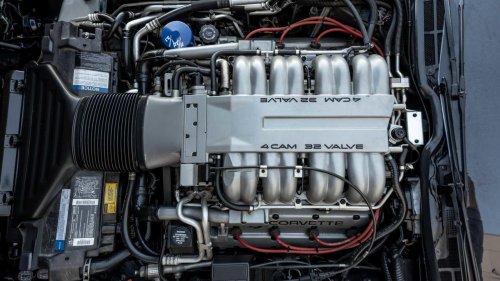
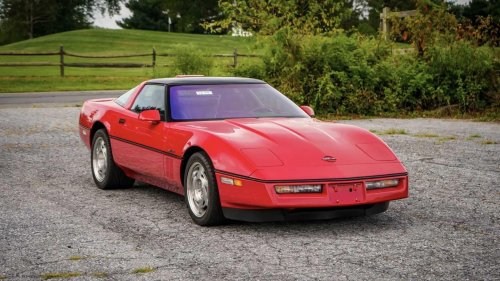
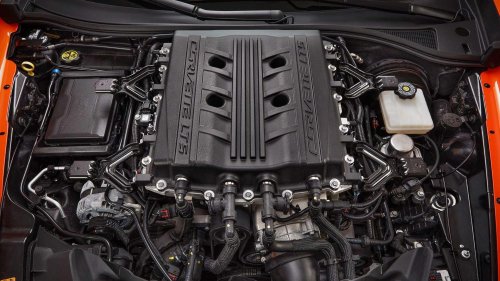
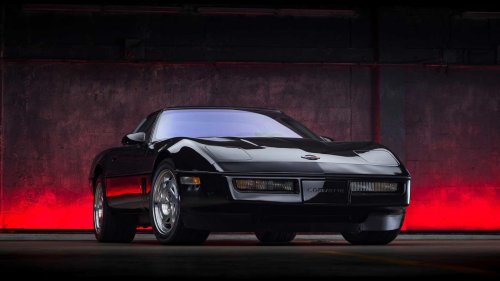

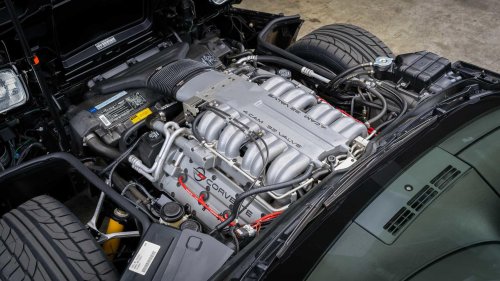



















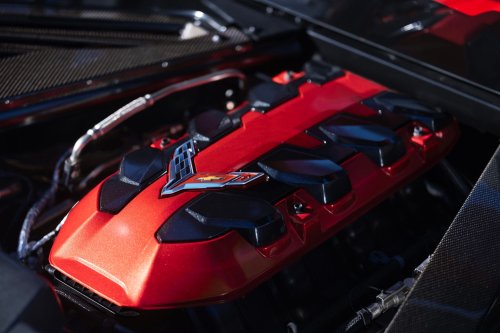
Jump Links1985-1995 Corvette Engine Specifications2019 LT5 Specifications What car has the LT5 engine?What's better, LT4 or LT5?Is the LT5 a V8?Is the LT5 engine still in production?Certain automotive partnerships make sense - Mercedes-Benz and AMG, MINI and John Cooper Works, BMW and Alpina. And then we look at the collaboration between General Motors and Lotus, a partnership so improbable that it still raises eyebrows to this very day. A blue-collar American muscle icon and a featherweight British consultancy, working harmoniously to develop one of the most technically sophisticated engines ever fitted to a Corvette, the LT5 engine.In 1986, General Motors took a 91% controlling stake in Lotus Cars, which, at the time, had shifted its focus primarily to engineering consulting, alongside its vehicle manufacturing arm. Despite GM's vast internal engineering resources, something they could not easily replicate was Lotus' culture of obsessive lightweight engineering, deep expertise in multi-valve cylinder head design, as well as a willingness to completely discard convention in the pursuit of performance. General Motors had three parts of the recipe - money, manufacturing scale, and the Corvette. Lotus brought talent and ideas to the table, and together, they produced the LT5.This article focuses specifically on the GM & Lotus engineered LT5 motor found in the C4 generation Corvette ZR-1 and the GM engineered LT5 motor found in the C7 generation Corvette ZR1. Engineering The C4 ZR-1's Heart: The Original LT5 1993 Chevrolet C4 Corvette ZR-1Despite the C4 generation Corvette having restored some credibility after the emissions-strangled malaise era, the speedster still found itself in a difficult position by the mid-1980s. European competition still trumped the Corvette on both road and track, and this ultimately led Chevrolet to the decision that the flagship C4 would have to be categorically better than the other models in the C4 lineup.Lotus' brief was to create an engine worthy of a supercar, a high-tech and incredibly advanced powertrain that made use of no existing General Motors components. The result was a 5.7-liter all-aluminum, dual-overhead-camshaft V8, a clean sheet motor the likes of which no American supercar had ever seen before.And while the Chevy LT5 was a V8, it bore almost no resemblance to the pushrod small-blocks that had powered Corvette models for decades prior. Featuring four camshafts driving 32 valves across its eight cylinders and each cylinder head designed to extract maximum breathing efficiency from its relatively small displacement (a Lotus specialty), the engine was a masterpiece. At a time when most American V8s were still cast from iron, the LT5's block and heads were both cast from aluminum and assembled by Mercury Marine in Stillwater, Oklahoma. This was due to the fact that the LT5's tolerances demanded precision manufacturing capability, something that GM was not quite capable of at the time.The LT5 sounded, looked and performed like nothing else on the market at the time. Its outputs far surpassed those of the standard Corvette's L98 V8. The Corvette ZR-1 into which the LT5 was fitted was immediately identifiable by its wider rear haunches which housed the 11-inch rear wheels, required to putt all that power down through the rear wheels. By The Numbers: C4 ZR-1 LT5 Engine Specs And Evolution 1990 Chevrolet Corvette ZR-1 front, three-quarterAt launch in 1990, the LT5's outputs of 375 horsepower and 370 lb-ft of torque were astonishing for a street-legal American car, this at a time when the standard Corvette made just 245 hp. Rivals from across the pond, such as the Ferrari 348 GTB and the Porsche 911 Carrera 2 were making just 316 hp and 247 hp, respectively. In essence, the ZR-1 was in an entirely different league.Progressive development across its production from 1990–1995 saw outputs increase to 405 horsepower and 385 lb-ft of torque, thanks to revised cylinder heads with larger ports and valves, as well as reprogrammed engine management and a number of other internal refinements to the LT5. In its final form, the LT5 was able to launch the ZR-1 from 0–60 mph in just 4.5 seconds and on to a top speed of 178 mph, figures that continued to remain competitive right through the '90s.1985–1995 Corvette Engine SpecificationsThe 1995 model year saw the discontinuation of the LT5 engine along with the ZR-1 Corvette, the C5 generation then being introduced in 1997. The C5 featured the new LS1 V8. However, this did away with the LT5's DOHC valvetrain, seeing a return to the pushrod setup of old. The Modern LT5: Supercharging An Icon For The C7 ZR1 2019_ZR1_LT5_EngineWhen it was confirmed that the C7 generation Corvette would once again see the return of the ZR1 nameplate, speculation was rife with fans uncertain as to what powertrain would make its way into the new flagship Corvette. Perhaps what no one was expecting was for GM to resurrect the LT5 name for the 2019 ZR1.Despite sharing a name, the C7 ZR1's LT5 is quite a different beast to its forbear, the original DOHC powerplant being crafted by British sensibility. The modern-day LT5 is a supercharged 6.2-liter pushrod V8, the centerpiece of which is a 2.65-liter (161.7 cubic inch) Eaton R2650 TVS supercharger. At the time of launch, this stood proudly as the largest displacement blower ever fitted to a production General Motors vehicle. Sitting above the engine and fed by a flat-plane intake manifold, the twin-rotor, Roots-type supercharger is able to force enough air into the combustion chambers to produce a still-impressive 755 horsepower and 715 lb-ft of torque from its 6.2-liters of displacement.While the Corvette Z06's LT4 shares a displacement of 6.2 liters, the addition of the supercharger and a few other tweaks allow for an additional 105 hp. Add to that an aggressive 10:1 compression ratio that carefully balances forced induction and detonation management, and the accompanying strengthened rotating assembly, and what you have is the most powerful engine ever produced by General Motors for a production vehicle at launch in 2019.Worth noting is the supercharged LT5's impressive cooling system. Making use of a dual-pass intercooler integrated into the supercharger assembly, the compressed intake charge is cooled before it enters the combustion chambers. Coolant temperatures for the intercooler circuit are then managed by two separate heat exchangers that are independent of the main engine cooling system. The net result is a powertrain that offers consistent power delivery, even under sustained high-load conditions - the sign of real-world, reliable performance as opposed to big numbers from a dyno queen.2019 LT5 Specifications Two different transmissions were available with the 2019 ZR1, either a seven-speed manual or an eight-speed automatic, and with the addition of the ZTK Performance Package, a Nürburgring Nordschleife time of 07:04, faster than any production Corvette that had come before it. Additionally, the 2019 ZR1's top speed of 212 mph made it the fastest production Corvette ever at the time of its launch.And so, while the two LT5 engines physically bear very little resemblance to one another, GM's revival of the legendary name perhaps hints at the weight that the designation carries among enthusiasts. GM had long since divested its stake in Lotus by 2019, but the revival of the LT5 name was clearly intentional, hinting at the fact that the unit powering the flagship Corvette wasn't just a warmed-over, slightly tweaked engine variant, but rather a carefully engineered, bespoke masterpiece for their pinnacle performance car. What Cars Have the LT5 Engine? 1990 Chevrolet Corvette C4 ZR-1 Coupe Black Front Angled ViewThe answer here is short and simple - only the 1990–1995 Chevrolet Corvette ZR-1 (C4) and the 2019 Chevrolet Corvette ZR1 (C7) were ever fitted with LT5 engines. For both of these vehicles, the LT5 was developed specifically as the flagship powerplant for the most performance-focused version of Chevrolet's sports car. In both instances, the LT5 was considered too specialized and too expensive to produce for broader application within the GM corporate portfolio. The C4 ZR-1's LT5 was hand assembled at a specialist facility and while the C7 ZR1's LT5 was assembled at GM's conventional engine plants, unique tooling and components ultimately made cross-platform sharing impractical.A significant part of the appeal of the LT5 V8 to collectors and enthusiasts is the exclusivity of the engine being limited to just two models. Owning either of the Corvette ZR-1/ZR1 models means having an engine that can be found nowhere else in no other vehicle. Is The LT5 Still In Production? Corvette C7 Zr1The end of the 2019 model year saw the discontinuation of the C7 Corvette and, along with it, the LT5 supercharged V8. No subsequent Corvette has made use of the LT5 motor, including the C8 Z06 and the C8 ZR1. The 2025 model year introduced the C8 ZR1 with its mid-engined platform and its twin-turbocharged 5.5-liter flat-plane V8 derived from the Z06's naturally aspirated LT6 V8. This impressive powertrain doesn't carry the LT5 name with no sign of the legendary designation being revived for a third time. Two Engines, One Name - LT5 1990 Chevrolet Corvette ZR-1The core theme that ties these two masterpieces together is one of ambition. In 1990, it represented Chevrolet's determination to build something that could genuinely compete with the best that the world had to offer and their subsequent willingness to explore outside their own engineering culture in order to achieve that. In 2019, the GM LT5 engine represented one last statement of intent from the front-engined Corvette before the dawn of its mid-engined replacement rendered it somewhat obsolete.And perhaps a fitting tribute to the unlikely partnership that started it all is the fact that long after more ordinary engines have faded from memory, these two icons will be remembered as the key components in two of Chevrolet's most revered performance cars, built to be the best versions that GM's budget and the technology of the time would allow. FAQs What car has the LT5 engine? The 1990–1995 Chevrolet Corvette ZR-1 (C4) has the original LT5 engine and the 2019 Chevrolet Corvette ZR1 (C7) features the second generation of the LT5 engine. What's better, LT4 or LT5? Both engines share the same 6.2-litre OHV V8 architecture and both use an Eaton TVS supercharger (albeit different capacities), but the LT5 is a more extreme development of the same formula, producing 755 hp vs the LT4's 650 hp. Is the LT5 a V8? Yes, both versions of the LT5 engine feature eight cylinders in a V configuration. Is the LT5 engine still in production? No, neither of the two LT5 V8 engines are currently in production. The last ended production in 2019.