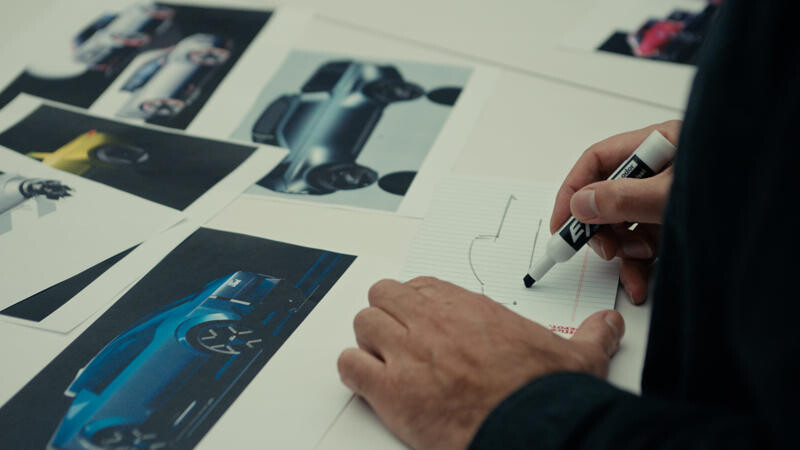
Ford Motor Co. leaders believe the automaker has the secret sauce to ignite customer demand for electric vehicles in the future — and if it can pull it off, analysts believe Ford may be right. The automaker outlined a litany of innovations on Feb. 17, including its work with a former Formula 1 team of aerodynamic engineers, that Ford said it will use in an upcoming midsize all-electric pickup to make it the most affordable and the most efficient in its category. The midsize pickup will be built on Ford's new universal electric vehicle platform and go on sale starting next year, to be priced around $30,000. Ford has said it will follow the pickup with a family of "affordable" and high-performance EVs, including a midsize SUV. "Ford is looking across design, product development, software engineering, supply chain and manufacturing to completely rethink vehicle production," Alan Clarke, Ford's executive director of Advanced EV Development, said during a media presentation on the progress of the universal EV platform and midsize EV pickup. “Every decision centers on how much we can reduce the size of the battery. How can we give more to the customer, so they get better value?" Clarke said for the auto industry to unlock the "transformative potential of EVs," Ford must rethink its entire design and engineering approach, but it believes it has a strategy that will allow Ford to achieve cost parity with gasoline-powered vehicles. Analysts call it an ambitious endeavor and heroic if Ford can pull it off. "They had to do something bold and lay out a vision that would get engineers, investors and customers excited. If they are able to execute, this is definitely along those lines," Dan Ives, managing director at Wedbush Securities, told the Detroit Free Press. Sam Abuelsamid said the development approach and technology won't matter if the resulting vehicle is not appealing in its "form factor design, performance and price. "If they do that it will succeed on its own merits," Abuelsamid, vice president of market research at Telemetry, said. "The form factor for the first vehicle is right as a Maverick-sized pickup, that we already know will sell. If they can deliver on the rest and then add other body styles on the same architecture, it can attract customers." Ford bets on innovation In August 2025, Ford had announced the new midsize EV pickup it had planned and the creation of a new EV production system and platform that will allow the Dearborn-based automaker to more efficiently bring several lower-cost EVs to market. But EV sales fell off a cliff a couple months later after the federal tax credit of up to $7,500 ended on Sept. 30. Prior to that, consumer demand for EVs had been growing, but not nearly at the rate the industry had predicted years earlier. Still, Ford and other automakers say they believe in an electric future even as Ford redirects funds to hybrids and gasoline models this year. CEO Jim Farley has often said the real competition of the future will be Chinese automakers and their low-cost, high-tech EVs, especially if they are able to start selling them in the United States. "With the federal tax credit gone and infrastructure remaining a huge pain point, Ford is going to bet on innovation," Ives said. "They are trying to make it like, ‘This is not your grandfather's Ford.' This is innovation." Peter Richardson, vice president of research at Counterpoint Technology Market Research, told the Detroit Free Press that while the government's rolling back of EV credits as well as a negative stance on EVs may dampen consumer demand for EVs, "EVs are cheaper to run especially if you can charge at home. And with Ford committing to achieving price parity with gas cars, this can help offset negative sentiment." Ford's bounty hunting In a 30-minute presentation, Ford engineering leaders outlined how the automaker is innovating to get its new family of EVs to market. It even gave a peek at some early design drawings of the midsize electric pickup. Some early drawings Ford Motor showed on Feb. 17, 2026, of the future midsize EV pickup off its universal electric vehicle platform. Clarke said most consumers want an EV that can deliver 300 miles of range or more. The traditional soluntion to achieve that was to install big and expensive batteries, which increased the weight of the vehicle and drained the energy needed to move it. Also, he said traditional vehicle designs tend to be aerodynamically inefficient, also taxing the battery. So Ford decided to focus on efficiency, Clarke said. "We did this by arming every engineer working on the project with what we call bounties," Clarke said. "Bounties are numerical metrics we assign to key factors like vehicle mass and aerodynamic drag." He said these are factors that directly translate to efficiency, which can improve range and lower the cost of the battery, making an EV more affordable for the customers. But it also requires the teams to make tricky, yet important, decisions for a quality result. Alan Clarke, Ford's executive director of Advanced EV Development, with 3D-printed parts behind him during a Ford Motor presentation of its universal electric vehicle program on Feb. 17, 2026. “In a low-cost vehicle, it can feel counterintuitive to increase the cost of a part just to decrease its weight, but if we can give that weight reduction a value in terms of the battery cost, then we can decide if making the part lighter and more expensive actually saves us more money than adding additional battery (weight)," Clarke said. "Bounties guide our engineers to make these tough trade-offs. The aim is to reduce overall consumption of the vehicle as a system, not simply the optimization of a single part." Racing aerodynamics Some of the bounties Ford engineers hit in aerodynamics include reducing drag and finding cost improvements there, said Saleem Merkt, Ford's advanced EV aerodynamics senior manager. "Aerodynamics is a crucial part of an electric vehicle’s performance because every bit of inefficiency caused by drag robs you of range. At higher speeds, drag becomes even more significant," Merkt said. "If you go twice as fast, the air holds you back four times as much and you need eight times more power to keep going that speed." Ford's designers and engineers worked hand-in-hand with its own team of ex-Formula 1 aerodynamicists to make the upcoming midsize EV truck "look great" and perform, Merkt said. "Together, we obsessed over our bounty targets," Merkt said. "Just like in racing where everyone is united in shaving milliseconds off lap times, the bounties keep us focused on chasing physics. When we finally achieved our target, we reset it to continue challenging ourselves to go even further." He said removing a millimeter in the roof height, for example, could equal a $1.30 savings in battery costs. "As a result, the aerodynamic efficiency of our truck is more than 50% better than any other pickup truck on the market today," Merkt said. "It will result in longer range and lower cost for customers." Ford streamlined the underbody of the vehicle, too, making the "the bolt holes shallower and carefully directed air around the tire and suspension." That along with other changes under the car reduced drag to contribute an estimated 4.5 more miles of range, he said. A Ford Motor team of universal electric vehicle engineers work on an underbody shield that will improve aerodynamics on Ford's upcoming family of new EVs. The roof and bed of the vehicle will be sculpted to create a surface for the high-speed air to completely skip over it. Merkt said even the mirrors contribute to efficiency. "Instead of separate motors for glass adjustment and another motor for folding, we’ve merged those functions into a single actuate," Merkt said. "The entire body of the mirror now moves. The mirror body size is now 20% smaller than a conventional mirror, which reduces mass, saves on cost and unlocks a more aerodynamic shape.” Merkt said that innovation alone delivers 1½ more miles of range. A savings achieved Abuelsamid said it's the attention to details, such as the mirror motor, that matters. "From the aero perspective, we heard some similar things from GM about the Silverado EV, but that vehicle still has huge frontal area, which combines with drag coefficient to give total drag," Abuelsamid said. "This truck will have much less frontal area and probably be smoother overall and leverage Ford's new rolling road wind tunnel that gives more accurate results." Merkt said Ford obsessed over every bearing, seal and joint in the vehicle to reduce mechanical friction by treating the "driving and oil management system like a race car." The engineers also enhanced the design of the regenerative brake system, which is a system that captures the kinetic energy when braking and then converts it into usable electric power for the high-voltage battery. “Our new design will save us about $100 in battery costs," Merkt said. "The result of all this work? If the same battery was married to the aerodynamics of the most aerodynamically efficient midsize gas truck in the U.S., we believe our new electric truck would have 50 miles or 15% more driving range and a 30% improvement at highway speeds.” Using unicasting to take on Tesla, Chinese What could put Ford on par with Chinese automakers and Tesla in terms of EV production is its use of unicastings, Abuelsamid said. Ford's Vladimir Bogachuk, chief engineer of Advanced Vehicle Structure Architecture, said reducing body structure is key to cutting out vehicle weight. To do it, Ford will use large aluminum unicastings for the first time. That means that its midsize EV pickup essentially has two structural parts — a front and a rear — as compared with the gasoline midsize Maverick pickup, which has 146 structural parts, Bogachuk said. A reduction in parts means fewer robots in factories, he said, giving Ford measurable gains in the quality and production. Tesla has used large-scale aluminium castings on its assembly lines since 2020. Other automakers such as Toyota and Volvo have also adopted it. But for Ford, it is a game changer, Abuelsamid said. "The use of unicastings and zonal electric architecture will significantly simplify assembly," Abuelsamid said. "They will have a big advantage over other legacy automakers, but they will probably just be beyond par with Tesla and China." Bogachuk ended his presentation by saying the engineering team has a philosophy: The best part, is no part. "If the part is necessary, then it must serve multiple purposes," Bogachuk said. "It’s not easy to find those opportunities.” Marshall, Michigan, to make better batteries Ford plans to make its EVs more affordable by using lower cost ingrediants in its batteries, which will be made in its factory in Marshall when it starts production, expected later this year. Ford's EV batteries will use lithium iron phosphate or LFP. Clarke said it also found an efficient way to pack the batteries that essentially turns the battery into an integral part of truck’s skeleton, reducing overall costs and delivering a quieter ride and "dynamic performance." Getting ahead of the competition Richardson said Ford's approach to overall system efficiency is new and it will give Ford an advantage, at least against domestic competition. "Chinese EV makers are likely still more cost-efficient," Richardson said. "But for now, Ford's core North American market is protected by steep subsidies from Chinese EVs, so Ford has some runway." Former President Joe Biden put 100% tariffs on Chinese imported cars, which President Donald Trump has left in place, keeping Chinese EVs offshore, for now. But Canada will soon allow some Chinese EVs in, inching closer to U.S. shores. Currently, about 8%-10% of consumers in the United States are looking for EVs, said Sam Fiorani, and growing that market will require even lower prices, better range, and improved utility to encourage the trade-ins of traditional gas-powered cars and trucks. "Ford is looking to keep up with the global development of electric vehicle technology," Fiorani, vice president of Global Vehicle Forecasting at AutoForecast Solutions, said. "While the U.S. market isn’t going to shift toward electric vehicles quickly, the competition around the world is not standing still. American buyers want more affordable vehicles and bringing such a model to the market, even if it’s electric, will capture a large segment of buyers who just can’t afford a $50,000 vehicle." Jamie L. LaReau is the senior autos writer for USA Today Co. who covers Ford Motor Co. for the Detroit Free Press. Contact Jamie at jlareau@freepress.com. Follow her on Twitter @jlareauan. To sign up for our autos newsletter. Become a subscriber. This article originally appeared on Detroit Free Press: Ford outlines innovations it says will make people want to buy its EVs